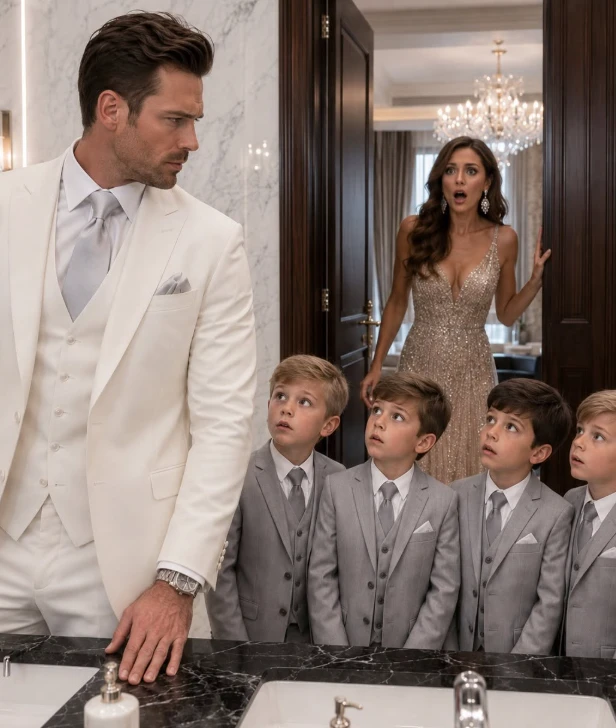
Four little boys walked into a restaurant bathroom just hours before I was supposed to announce my engagement. Five minutes later, I was staring into the mirror at four six-year-old versions of myself—and wondering who had stolen six years of my life.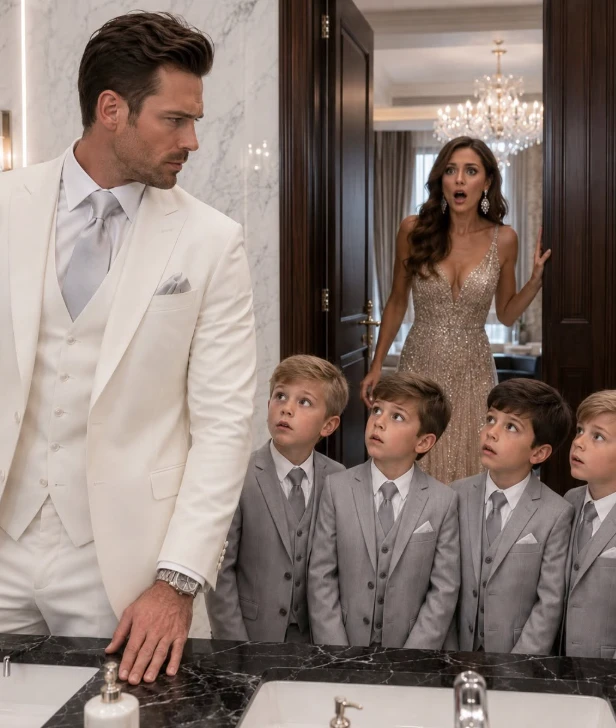
Everything about that afternoon had already been decided for me.
My Manhattan-tailored suit. My grandfather’s cuff links. Even the engagement ring in my pocket had been approved by my mother and attorneys.
At seven, I was supposed to propose to Serena Vance in my family’s conservatory overlooking Central Park.
It wasn’t love.
It was a merger with a diamond attached.
Then I walked into the men’s room.
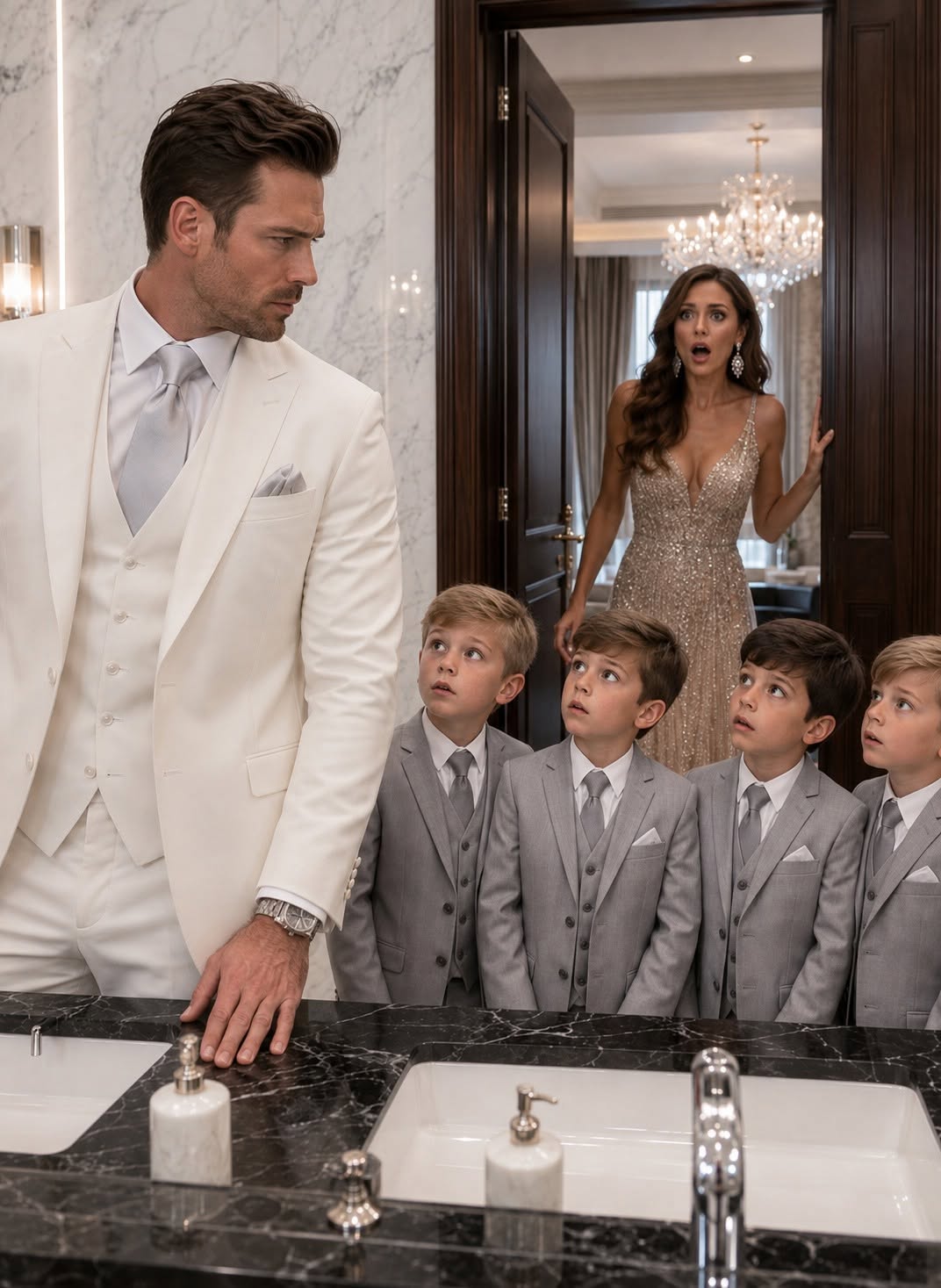
Four boys in matching navy uniforms stood at the sinks.
I barely noticed them until one pushed his wet hair backward.
The other three copied him.
My chest tightened.
Forehead to crown. Quick shake. Left hand touching the back of the neck.
My father used to laugh whenever I did exactly that.
“That’s how you know a Mercer man is nervous.”
One boy caught me staring through the mirror.
“Mister, why are you copying us?”
“I’m not.”
We all looked into the glass.
Five faces.
The same gray-blue eyes.
The same sharp chin.
The same dimple in the left cheek.
My mouth went dry.
“I’ve always done that.”
The boys grinned.
“So have we.”
The boldest held out his hand.
“I’m Leo. That’s Liam, Luke, and Logan. We’re quadruplets.”
I could barely breathe.
“Where’s your mother?”
“She works here,” Leo said. “But her boss says we can’t sleep here tonight.”
I followed them into the restaurant.
And saw a ghost.
Elena.
She stood in a server’s apron while her manager glared at her.
“Employees cannot sleep in my storage room.”
“Please,” she begged. “My boys only need somewhere safe until morning.”
“Not my problem.”
Then Elena saw me.
Her face went white.
The tiny scar above her eyebrow. Those green eyes I had spent years trying to forget.
The woman I had loved.
The woman my mother swore had abandoned me six years ago.
“Elena?”
Panic flashed across her face.
“Boys. We’re leaving.”
Outside, February wind tore through our coats. Two battered duffel bags sat beside the children.
I handed Elena the key card to my empty Tribeca apartment.
“No questions tonight. Take them somewhere warm.”
She refused until Leo whispered, “Mom, I’m tired.”
Finally, she took it.
But before climbing into my SUV, she turned on me.
“You don’t get to disappear for six years and suddenly decide you’re their father.”
My blood went cold.
“I disappeared?”
Her expression changed.
I looked at the four boys.
“I was told you left me.”
Elena stared at me as though I’d just confirmed her worst fear.
At 4:18, I called my assistant.
“Cancel tonight.”
“Your engagement announcement?”
“Yes.”
“Your mother already has hundreds of guests arriving.”
“I don’t care.”
I ended the call.
Because I suddenly understood something terrifying.
Elena believed I had abandoned her.
I believed she had abandoned me.
And somewhere between those two lies were four little boys with my face.
Someone had wanted us separated.
And I was beginning to suspect exactly who.
Four Boys in the Mirror
My name is Adrian Mercer.
At 4:23 that afternoon, I was sitting in the back of my own SUV with four six-year-old boys I had met less than twenty minutes earlier.
One of them had fallen asleep.
Another was counting yellow taxis through the window.
The third kept asking whether the apartment had cereal.
Leo—the boy who had spoken to me in the bathroom—watched me with open suspicion.
Across from us sat Elena.
She had not taken her eyes off me since we left the restaurant.
Not with affection.
Not nostalgia.
Fear.
That frightened me more than the resemblance.
“You don’t have to stay at my apartment,” I said. “I can put you somewhere else.”
“I’m not taking the boys to a hotel registered under the Mercer name.”
“Fine.”
“Your security doesn’t come upstairs.”
“Fine.”
“And you are not taking any of them anywhere alone.”
I stared at her.
“Elena.”
“You disappeared for six years.”
“So did you.”
Her face tightened.
“That is exactly the problem.”
Leo looked between us.
“Are you guys mad?”
Elena immediately softened.
“No, sweetheart.”
I answered at the same time.
“Yes.”
She glared at me.
I shrugged.
“He asked.”
Leo seemed satisfied.
“Okay.”
Then Liam, the quietest of the four, looked at me.
“Are you really our dad?”
The question landed somewhere beneath my ribs.
Elena closed her eyes.
I looked at him.
“I don’t know yet.”
His face fell.
I corrected myself.
“I think there is a very strong possibility.”
Leo interrupted.
“You look exactly like us.”
“Apparently.”
Logan leaned forward.
“Do you have allergies?”
“What?”
“Luke has peanuts.”
Luke frowned.
“Tree nuts.”
“Same thing.”
“It is not.”
They began arguing.
I stared.
Six years of birthdays.
Fevers.
First words.
First steps.
Arguments about nuts.
Gone.
Not because they had died.
Because I had never known they existed.
My phone began ringing.
MOTHER
I let it ring.
Then again.
Then my assistant.
Then Serena.
Elena watched the screen.
“You should answer.”
“No.”
“You canceled an engagement in the middle of Manhattan. You probably created a small diplomatic incident.”
“You always did exaggerate.”
Her face changed.
For half a second, I saw the woman I had known.
Then it disappeared.
May you like


“I didn’t exaggerate when I told you I was pregnant.”
My blood went cold.
“What?”
The boys stopped arguing.
Elena realized.
Too late.
I looked at her.
“You told me?”
Her face drained.
She turned toward the children.
“Boys, look outside.”
Four faces turned toward Manhattan.
I lowered my voice.
“When?”
Elena stared at me.
“Six years ago.”
“I never knew.”
“I wrote to you.”
“I never received anything.”
“I called.”
“My number never changed.”
“It stopped connecting.”
“How?”
“I was blocked.”
“By me?”
“That’s what your mother said.”
Something in my chest went very still.
“My mother spoke to you?”
Elena looked at me as though I had gone insane.
“She came to my apartment.”
The Tribeca apartment had belonged to my grandfather.
I rarely used it.
That was why I chose it.
No family staff.
No photographs.
No mother.
My security director arranged for groceries to be delivered downstairs and then left when I ordered him to.
Elena checked every room before allowing the boys inside.
I watched her.
“You think I hid people here?”
“I don’t know what you do anymore.”
Fair.
The boys discovered the kitchen.
Then the pantry.
Then the fact that someone had delivered cereal.
That bought us twenty minutes.
Elena stood at the far end of the living room with her arms crossed.
I stayed near the windows.
Six feet between us.
Maybe eight.
It felt safer that way.
“Tell me exactly what happened.”
She laughed softly.
“You first.”
“Fine.”
I did not need to think.
I had replayed the memory for six years.
“We had dinner at Lucien on April eighth.”
Her eyes changed.
“Yes.”
“You left early because you felt sick.”
“Yes.”
“I called the next morning.”
“No answer.”
“I called again.”
“I was at the doctor.”
“I came to your apartment.”
“You didn’t.”
“I did.”
Her face tightened.
“The doorman said you had checked out.”
“I was subletting.”
“He said you left.”
“I hadn’t.”
“I went back three times.”
She stared.
“You’re lying.”
“No.”
Her breathing changed.
I continued.
“Four days later, I received your letter.”
“What letter?”
I almost laughed.
Of course.
Of course there was another letter.
“You said you had met someone.”
Elena looked physically ill.
“You said you were moving to California.”
“No.”
“You said being with me had been a mistake.”
“No.”
“You said you never wanted the Mercer life.”
“That part sounds like me.”
Despite everything, I almost smiled.
She didn’t.
“What else?”
“That you had been planning to leave for months.”
“I hadn’t.”
“You asked me not to follow you.”
“I never wrote that.”
“You said if I cared about you at all, I would leave you alone.”
Her eyes filled.
“I never wrote that.”
My hands started shaking.
“I still have it.”
“Why?”
“Because I was pathetic.”
Her expression softened for exactly one second.
“I kept it.”
I looked away.
“For years.”
Then:
“Your turn.”
Elena sat.
Not because she was comfortable.
Because her knees apparently stopped trusting her.
“The morning after Lucien, I went to my doctor because I thought I had food poisoning.”
I waited.
“I was pregnant.”
My mouth went dry.
“Already?”
“Eight weeks.”
I stared.
“How did neither of us know?”
“I had irregular cycles.”
I remembered.
She had always been irregular.
Stress.
Work.
Nothing unusual.
“I called you from the clinic.”
“I never got it.”
“Voicemail.”
“No.”
“Then again.”
“No.”
“I texted.”
I shook my head.
“Nothing.”
“The messages showed delivered at first.”
“To my phone?”
“Yes.”
“Then?”
“Your number stopped accepting mine.”
My stomach turned.
“I did not block you.”
“I know that now.”
The sentence almost broke me.
She continued.
“I went to your office.”
“When?”
“April tenth.”
“I was in London.”
Her eyes narrowed.
“You told me Chicago.”
“I was sent to London that morning.”
“Who knew?”
“My mother.”
There it was again.
Elena looked down.
“Your receptionist said you weren’t available.”
“Who?”
“Margaret.”
Margaret Kline.
My mother’s executive assistant.
Not mine.
But during those years she handled most family-office scheduling.
“She told me you had left instructions not to admit me.”
“I never did.”
“I believed her.”
“Then what?”
“I went home.”
Her fingers twisted together.
“That night your mother arrived.”
I stopped breathing.
“What did she say?”
Elena’s face changed.
She was not looking at me anymore.
She was back there.
Six years younger.
Pregnant.
Alone.
“She knew.”
“How?”
“She congratulated me.”
My stomach dropped.
“She knew before I told her.”
“Did you ask?”
“Yes.”
“She said you had told her.”
“I didn’t know.”
“I know.”
“What did she want?”
Elena laughed bitterly.
“What do women like your mother always want?”
“Control.”
Her eyes returned to mine.
“She brought documents.”
“What documents?”
“Printed emails.”
“From me?”
“Yes.”
I felt cold.
“What did they say?”
“That you had made a mistake.”
“That you were too young to be tied to someone who didn’t understand your obligations.”
My jaw tightened.
“That if the pregnancy was yours, you would support the child financially but wanted no personal involvement.”
I could barely hear her.
“She showed me one where you supposedly wrote that marrying me would destroy your future.”
I stood.
“Where are those emails?”
“I kept them.”
“Where?”
“In my bag.”
My heart hammered.
“Show me.”
She stared.
“No.”
“Elena.”
“You do not get to become the powerful man with lawyers five minutes after finding out these boys exist.”
I stopped.
She was right.
Again.
I sat.
“Fine.”
She breathed.
Then continued.
“Your mother offered me two million dollars.”
I stared.
“For what?”
“To leave New York.”
My body went numb.
“I refused.”
“Of course you did.”
“She increased it.”
“How much?”
“Four.”
Jesus.
“I refused again.”
A tiny smile touched her mouth.
“She called me stupid.”
“That also sounds like her.”
“Then she stopped being polite.”
My pulse slowed.
“What did she say?”
“That if I tried to involve you, the Mercer family would seek custody.”
I became absolutely still.
“She said your attorneys could prove I was unstable.”
“What?”
“I had no family money.”
“I worked in a restaurant.”
“I lived in a studio.”
“She said your family had private schools, doctors, judges, investigators.”
Elena’s voice became smaller.
“She said if I wanted to keep my child, I needed to disappear.”
I stood again.
This time she did not stop me.
I walked to the window because if I remained near her, I would break something.
Not her.
Everything else.
“Did she know there were four?”
“Not then.”
“When did you find out?”
“Eleven weeks.”
I closed my eyes.
Quadruplets.
“Natural?”
She almost laughed.
“No.”
I turned.
Her expression softened despite herself.
“We had gone through fertility treatment.”
I stared.
“What?”
“You forgot?”
“No.”
I had not.
A year before we separated, Elena had been diagnosed with endometriosis.
We had talked about freezing embryos eventually.
Then life happened.
My grandfather became ill.
I was traveling constantly.
We postponed.
“We never did IVF.”
“No.”
She looked down.
“But my doctor had given me ovulation medication shortly before.”
I remembered.
The treatment we assumed had failed.
“Four.”
“Yes.”
She smiled faintly.
“Everyone was shocked.”
I stared toward the kitchen.
Four identical navy uniforms scattered around an unfamiliar apartment.
“They’re not identical,” Elena said, reading my face.
“What?”
“Two sets are genetically closer than the others. The doctors explained it better.”
I almost laughed from pure disbelief.
“Of course they did.”
“You can do DNA testing.”
“I will.”
Her face hardened.
“With my lawyer involved.”
“Yes.”
“Independent laboratory.”
“Yes.”
“No Mercer family doctor.”
“Yes.”
She studied me.
“You’re agreeing too easily.”
“I have four six-year-olds in my kitchen who share my face.”
That finally made her laugh.
One short sound.
Then she covered her mouth.
I felt something ache.
I had forgotten that laugh.
The engagement gala began without me at seven.
I know because my mother left a voicemail at 7:04.
Adrian, whatever childish crisis you are manufacturing, there are three hundred guests in this house. Serena’s family is here. Your grandfather’s board members are here. You will come home immediately.
I deleted it.
Then Serena called.
I answered.
“Hello?”
Her voice was controlled.
Too controlled.
“Are you alive?”
“Yes.”
“Good.”
Pause.
“Are you coming?”
“No.”
“Are we engaged?”
“No.”
Another pause.
“Excellent.”
That surprised me.
“What?”
She exhaled.
“Adrian, I have spent six months trying to decide whether being married to you would be more tedious than being married to no one.”
I almost smiled.
“Serena.”
“Your mother keeps telling everyone we are a love match.”
“We aren’t.”
“Correct.”
“Your father?”
“Wants the logistics partnership.”
“My mother wants your port assets.”
“Exactly.”
Silence.
Then:
“So why did you cancel?”
I looked toward Elena.
She was cutting apples into four equal piles.
“Something happened.”
“With Elena?”
My blood froze.
“What did you just say?”
Silence.
“Serena.”
She cursed quietly.
“How do you know Elena?”
“I don’t.”
“You said her name.”
“Your mother mentioned her.”
“When?”
“Three months ago.”
Everything inside me sharpened.
“What exactly did she say?”
“Adrian.”
“Exactly.”
Serena hesitated.
“She said there was an old relationship that might become inconvenient.”
I looked at Elena.
She had stopped cutting.
She was listening.
“What kind of inconvenient?”
“She did not explain.”
“Did she mention children?”
“No.”
“You swear?”
“Yes.”
I believed her.
Serena could be many things.
A liar was rarely one of them.
“What did she ask you?”
“She wanted me to sign an amendment to the preliminary Vance-Mercer family governance agreement.”
My stomach tightened.
“What amendment?”
“Representation regarding undisclosed heirs.”
I stopped.
“What did it say?”
“That to the best of my knowledge neither of us had undisclosed children who could affect family trust succession.”
I laughed.
Not because it was funny.
Because the architecture was appearing.
“Did you sign?”
“No.”
“Why?”
“Because I don’t sign statements about your reproductive history.”
I closed my eyes.
Thank God for Serena.
“Did my mother?”
“She said it was routine.”
“Nothing about this is routine.”
“What happened?”
I looked toward the boys.
“You were right not to sign.”
Silence.
Then:
“Oh.”
Serena was smart.
Very smart.
“How many?”
I smiled despite myself.
“Four.”
A long silence.
Then she burst out laughing.
I almost hung up.
“I’m sorry.”
She tried to stop.
“Four?”
“Yes.”
“You always were excessive.”
“Serena.”
“I said I’m sorry.”
Then she became serious.
“Do they look like you?”
“Enough that the bathroom mirror nearly gave me a cardiac event.”
Another small laugh.
Then:
“Does your mother know?”
“I think she always knew.”
Serena stopped.
“That is different.”
“Yes.”
“Do you want the Vances out of this?”
“I want you out unless you choose otherwise.”
“That is the first romantic thing you’ve ever said to me.”
I laughed.
“Cancel everything.”
“Already did.”
“What?”
“I told my father thirty minutes ago that I was not marrying a man who left his own engagement announcement without explanation.”
“Fair.”
“Then your mother called me disloyal.”
“Also predictable.”
She paused.
“Adrian.”
“Yes?”
“Whatever she did, don’t make me part of your revenge.”
“I won’t.”
“Good.”
And she hung up.
That was the end of our engagement.
No shattered champagne glass.
No abandoned bride.
Two people relieved to stop pretending a merger was a romance.
At eight thirty, my attorney arrived.
Naomi Park.
Forty-six.
No Mercer family history.
That was why I used her for personal matters.
She took one look at the four boys and said:
“Oh.”
Exactly.
Elena had called her own attorney too.
A legal-aid family lawyer named Rachel Torres who joined by video because she was home with a sick child.
Good.
Separate representation.
We sat at opposite ends of the dining table while the boys watched a movie in the next room.
Naomi said:
“First, nobody changes custody, residence, school, or financial arrangements tonight.”
I nodded.
Elena looked relieved.
“Second, Adrian, you do not publicly acknowledge paternity until testing.”
“I understand.”
“Third, Elena, you do not need to permit unsupervised contact.”
“I understand.”
“Fourth, we preserve whatever evidence exists regarding six years ago.”
Elena reached into her duffel bag.
Not her clothing bag.
Another.
Inside was a plastic accordion folder.
Six years of survival.
Letters.
Medical bills.
Certified-mail receipts.
Printed emails.
Photographs.
Birth certificates.
Four names.
No father listed.
I stared.
That hurt more than I expected.
Naomi looked at me.
“Do not touch anything yet.”
I almost laughed.
“Chain of custody?”
“Exactly.”
Rachel joined through the laptop.
“We’ll scan with Elena present.”
Good.
The first letter supposedly from me was printed on Mercer Family Office stationery.
My signature beneath it.
Elena,
What we had mattered to me, but I cannot allow a pregnancy to dictate the rest of my life. My family will ensure the child is provided for. I ask that you respect my decision not to be involved personally.
I stared.
“I never wrote this.”
Elena said nothing.
Another.
Do not contact my office again.
My signature.
Another.
If you involve the press or attempt to use the pregnancy against my family, counsel will respond accordingly.
I looked at Naomi.
“Can we prove these are fake?”
“Maybe.”
“Six years later?”
“Maybe.”
Again.
Useful word.
Then Elena handed her the certified-mail receipt.
Addressed to me.
Mercer Tower.
Delivered.
Signed by:
M. KLINE
Margaret.
My mother’s assistant.
My body went cold.
“What was inside?”
Elena answered.
“Ultrasound.”
I closed my eyes.
“And?”
“A letter.”
“What did you say?”
“That there were four.”
My hands began shaking.
My mother knew.
At the latest, she knew before my sons were born.
Maybe earlier.
“Did you send anything else?”
“After they were born.”
Another certified receipt.
Margaret again.
Inside:
Copies of birth records.
Photograph.
A handwritten note.
If Adrian truly wants nothing to do with them, I will stop contacting him. But I need to hear that from him directly once.
I stared at those words until they blurred.
“You never heard from me.”
“No.”
“Because I never saw it.”
“I know.”
The six years between us suddenly felt physical.
A room.
A wall.
Built one document at a time.
DNA testing happened two days later.
Not secretly.
Not through my family hospital.
A laboratory chosen jointly by both attorneys.
Cheek swabs.
Four boys.
One extremely nervous man.
Logan asked:
“Will it hurt?”
“No.”
“Are you sure?”
“No.”
The technician laughed.
“It won’t.”
Leo looked at me.
“What happens if you’re not our dad?”
I had spent forty-eight hours avoiding that thought.
“Then I’m still glad I met you.”
Elena looked at me.
Her face changed.
“What if you are?”
I thought.
“Then I have a lot to learn.”
Leo nodded.
Acceptable answer.
The results arrived four days later.
All four boys were mine.
The probability calculations were effectively conclusive.
I read the report alone first.
Then again.
Then I sat on the floor of my office.
Not cried elegantly.
Not one masculine tear.
I sobbed.
Six birthdays.
Six Christmas mornings.
Four first days of school.
Four first words.
Forty-eight baby teeth.
Maybe more.
I had no idea.
That was the worst part.
Not knowing what I had missed.
You can grieve a dead person through memories.
How do you grieve six years you never possessed?
I wanted to confront my mother immediately.
Naomi stopped me.
“No.”
“She knew.”
“We have evidence she likely received documents.”
“Likely?”
“Margaret signed.”
“That’s her assistant.”
“Correct.”
“What more do you need?”
“Evidence of what Victoria herself knew and did.”
“I can ask her.”
“You can.”
“Then?”
“She can lie.”
I hated lawyers.
“Preserve first.”
So we did.
The Mercer Family Office maintained archived email.
Not forever.
Seven years.
Barely enough.
My grandfather had insisted on it after a tax investigation decades earlier.
The old man’s paranoia finally became useful.
IT was instructed by independent company counsel—not my mother—to preserve communications involving:
Elena’s name.
Margaret Kline.
My old email accounts.
Outside investigators.
Vance family governance.
Family trust succession.
No mass seizure.
Scoped review.
The first result arrived three days later.
An email from Margaret to my mother.
Dated April tenth, six years earlier.
Elena Reyes came to the office. Says she is pregnant. Adrian is in London. How do you want this handled?
My mother replied twelve minutes later.
Do not contact Adrian. I will speak with her myself.
I read the sentence twice.
Then:
MARGARET: Understood.
Another email two days later.
VICTORIA: Block Elena’s number from the family-managed mobile account and remove her from visitor authorization until further notice.
My phone at the time had been paid through the family office.
I had forgotten.
She could do it.
She did.
Another:
VICTORIA: If Adrian asks, Elena left voluntarily. I will manage the rest.
I stopped reading.
Naomi watched me.
“Take a minute.”
“No.”
More.
A scanned copy of Elena’s ultrasound.
Four sacs.
Forwarded to my mother.
Her reply:
This makes discretion essential.
No shock.
No concern.
Discretion.
Then the birth letter.
Photograph attached.
Four premature infants in NICU bassinets.
My sons.
My mother had seen them six years before I did.
I stood.
The chair fell backward.
Naomi said my name.
I walked to the window.
Could not breathe.
On the screen behind me was an email my mother had sent Margaret.
Arrange payment of outstanding NICU balance through the Mercer Children’s Foundation. Anonymous. No direct payment to Ms. Reyes.
I turned.
“What?”
Naomi scrolled.
Medical debt.
$186,400.
Paid anonymously.
Elena never knew.
My mother had helped them.
Secretly.
That somehow made it worse.
She knew they were real.
Knew they were sick.
Knew they needed care.
She paid.
Then kept them from me.
Not hatred.
Management.
A problem handled privately.
My sons had been line items.
We found the letter supposedly written by Elena to me too.
The one I had kept.
Metadata no longer existed because it was paper.
But the family archive did.
A draft attached to an email.
From Victoria to Margaret.
Subject:
For Adrian
Attachment:
Elena_departure.docx
My mother wrote:
Print on plain stationery. No family letterhead. Leave with his personal mail after London.
I sat completely still.
There are moments when anger becomes so large it becomes quiet.
This was one.
Margaret replied:
Do you want me to mimic her signature?
My mother:
No. Type her name. He will recognize the tone.
She knew me.
That was the unbearable part.
She knew exactly which sentence would make me stay away.
If you ever cared about me, leave me alone.
Because Elena had always hated being controlled.
I believed respecting her meant disappearing.
My mother weaponized the best thing I believed about myself.
I had spent six years thinking I honored Elena’s choice.
I had been obeying Victoria’s.
The investigation uncovered a private investigator too.
Annual invoices.
Not continuous surveillance.
Periodic checks.
Elena’s address.
Employment.
The boys’ school.
Medical emergencies.
Photographs.
Four toddlers at a playground.
Elena carrying two grocery bags while Logan sat on her shoulders.
A kindergarten Christmas concert.
My mother had photographs of my children growing up.
I had none.
One report said:
No contact observed between subject and Adrian Mercer.
Another:
Ms. Reyes continues restaurant employment. No media outreach.
Another:
Children appear healthy. Strong resemblance increasingly noticeable. Recommend continued discretion.
My hands shook.
“Who recommended it?”
The investigator.
“Who requested reports?”
Invoices billed to a family-office discretionary account authorized by Victoria.
Enough.
Not murder.
Not kidnapping.
Not some cinematic conspiracy.
A mother using money, staff, access, and lies to separate adults who trusted her position.
Smaller than a crime empire.
Bigger than my life.
I confronted Victoria seven days after the restaurant.
Not at her home.
At Mercer Holdings.
Conference room.
Independent counsel present.
My attorney.
Hers.
And my uncle Jonathan, chair of the family trust committee.
I wanted no private conversation she could rewrite afterward.
My mother entered wearing cream.
Perfect.
Pearls.
No visible panic.
She sat across from me.
“Adrian.”
“Mother.”
Her lawyer started.
“We understand this is an emotionally charged family matter—”
“No.”
Everyone stopped.
“It is a family matter.”
I looked at my mother.
“But some of what she did involved family-office staff and trust governance.”
Jonathan nodded.
Good.
Victoria folded her hands.
“What exactly are you accusing me of?”
I placed the first email on the table.
Do not contact Adrian. I will speak with her myself.
Her eyes moved down.
No denial.
Second.
Block Elena’s number.
Third.
Fake departure letter.
Fourth.
PI invoices.
Fifth.
NICU payment.
Then the certified-mail receipts.
Margaret’s signature.
My mother looked at every page.
When she finished, she said:
“I protected you.”
I laughed.
There it was.
Of course.
“From what?”
“You were twenty-eight.”
“I was an adult.”
“Your grandfather was dying.”
“Yes.”
“You were about to take responsibility for a company employing twenty thousand people.”
“And?”
“Elena was pregnant with four children.”
“My children.”
“You did not know that then.”
“Because you made sure I didn’t.”
Her face hardened.
“She would have derailed everything.”
The room became quiet.
“Everything?”
“You would have married her.”
“Yes.”
“You would have abandoned your transition plan.”
“You don’t know that.”
“I know you.”
“No.”
I leaned forward.
“You knew how to manipulate me.”
“That is not the same.”
She flinched.
Good.
“What did Elena do to deserve being threatened with custody?”
My mother’s eyes changed.
“I never threatened to take her children.”
“She says you did.”
“I told her the Mercer family would protect its interests if she tried to use the pregnancy publicly.”
I stared.
“You think that is different?”
“Yes.”
Of course she did.
Her lawyer shifted.
Victoria continued.
“She was frightened.”
“You made her frightened.”
“I made her realistic.”
My hands became fists.
Jonathan interrupted softly.
“Victoria.”
She ignored him.
“You were not ready to be a father.”
“Then I should have failed honestly.”
Silence.
That came from somewhere deeper than anger.
“I should have had the chance to be terrified.”
“To make mistakes.”
“To show up.”
“To leave.”
“To stay.”
“To be selfish.”
“To be good.”
“Whatever I would have done, it was mine to do.”
Her face cracked for the first time.
“I thought you would hate me temporarily.”
I almost laughed.
“Temporarily?”
“I thought once the company was stable—”
“When?”
“I don’t know.”
“When were you planning to tell me?”
She looked down.
There.
Never.
Or someday so distant it meant never.
“What changed now?”
I asked.
Her eyes lifted.
“What?”
“The engagement.”
“The Vances.”
Her face tightened.
Jonathan looked at her.
I continued.
“You introduced an undisclosed-heirs representation into the governance package.”
Her lawyer intervened.
“Adrian, those were preliminary negotiations.”
“I know.”
I looked at my mother.
“Why?”
She said nothing.
Jonathan did.
“Because children affect the descendant trust.”
Victoria’s eyes flashed toward him.
Too late.
I looked at my uncle.
“Explain.”
He sighed.
My grandfather had created the Mercer Descendant Continuity Trust twenty-two years earlier.
It held a portion of family voting interests and long-term assets.
While I had no children, certain advisory powers sat with the senior family committee.
Victoria chaired it.
If I had legally recognized descendants, a new branch trust had to be created.
Independent trustees appointed.
Certain voting rights reallocated.
Not to the children directly.
Not to me.
To fiduciaries protecting their branch.
“How much?”
I asked.
Jonathan answered.
“Approximately eleven percent of the family-controlled voting block shifts out of the senior committee’s discretion over time.”
I looked at my mother.
“There it is.”
She stared back.
“That was not why I separated you.”
“Not originally.”
Silence.
That mattered.
The first lie had been about class.
Control.
My career.
Her belief she knew what was best.
But once the boys existed, keeping them hidden began preserving something else.
Her own authority.
“What about the Vance deal?”
Jonathan answered again.
“The proposed governance alignment assumed no undisclosed descendant branch requiring separate trustee participation.”
“Would the business merger collapse?”
“No.”
“Would terms change?”
“Yes.”
“How?”
“Victoria’s proposed family committee would control fewer votes.”
My mother snapped:
“This is not about my votes.”
I looked at her.
“Maybe not six years ago.”
Then I pointed to the recent emails.
“But it became about them.”
Her face fell.
That was the first time I saw shame.
Not enough.
Still real.
The board did not throw my mother out of the company that afternoon.
Life is rarely that satisfying.
There was an investigation.
Her conduct involved family-office resources used for personal purposes.
Interception of correspondence.
Misleading records.
Undisclosed private-investigator spending.
Potential fiduciary conflicts around the trust.
Some actions were old.
Some possibly outside legal limitation periods.
Some were unethical but not necessarily criminal.
The family trust removed her as senior advisory chair.
Independent trustees replaced her.
Mercer Holdings required reimbursement for certain improperly charged investigative expenses.
She resigned from the family foundation board.
Not because I demanded public humiliation.
Because the foundation had been used to make anonymous NICU payments connected to a secret she was personally managing.
Even kindness needs clean governance.
My mother remained wealthy.
Kept her home.
Kept personal assets.
Kept some company shares.
She did not become homeless because she hid my children.
Consequences are not fairy tales.
The Vance-Mercer business deal continued eventually.
Without marriage.
Without family-governance alignment.
A normal commercial joint venture.
Smaller.
Clearer.
Serena became one of the toughest negotiators on the other side.
I respected her more after we stopped pretending to love each other.
At signing, she whispered:
“You’re much less annoying when I don’t have to marry you.”
“Mutual.”
She smiled.
Progress.
Elena did not care about any of that.
That was another shock.
While I was discovering trust structures and board consequences, she was trying to find housing.
Her apartment building had been condemned after an electrical fire three days before we met.
That was why the boys had been at the restaurant.
Not years of homelessness.
Not some melodramatic life on the streets.
One terrible week.
She had rented the same Queens apartment for four years.
Paid bills.
Worked.
Raised four children.
Without me.
That fact humbled me more than anything else.
I offered the Tribeca apartment.
She said no.
I offered another apartment under an anonymous lease.
“No.”
“Why?”
“Because I don’t want to live in something you can take away.”
“I wouldn’t.”
“You don’t know who you are to us yet.”
That hurt.
Correctly.
So her attorney and mine negotiated temporary housing support as part of an interim child-support arrangement.
A lease in Elena’s name.
Payments documented.
No strings.
No surprise ownership.
No gratitude clause.
I also reimbursed half of extraordinary medical expenses and certain documented childcare costs going forward.
Retroactive support was legally complicated because paternity had never been established and no support order existed.
I wanted to write a check for six years.
Naomi stopped me.
“Elena gets independent advice first.”
Good.
Eventually we agreed on a voluntary settlement covering a substantial portion of past child-related expenses without pretending money could purchase lost parenting time.
Elena used some to clear debt.
Saved most.
Kept working.
She refused the ridiculous SUV I offered.
“Four boys.”
I pointed toward her ten-year-old minivan.
“That door is held shut with rope.”
“It’s temporary.”
“It’s a kidnapping tutorial.”
She laughed despite herself.
Eventually she accepted help purchasing a safe used vehicle through the support agreement.
Not a Bentley.
A Honda Odyssey.
The boys thought it was the greatest car ever manufactured.
Money has different definitions depending on age.
I became their father slowly.
Painfully.
At first:
Mr. Mercer.
Then Adrian.
Leo tested me.
Constantly.
“You said you’d come Wednesday.”
“Yes.”
“It’s raining.”
“I know.”
“Mom says traffic is bad.”
“I know.”
“So you’re canceling?”
“No.”
I arrived seventeen minutes late.
He was standing by the school entrance.
When he saw me, something in his face relaxed.
That became my first real lesson.
Showing up once meant almost nothing.
Showing up again began to matter.
Liam barely spoke around me for weeks.
Then one afternoon he placed a math worksheet in front of me.
“Can you do number eight?”
I could not.
Six-year-old math had apparently evolved into witchcraft.
He stared.
“You don’t know?”
“No.”
A smile appeared.
“Mom knows.”
“I’m sure she does.”
He taught me.
Luke loved drawing.
He drew all five of us once.
Elena stood far away on one side.
I stood far away on the other.
The boys filled the middle.
Accurate.
Logan asked for money immediately.
“How much do you have?”
“Enough.”
“Can I have a dinosaur?”
“What kind?”
“The big one.”
No idea.
He showed me a plastic T-Rex costing $24.99.
I bought it.
Elena looked at me.
“Careful.”
“What?”
“You have four children.”
I looked at four boys.
Right.
The dinosaur budget could become a sovereign-debt crisis.
I learned.
The first time one of them called me Dad, it was an accident.
Nine months after we met.
Logan fell off a scooter.
Scraped knee.
Nothing serious.
I was closest.
He screamed:
“Dad!”
I picked him up.
Then he froze.
So did I.
His face changed.
“I mean Adrian.”
I swallowed.
“You can call me either.”
He looked embarrassed.
“Okay.”
Then:
“Dad, it hurts.”
That nearly killed me.
I cleaned a scraped knee while pretending my hands were not shaking.
No orchestra.
No speech.
Antibiotic cream.
Bandage.
Parenthood arrived wearing a Spider-Man adhesive strip.
Elena and I did not restart our relationship.
Not then.
Everyone around us expected it.
My uncle.
Her coworkers.
My sons.
Especially Logan, who had apparently decided romance was an administrative problem.
“You should marry Mom.”
“No.”
“Why?”
“Complicated.”
“Do you like her?”
“Yes.”
“Does she like you?”
Elena shouted from the kitchen:
“Questionable.”
The boys laughed.
But privately, Elena was clear.
“You don’t get to recover us because we were stolen from each other.”
I hated that sentence.
“Why?”
“Because we’re not twenty-eight anymore.”
“I know.”
“You don’t know me.”
“I know some things.”
“Old things.”
She looked at me.
“And I don’t know you.”
That was true too.
The man she had loved had spent six years believing she abandoned him.
I had become colder.
More controlled.
More willing to accept my mother’s management.
Elena had raised four boys.
Worked nights.
Survived fear of my family.
Become someone who read every contract twice.
“We start with the boys,” she said.
“Nothing else.”
I agreed.
It was one of the hardest yeses I ever gave.
My mother did not meet them for almost two years.
Her first request came three weeks after the investigation began.
“No.”
“They are my grandsons.”
“No.”
“Adrian.”
“Biology does not create access.”
She stared at me.
The sentence probably sounded familiar.
Good.
“What do I have to do?”
That was the wrong question.
I said nothing.
She tried letters.
I returned the first two unopened.
The third was addressed to Elena.
Elena read it.
Then threw it away.
I did not ask why.
Her choice.
A year later, Victoria wrote again.
This time:
Elena, I told myself I was protecting Adrian. That sentence allowed me to ignore that I was frightening a pregnant woman who had no reason to trust my family.
Better.
I knew you attempted to reach him. I stopped those attempts.
Specific.
I had no right to decide whether Adrian became a father.
Better.
After the boys were born, I continued hiding them because admitting what I had done would have cost me my son’s trust and eventually some of my authority in the family trust.
There.
No reputation.
No noble excuse.
I made four children invisible because visibility would have exposed me.
Elena cried reading that line.
So did I.
At the bottom:
I do not ask to meet them. If they ever want to know me, I will follow whatever boundaries you and Adrian set.
Elena looked at me.
“What do you think?”
“I don’t know.”
“Useful.”
“I hate that word now.”
She smiled.
We waited another six months.
Then told the boys they had a grandmother who wanted to meet them.
Leo asked:
“Is she the one who lied?”
“Yes.”
“Why?”
I gave him the child-size truth.
“She thought she knew what was best and did something very wrong.”
“Did she say sorry?”
“Yes.”
“Does sorry fix it?”
“No.”
He thought.
“Can we see her once?”
“Yes.”
The meeting happened in a park.
Not Mercer House.
Neutral.
Victoria brought no gifts.
Smart.
She sat on a bench looking more frightened than I had ever seen her.
Four boys approached.
She stood.
Then stopped herself from hugging them.
Leo looked at her.
“You’re Grandma?”
“If you want to call me that.”
He stared.
“Dad says you hid us.”
Victoria’s face broke.
“Yes.”
“Why?”
She looked at me.
I did not rescue her.
Then at Elena.
Elena did not either.
Victoria looked back at Leo.
“Because I made a selfish decision and then became afraid to admit it.”
Leo considered.
“That was dumb.”
A laugh escaped me before I could stop it.
Victoria nodded.
“Yes.”
Very.
They played for forty minutes.
Nothing healed.
Something began.
That was enough.
Margaret Kline testified during the family-office review.
She admitted signing the certified letters.
Blocking Elena’s number through the managed mobile account.
Printing the false departure letter.
She cried.
Said Victoria controlled her career.
That was partly true.
Still, she had choices.
She had also received a $75,000 retention bonus that year.
Not payment explicitly labeled for deception.
But timing mattered.
The company negotiated her departure.
No prosecution emerged from the internal review, though counsel referred potentially relevant records to appropriate authorities where required.
Statutes.
Evidence.
Intent.
Old conduct.
Complicated.
Again, I did not need everyone in prison for the truth to exist.
Margaret wrote me a letter years later.
I never answered.
Some apologies do not require a relationship.
The hardest conversation with Elena happened when the boys were eight.
We had become friends again by then.
Real friends.
Not lovers.
Coffee after school drop-off.
Shared jokes.
Arguments about screen time.
One evening, she asked:
“Do you blame yourself?”
“Yes.”
“For what?”
“Not finding you.”
She stared.
“How?”
“I should have investigated.”
“Based on what?”
“The letter.”
“You believed it.”
“I should have known.”
“No.”
Her voice hardened.
“Don’t do that.”
“What?”
“Turn your mother’s deception into evidence you failed a secret test.”
I stared.
“You came to my apartment.”
“Yes.”
“Office.”
“Yes.”
“Called.”
“Yes.”
“Then I received a letter telling me to leave you alone.”
“Yes.”
“I thought respecting you meant stopping.”
“Yes.”
She softened.
“You were manipulated.”
I looked down.
“So were you.”
“Yes.”
“Then who owns the six years?”
She thought.
“Victoria owns what she did.”
“Margaret owns what she did.”
“I own my decision not to file for paternity or support.”
That surprised me.
“You were threatened.”
“Yes.”
“And scared.”
“Yes.”
“Still.”
Elena looked at me.
“I had options I was too afraid to use.”
“That doesn’t make what happened your fault.”
“I know.”
“Then why say it?”
“Because agency matters even when fear narrows it.”
I sat with that.
She continued.
“You own your decisions after the lie.”
“I own mine.”
“Your mother owns hers.”
“No one person gets all the blame.”
I hated that.
Then understood why it mattered.
If I gave Victoria ownership of every lost year, I also gave her too much power over what came next.
When the boys were nine, I moved out of Mercer House.
Not because anyone forced me.
Because I realized I had spent my entire adult life in buildings chosen by family committees.
I bought a townhouse in Brooklyn.
My mother nearly fainted.
“No doorman?”
“There is a door.”
“Security?”
“Discrete.”
“Garage?”
“One car.”
She stared as though I had joined a cult.
The boys loved it.
Their rooms were small enough to feel like rooms rather than hotel suites.
They argued over who got the attic.
Logan won through some political process I still do not understand.
Elena remained in Queens.
We did not build a fake instant family.
Schedules.
Two homes.
School.
Ordinary.
I learned to cook three things.
Eggs.
Pasta.
Pancakes.
The first pancakes were so bad Leo photographed them.
“For evidence.”
My son.
Definitely.
I dated no one for three years.
Then Elena did.
A pediatric physical therapist named Daniel.
I hated him immediately.
For absolutely no reason.
He was kind.
Competent.
Brought his own wine to dinner.
The boys liked him.
Awful.
I told Naomi.
She laughed for five full minutes.
“You need therapy.”
“I have therapy.”
“More.”
Elena dated Daniel for eleven months.
Then they ended kindly.
No betrayal.
Different goals.
I learned something uncomfortable.
Elena was allowed to build a life that did not orbit the fact I had finally found her.
That should have been obvious.
It wasn’t.
Loss makes entitlement sound like destiny.
I had to unlearn that.
Our relationship changed only after the boys turned ten.
Four years after the restaurant.
Elena and I were at a school fundraiser.
She wore a green dress.
Nothing dramatic.
I watched her laugh with another parent.
Something familiar moved through me.
Later, walking toward the subway, I said:
“I still love you.”
She stopped.
I immediately regretted it.
“Sorry.”
“No.”
“I shouldn’t have—”
“Stop.”
She stared.
“How long?”
“Probably six years longer than was useful.”
Her eyes filled.
“That’s not fair.”
“I know.”
“No.”
She looked angry.
“You don’t get to make this tragic and beautiful.”
“I wasn’t.”
“Yes, you were.”
Fair.
“Then ugly version?”
“Yes.”
“I love you.”
“I’m scared of you leaving again even though I know you didn’t leave.”
“I’m jealous of people who knew the boys before me.”
“I still sometimes hate you for not magically finding us.”
“I resent your mother.”
“I resent myself.”
“I want something with you and also know wanting it does not make it wise.”
Elena stared.
Then laughed through tears.
“Better.”
“Your turn.”
She looked down.
“I love you too.”
My chest stopped.
Then she raised one finger.
“No.”
“What?”
“That is not a proposal.”
“I wasn’t—”
“You own too many rings.”
I laughed.
She continued.
“I love the man you are now.”
“I also love some of who you were.”
“And I’m still furious that our history was manipulated.”
“Same.”
“So?”
“We date.”
I smiled.
“Date?”
“Yes.”
“After four children?”
“Especially after four children.”
Our first official date happened six years after our last one.
Restaurant.
No children.
No lawyers.
No mothers.
I was more nervous than I had been before billion-dollar negotiations.
Elena noticed.
She pushed a basket toward me.
“Eat bread.”
I laughed.
Maybe some stories do circle back.
Just not quickly.
We married two years later.
The boys were twelve.
No merger.
No conservatory.
No approved ring.
No three hundred guests.
City Hall.
Then dinner.
Twenty-two people.
Serena came.
Of course she did.
She brought her husband, a documentary filmmaker my mother considered “economically confusing.”
I loved him immediately.
Victoria attended only because Elena invited her.
That mattered.
At dinner, Leo stood with a glass of sparkling cider.
“I have a speech.”
Everyone groaned.
He ignored us.
“When we were six, we met Dad in a bathroom.”
I covered my face.
Elena laughed.
“Please phrase this carefully.”
Leo continued.
“He looked like us, which was creepy.”
Liam interrupted.
“You looked like him.”
“Same thing.”
Then Leo looked at me.
“We didn’t know if he was our dad.”
His voice changed.
“But then he kept coming.”
That silenced me.
“Wednesday.”
“Saturday.”
“School stuff.”
“Doctor stuff.”
“Boring stuff.”
People laughed.
“He was bad at pancakes.”
More laughter.
“He got better.”
Barely.
Then:
“Mom says biology can tell you who someone is related to.”
Leo looked at me.
“But repetition tells you who shows up.”
I cried.
At my own wedding.
In front of everyone.
No dignity.
Perfect.
Years later, people learned parts of the story.
Not from us initially.
A journalist found old family-trust filings after Victoria stepped down.
Rumors.
A secret branch.
Quadruplets.
Canceled engagement.
The press transformed everything into mythology.
MERCER HEIR DISCOVERS FOUR SECRET SONS HOURS BEFORE ARRANGED MARRIAGE
Great headline.
Wrong emphasis.
People asked whether my sons had inherited hundreds of millions.
No.
They were beneficiaries of trusts designed to protect their future.
They did not control companies at twelve.
They received ordinary allowances.
Went to school.
Had chores.
Leo got grounded for crashing a drone into our neighbor’s window.
No trust clause protected him from Elena.
Thank God.
People asked whether my mother lost everything.
No.
She lost authority she had misused.
People asked whether I sued her.
Some trust and family-office issues were resolved through formal legal processes and settlements.
I chose not to make every private wrong into public litigation where other remedies were adequate.
People asked why Elena did not take the four million dollars six years earlier.
Because she did not want to disappear.
That was all.
Then they asked the worst question.
“Do you wish you had found out sooner?”
Of course.
What kind of question is that?
But years later, my answer became more complicated.
“Yes.”
I wish I had known Elena was pregnant.
I wish I had been in the NICU.
I wish I had held four tiny bodies against my chest.
I wish I had heard first words.
Changed diapers.
Been exhausted.
Been afraid.
Argued with Elena about feeding schedules.
Everything.
But wishing cannot create an alternate childhood.
Eventually, grief becomes arrogant if it keeps insisting reality should return what it cannot.
So I stopped asking for the first six years back.
I focused on the next six.
Then the next.
When the boys turned eighteen, I gave each of them a box.
Not money.
They already understood the trust.
Documents.
Photographs.
Copies of Elena’s original letters.
The fake letters.
The DNA reports.
Their birth records.
A written timeline prepared years earlier with both parents and attorneys.
Not because I wanted them angry at Victoria.
Because family history should not depend on whoever tells it most confidently.
Leo read everything in one night.
Liam took two weeks.
Luke cried.
Logan asked why the fake letter’s font looked “so ancient.”
Different children.
Same history.
Then they asked to see Victoria.
She was older.
Seventy-eight.
Less polished.
Still terrifying to waiters.
We met at her apartment.
No staff in the room.
Leo asked:
“Did you ever plan to tell Dad?”
Victoria took a long time.
“No.”
The boys went silent.
I respected the answer.
She continued.
“I told myself I would.”
“But every year made telling him more expensive.”
“So I kept postponing.”
Liam asked:
“Expensive how?”
“Emotionally.”
“Financially.”
“Socially.”
“Everything.”
Then:
“At some point, protecting the original lie became more important to me than whatever reason I had told it in the first place.”
That was perhaps the most honest thing she ever said.
Luke asked:
“Did you love us?”
Victoria cried.
“I loved the idea that you were safe.”
He frowned.
“That’s not the same.”
“No.”
She nodded.
“It isn’t.”
Then:
“I did not know you.”
There.
No fake grandmother mythology.
“I watched reports.”
“Photographs.”
“That was surveillance, not relationship.”
My throat tightened.
She continued.
“I had no right to call that love.”
Leo looked at her.
“Do you love us now?”
“Yes.”
“How do we know?”
Victoria almost answered.
Then stopped.
She looked at me.
Maybe remembered.
Repetition.
Finally:
“You decide from what I do.”
Good.
She had learned.
Late.
Still learned.
One of my sons eventually asked the question I had been avoiding for almost twenty years.
We were back in Manhattan.
Same restaurant.
Different name now.
The original had closed.
The bathroom had been renovated.
Nothing recognizable.
Logan was twenty-four.
He stood beside me at the sinks.
“You ever think about the mirror?”
“All the time.”
He smiled.
“You looked terrified.”
“I was.”
“We thought you were weird.”
“You were correct.”
Then he pushed his wet hair backward.
Forehead to crown.
Quick shake.
Left hand at the back of the neck.
I laughed.
He looked at me through the mirror.
Five faces had stood there once.
Now only two.
“Grandpa used to do this?”
“My father.”
“Yes.”
“Did you ever tell us much about him?”
Not enough.
My father had died before the boys were born.
Maybe that was part of why seeing his gesture in them had hit me so hard.
“He said it meant a Mercer man was nervous.”
Logan smiled.
“That’s stupid.”
“Probably.”
Then:
“Dad?”
“Yes?”
“Did Grandma steal six years?”
I stared at our reflections.
Once, the answer would have been immediate.
Yes.
Now?
“She caused us to lose them.”
“Difference?”
I thought.
“Stealing makes it sound like she still owns them somewhere.”
Logan frowned.
“She doesn’t.”
“No.”
“They’re just gone.”
“Yes.”
He looked down.
“That’s worse.”
“In some ways.”
“So how did you stop being angry?”
I laughed.
“I didn’t.”
“Seriously?”
“Anger is still there.”
“Then?”
“It stopped being in charge.”
He nodded.
Adult enough to understand.
Then:
“If she hadn’t done it, would you and Mom have stayed together?”
“I don’t know.”
He looked offended.
“After all this?”
“Your mother and I were twenty-eight.”
“We might have married.”
“Maybe fought.”
“Maybe separated.”
“Maybe become unbearable.”
“Maybe not.”
He shook his head.
“That’s depressing.”
“It’s honest.”
Then I looked at him.
“But you four would have been loved.”
“That part I know.”
Good.
That was the part that mattered.
People often ask what the great revenge was.
They expect me to say my mother lost control of Mercer Holdings.
She didn’t control it outright.
They expect the Vance merger to collapse.
It didn’t.
They expect Elena to become a billionaire overnight.
She didn’t want that.
They expect Serena to be humiliated.
She was relieved.
They expect four secret sons to inherit an empire and make everyone bow.
My sons would laugh.
The actual consequence was less cinematic.
My mother lost the privilege of being believed automatically.
That may have been worse for her.
For decades, Victoria Mercer said:
This is necessary.
This is best.
This is how the family survives.
And people moved.
After the truth came out, every important claim required another signature.
Another trustee.
Another independent confirmation.
Her certainty stopped being governance.
That was the structural consequence.
The personal consequence was simpler.
She had to meet four grandsons as a stranger.
No amount of money could fix that.
Just repetition.
Wednesday.
Saturday.
School concerts.
Birthday calls.
Showing up.
The same currency I had to use.
Perhaps that was justice.
Not suffering.
Work.
I still have the engagement ring I intended to give Serena.
Technically, it belonged to me.
No proposal.
No transfer.
For years, it remained inside the original velvet box.
Elena found it once after we married.
“Why do you still have this?”
I looked.
“Oh.”
“Oh?”
“I forgot.”
She narrowed her eyes.
“You forgot a four-carat engagement ring?”
“I own warehouses.”
“That is the least romantic explanation possible.”
I laughed.
“What should I do with it?”
“Not my problem.”
“Sell it?”
“Probably.”
We did.
Part of the proceeds funded a legal-aid program for parents facing coercive family disputes.
Elena chose the organization.
Not because the ring needed redemption.
Jewelry is innocent.
But because one of the reasons she disappeared six years earlier was fear that she could never afford enough lawyer to stand across from Mercer money.
That part we could change for someone else.
No name on the program.
No plaque.
Good.
The boys are grown now.
Not identical.
Obviously.
Leo became a journalist.
Of course.
The child who interrogated me first now gets paid for it.
Liam became an engineer.
Luke teaches art.
Logan went into hospitality and, to my horror, works for Mercer Hotels.
He says he intends to “fix the pancakes.”
Traitor.
Elena and I have been married long enough that the stolen six years are now smaller than the years we actually lived.
Not erased.
Never erased.
Just no longer dominant.
That matters.
One afternoon, I found the original fake letter while reorganizing old files.
The one supposedly from Elena.
If you ever cared about me, leave me alone.
For six years, that sentence had controlled my life.
Then for another decade, it represented what was stolen.
I called Elena.
“Can I throw this away?”
She laughed.
“You’re asking permission?”
“Apparently I’ve improved.”
“Throw it out.”
“Should we burn it dramatically?”
“No.”
“Shredder?”
“Recycling.”
Anticlimactic.
Perfect.
I dropped it into the bin.
Paper.
Just paper again.
The truth had already survived it.
The afternoon I met my sons, I believed someone had stolen six years of my life.
That was true.
But incomplete.
Those years were also Elena’s.
Leo’s.
Liam’s.
Luke’s.
Logan’s.
My mother’s lie did not create one victim and four prizes waiting to be recovered.
It created five separate relationships that never got to begin on time.
That changed how I tried to repair them.
I could not arrive with money and declare myself father.
I could not look at Elena and declare us soulmates robbed by fate.
I could not punish Victoria hard enough to make the boys six again.
The only thing available was forward motion.
One school pickup.
One breakfast.
One argument.
One missed train.
One fever.
One birthday.
One apology.
One boring Wednesday after another.
That was how I became their father.
Not in the bathroom mirror.
The mirror only gave me information.
DNA gave me biology.
The rest required repetition.
And that became the answer to the question that haunted me for years.
Who stole six years of my life?
My mother helped take them.
Fear helped preserve the loss.
Silence made it longer.
But eventually I realized the more important question was not who owned the missing years.
No one did.
They were gone.
The question was what I would do with the years still waiting.
So I stopped trying to recover childhoods that could not be returned.
I showed up for the ones still happening.
That was the only inheritance my sons ever needed from me.
And it began with four little boys looking into a restaurant mirror and asking why a stranger was copying them.