“One year after my divorce, I ran into my ex-husband in the pediatric wing of the hospital where I worked. He proudly introduced the one-year-old son he had with my former best friend, expecting me to fall apart in front of everyone. Instead, I smiled and quietly said, “”Really?”” Five minutes later, my attorney stepped off the elevator—and the sound of a baby bottle hitting the floor was the first crack in the life they thought they had stolen from me.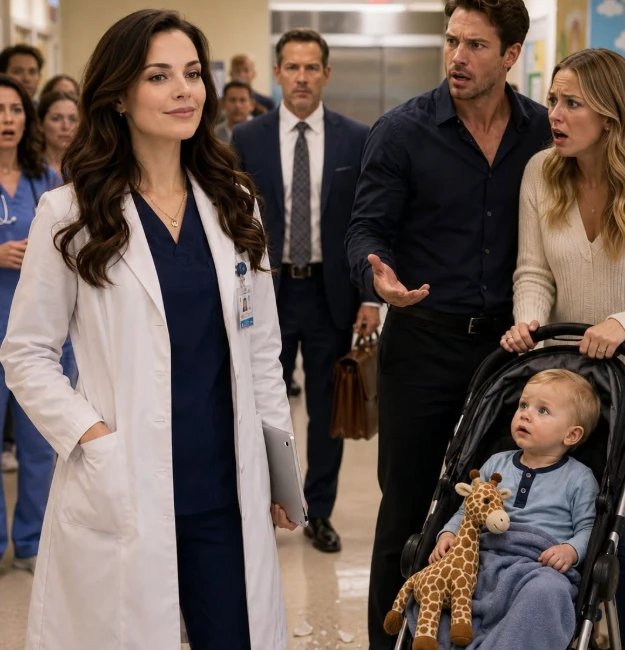
A year had passed since Connor Fleming walked out of our marriage.
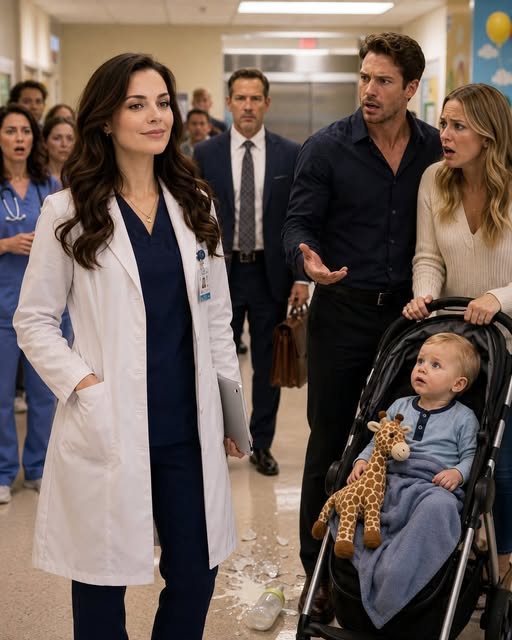
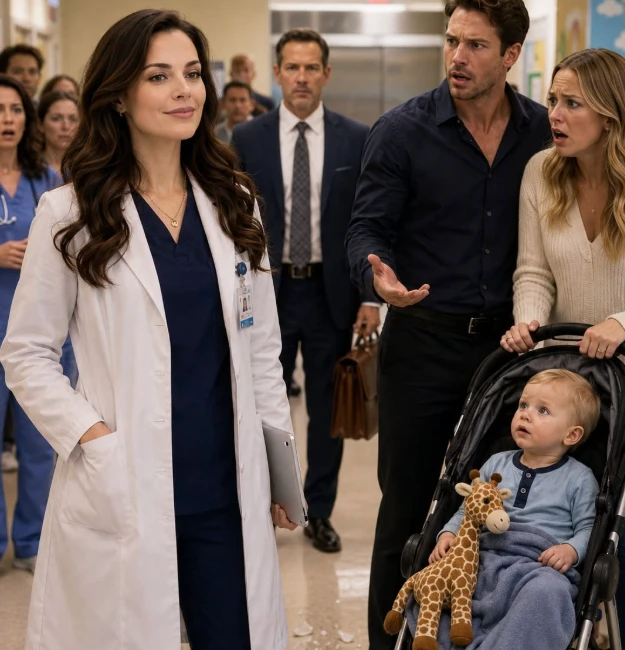
He stood in the middle of the pediatric wing as though he owned the hallway, one hand resting on a diaper bag and the other gripping a stroller. That same arrogant smile still sat on his face, the one that always appeared when he thought he had won.
Beside him stood Melinda.
My former best friend.
The woman who used to comfort me through my marriage while secretly becoming the reason it was ending.
She held a baby bottle in trembling fingers while adjusting a blanket around a little boy with soft blond hair and bright blue eyes.
The child reached for a stuffed giraffe, completely unaware that his parents were about to turn a hospital corridor into a courtroom.
I was wearing my white lab coat.
My badge read **Dr. Kirsten Sinclair**, and a tablet full of patient charts rested beneath my arm. I had a staff meeting in twelve minutes and every intention of walking past them.
Then Connor saw me.
“”Well,”” he said loudly, making sure nearby families could hear, “”look who it is.””
Several people looked up.
I stopped walking.
“”Hello, Connor.””
He seemed disappointed that my voice stayed calm.
During our marriage, he fed on emotional reactions. Tears. Anger. Silence. Anything he could later use to prove I was unstable.
Medicine had taught me something different.
I had learned to keep steady hands while families panicked and calm voices when entire rooms fell apart.
Connor glanced at my badge.
“”Still working too much?””
I almost smiled.
That accusation had survived our divorce.
Too many hours.
Too much ambition.
Too much of a life outside the version of a wife he wanted.
“”I love my work,”” I answered.
His grin widened.
“”Oh, I know.””
The hallway grew noticeably quieter.
Connor stepped closer to the stroller, making sure everyone saw the little family he had built.
Then he delivered the line he’d clearly rehearsed.
“”Leaving you was the best decision I ever made.””
Melinda whispered his name.
He ignored her.
“”A woman who can’t have children shouldn’t be surprised when a man finds someone who can give him a real family.””
The words echoed through the hallway.
A nurse stopped typing.
A father lowered his coffee cup.
Seven years of fertility appointments flashed through my mind. Seven years of blaming myself for something I couldn’t control while believing grief had changed the man I loved.
Now I understood.
Cruelty had always been there.
Connor proudly nodded toward the stroller.
“”I have a one-year-old son with your best friend.””
I looked at the child first.
He was innocent.
Then I looked at Melinda.
She wasn’t smiling.
She wasn’t proud.
She wouldn’t even meet my eyes.
She looked…
Afraid.
Finally, I turned back to Connor.
He waited for tears.
For anger.
For anything that would make him feel victorious.
Instead, I smiled.
“”Really?””
His expression faltered for just a second.
Doctors notice tiny changes.
A tightening jaw.
A skipped breath.
A flicker of fear.
“”What does that mean?”” he demanded.
“”Nothing.””
My phone buzzed inside my pocket.
The message was from my attorney, Kenneth Boyd.
**I’m downstairs. We need to talk.**
My pulse quickened.
Kenneth never interrupted my workday unless something significant had happened.
Connor noticed my silence.
“”Bad news?”” he asked smugly.
I slipped my phone away.
“”No.””
I held his gaze without blinking.
“”Not for me.””
Five minutes later, the elevator doors opened.
Kenneth stepped out carrying a sealed legal folder tucked beneath one arm.
He looked at me.
Then at Connor.
Then at Melinda.
The moment she recognized him, every trace of color disappeared from her face.
The baby bottle slipped from her trembling hand and shattered against the hospital floor.
Every conversation stopped.
And I knew the truth they had buried was finally about to catch up with them.
PART 2
Kenneth did not rush toward me.
That was how I knew the folder mattered.
He walked with the same measured pace he used entering courtrooms, his gray suit perfectly buttoned, his expression unreadable.
Connor looked at him with irritation rather than recognition.
Melinda looked like she had seen a ghost.
The shattered bottle lay between us, milk spreading across the polished tile.
A nurse hurried forward.
“Please stay back from the glass.”
Melinda barely seemed to hear her.
Connor frowned.
“You know him?”
I looked at Melinda.
“She clearly does.”
Kenneth stopped beside me.
“Kirsten.”
“What happened?”
“We received the final records from Westbridge Fertility this morning.”
Connor’s face changed.
Only slightly.
Melinda’s changed completely.
She grabbed the stroller handle.
“We should go.”
Connor turned toward her.
“What?”
“The baby’s tired.”
“He’s fine.”
“We need to leave.”
Kenneth looked at the little boy.
Then at Connor.
“I would advise against leaving the state.”
The arrogance returned immediately.
Connor laughed.
“Who exactly do you think you are?”
“Kenneth Boyd. I represent Dr. Sinclair in her civil action concerning altered fertility records, fraudulent consent, and misappropriation of reproductive material.”
The hallway went silent again.
Connor stared at me.
“What civil action?”
“The one you were going to learn about this afternoon.”
He looked genuinely confused.
Melinda did not.
That difference mattered.
I turned toward her.
“How much did you know?”
Her lips trembled.
“Kirsten—”
“How much?”
Connor stepped between us.
“Know about what?”
Kenneth opened the folder.
“Westbridge’s archived embryology logs.”
Connor’s eyes hardened.
“We went through all of that years ago.”
“No,” I said quietly. “We went through the reports you gave me.”
His jaw tightened.
Kenneth continued.
“The original laboratory records do not match the patient-facing reports Dr. Sinclair received during her final two treatment cycles.”
Connor glanced around the hallway.
“This is not appropriate.”
“You called me infertile in front of a pediatric ward.”
May you like

I folded my arms.
“We’re past appropriate.”
He lowered his voice.
“Kirsten, whatever this attorney has convinced you of—”
“Kenneth did not convince me of anything.”
I looked at Melinda.
“She did.”
Connor turned.
Melinda’s hand tightened around the stroller.
“What did you do?”
She began crying.
I had imagined this confrontation many times during the previous four months.
In those fantasies, I shouted.
Demanded explanations.
Maybe even slapped her.
Reality felt different.
The little boy in the stroller kicked beneath his blanket and made a soft humming sound.
He deserved adults who could keep their damage away from him.
So I kept my voice calm.
“Westbridge found six viable embryos from our final cycle.”
Connor stopped breathing.
I continued.
“I was told there were none.”
Melinda closed her eyes.
Connor looked at her.
“What is she talking about?”
Kenneth removed a page.
“Three embryos were placed in long-term storage under reassigned patient identifiers.”
Connor snatched the paper from him.
“That’s impossible.”
“One was transferred fourteen months later.”
My attention moved toward the stroller.
The boy with the blond hair.
The blue eyes.
The dimple beneath his left cheek.
The same dimple my father had.
The same one I saw in the mirror every morning.
Kenneth’s voice softened.
“The receiving patient was Melinda Clarke.”
Connor looked at her.
“No.”
She began shaking.
“Connor—”
“No.”
He looked back at me.
Then at the child.
“What are you saying?”
I answered because Kenneth should not have to.
“I’m saying the baby you just used to humiliate me was created from one of my eggs.”
Connor laughed.
It was too loud.
Too sharp.
“That’s insane.”
“The genetic test is in the folder.”
He stopped.
Melinda covered her mouth.
Kenneth handed me the sealed report.
I had already seen a digital copy.
Reading it in Connor’s presence felt different.
MATERNAL GENETIC RELATIONSHIP: CONSISTENT.
Probability greater than 99.99%.
PATERNAL GENETIC RELATIONSHIP: CONSISTENT WITH CONNOR FLEMING.
I looked at the child again.
My biological son.
A boy who did not know me.
A boy who had spent his first year calling another woman Mommy.
A boy Connor had just presented as evidence that my body had failed.
My knees nearly weakened.
But I remained standing.
Connor stared at the report.
Then turned toward Melinda.
“You said the embryo was yours.”
She began sobbing.
“I thought you knew.”
His face emptied.
“What?”
“You told me Kirsten had signed the release.”
“I did not know the embryo was hers.”
Now it was my turn to look at him carefully.
That fear was real.
Connor was many things.
But in that moment, I believed him.
He knew something had been done.
He did not know everything.
Kenneth closed the folder.
“That is precisely why none of you should discuss this further without counsel.”
The little boy began to cry.
Melinda bent over him immediately.
Her hands shook as she adjusted his blanket.
I watched her calm him.
The movement was practiced.
Tender.
Whatever she had done to me, she had spent a year being his mother.
That truth would not disappear because another truth had arrived.
Connor looked at me.
“You’re lying.”
“No.”
“This is some kind of revenge.”
“I didn’t know until four months ago that the records were wrong.”
“Why didn’t you tell me?”
The question almost made me laugh.
“Because the clinic investigation was sealed.”
“No. Why didn’t you tell me you thought the baby was yours?”
“I did not know until yesterday.”
His face changed again.
Yesterday.
For him, this nightmare was twelve minutes old.
For me, it had occupied every waking hour since the lab called.
PART 3
Security moved us into a private consultation room.
Not because anyone had been arrested.
Because Connor was beginning to attract a crowd.
I asked the charge nurse to ensure my staff meeting continued without me.
Then I sat across from the two people who had dismantled my marriage.
The child remained between us in his stroller.
His name, apparently, was Oliver.
I had seen it online.
Connor’s mother posted photographs constantly.
My grandson.
Our miracle boy.
The family blessing we prayed for.
Each caption had once felt like a knife.
Now every photograph had become evidence that people could celebrate a story while knowing almost nothing about how it began.
Kenneth opened the file.
“Westbridge Fertility entered receivership six months ago after a regulatory audit identified irregular embryo transfers.”
Connor leaned forward.
“Who authorized this?”
“That is under investigation.”
“Did Dr. Heller do it?”
My pulse shifted.
Dr. Martin Heller had treated Connor and me for nearly four years.
He told us I had poor egg quality.
Repeated implantation failure.
Diminished ovarian reserve.
He was the one who suggested we stop trying.
I had sat beside Connor in his office while Heller said:
Sometimes biology simply closes a door.
I cried in the car for an hour.
Connor held me.
At least I believed he did.
Kenneth placed another page on the table.
“Dr. Heller received three hundred thousand dollars from an entity controlled by Connor’s father.”
Connor went completely still.
“What?”
This part was new to me.
I looked at Kenneth.
“You didn’t tell me that.”
“We confirmed it forty minutes ago.”
Connor’s father, Richard Fleming, had died eleven months before our divorce.
He was a venture capitalist.
Old money.
Old expectations.
And utterly obsessed with grandchildren.
Richard never insulted me directly.
He preferred concern disguised as kindness.
Are you eating properly?
Do women doctors work too many hours?
Maybe stress is the problem.
Have you considered stepping away from medicine for a year?
He treated my fertility as a family-management issue.
Connor stared at the payment record.
“My father paid Heller?”
“Yes.”
“For what?”
Kenneth opened another document.
“Consulting.”
Connor laughed bitterly.
“My father wasn’t in reproductive medicine.”
“No.”
“So what was he buying?”
Kenneth looked at Melinda.
Her face had gone pale again.
“Access.”
I turned toward her.
“You knew Richard was involved.”
She shook her head.
“Not at first.”
“When?”
She swallowed.
“Before the transfer.”
Connor stood.
“You said the clinic contacted you because there were donated embryos.”
“They did.”
“From anonymous donors.”
“That’s what I was told at first.”
“At first?”
Her voice broke.
“Connor, sit down.”
“Do not tell me to sit down.”
Oliver startled.
Instantly, all three of us stopped.
The baby began crying.
Melinda lifted him from the stroller.
Connor lowered his voice.
“When did you know?”
She held Oliver tightly.
“Two days before the transfer.”
The room became still.
“You knew whose embryo it was?”
“Yes.”
Mine.
My former best friend had known.
She had sat beside me through failed cycles.
Brought food after retrievals.
Listened when I said I felt broken.
Then accepted an embryo created from my body.
“Why?” I asked.
She looked at me.
“I wanted a baby.”
“That explains fertility treatment.”
“I wanted Connor too.”
There it was.
No excuse improved it.
“I knew your marriage was falling apart,” she continued.
“It wasn’t.”
“You were barely speaking.”
“Because I was grieving infertility.”
“Connor said you pushed him away.”
I looked at him.
He looked down.
Of course.
The affair had needed a story in which my pain became cruelty.
“You still knew the embryo was mine,” I said.
Melinda started crying harder.
“Richard said you had signed everything.”
“Did you see my signature?”
“Yes.”
Kenneth placed another page on the table.
The release form.
My signature appeared at the bottom.
Perfectly.
Too perfectly.
A forensic document examiner had determined it was copied from a surgical consent form I signed eighteen months earlier.
Connor stared at it.
“I’ve seen that signature before.”
“Because it appeared in your divorce exhibits,” I said.
His head snapped toward me.
“What?”
My attorney explained.
During divorce discovery, Connor’s lawyers submitted a fertility-release document showing I had voluntarily discontinued treatment and abandoned remaining reproductive material.
The same forged signature appeared there.
It supported Connor’s claim that I had emotionally withdrawn from the marriage after choosing to stop trying for children.
The lie had served two purposes.
Steal the embryo.
Then rewrite why our marriage failed.
Connor looked genuinely sick.
“My attorney got that from Heller.”
“Probably,” Kenneth said.
“You think I knew it was forged?”
“I think the evidence will answer that.”
PART 4
Connor began pacing.
For the first time since I had known him, arrogance had no place to land.
He pointed at Melinda.
“You carried Kirsten’s embryo and never told me?”
“I thought Richard told you.”
“My father was dead before Oliver was born.”
“He arranged it before.”
“Why?”
No one answered immediately.
Then Kenneth placed a copy of Richard Fleming’s trust on the table.
Connor stopped pacing.
His family fortune had always been complicated.
Richard controlled several investment partnerships and real-estate funds worth hundreds of millions.
Connor was wealthy but not independently powerful.
Most voting control remained inside trusts.
“Your father’s estate contains a succession provision,” Kenneth said.
Connor’s face tightened.
“I know.”
I did not.
Of course I didn’t.
Another secret in a marriage filled with financial rooms I was never invited to enter.
“The first biological grandchild born to Connor during Richard’s lifetime or within eighteen months of his death triggers release of a controlling interest in Fleming Capital.”
I looked at Connor.
“How much?”
He did not answer.
Kenneth did.
“Approximately forty-one percent.”
Melinda stared at him.
“You told me it was just a family trust.”
Connor ignored her.
I understood now.
Richard needed Connor to produce a biological child.
Not eventually.
Before a deadline.
Our infertility threatened control of the company.
His younger brother, Mason, had a pregnant wife.
If their child was born first under the trust provisions, Mason’s branch would receive voting priority.
Richard had treated my uterus as a corporate obstacle.
And when my body did produce viable embryos, someone made sure the best one went where they believed pregnancy was more likely.
“Was Melinda already involved with Connor?” I asked.
She looked down.
“No.”
Connor answered too quickly.
“Not then.”
I looked at both of them.
“When?”
Melinda whispered:
“After the transfer.”
I laughed once.
“You became pregnant with my embryo and then started sleeping with my husband.”
She flinched.
“It wasn’t immediate.”
“How considerate.”
“Kirsten—”
“No.”
I held up one hand.
“Do not ask me to understand the timeline as though spacing betrayals farther apart makes them different.”
Connor sat down slowly.
“My father did this.”
“Your father started it.”
He looked at me.
“I didn’t know.”
“Did you know there were frozen embryos?”
Silence.
That was enough.
“Connor.”
He rubbed both hands over his face.
“Heller told me there might be two or three that were not clinically useful.”
“And?”
“My father said preserving them was pointless.”
“Did you sign anything?”
“I signed a disposal authorization.”
My stomach turned.
“Without telling me?”
“I thought you had signed too.”
“Did you see my signature?”
He hesitated.
“No.”
There it was.
Not innocence.
Different degrees of guilt.
Connor may not have known Melinda received my embryo.
But he had participated in decisions about embryos created from both of us without confirming my consent.
He had allowed his father and doctor to manage the process.
Then he used the resulting child to humiliate me.
Ignorance did not erase choices that made the theft possible.
PART 5
Kenneth slid another document toward me.
“This is the part that triggered today’s emergency meeting.”
The top line read:
FLEMING CAPITAL DISTRIBUTION – BENEFICIARY CERTIFICATION.
Oliver Fleming was listed as Connor’s biological son.
That part was true.
What came next was not.
Maternal biological parent:
Melinda Clarke.
My name did not appear anywhere.
The trust had released Connor’s controlling shares based on false parentage documentation.
“How much money has he received?” I asked.
Connor stiffened.
Kenneth answered.
“Approximately eighteen million dollars in distributions and voting control worth considerably more.”
Melinda sank into the chair.
“You told the trust I was the biological mother?”
Connor looked at her.
“That was what Heller’s records said.”
“You knew I wasn’t.”
“I knew you carried him.”
“That is not what biological means.”
Interesting.
A year earlier, both of them had benefited from blurred language.
Now precision mattered.
Kenneth continued.
“The trustee has already frozen further distributions.”
Connor shot to his feet.
“You did what?”
“I did nothing.”
Kenneth remained calm.
“The trustee acted after receiving genetic evidence.”
“You had no right to contact them.”
“I represent the person whose genetic identity was fraudulently omitted from trust documents.”
Connor turned toward me.
“So this is about money.”
I stared at him.
“You just called me a woman who could not have children while standing beside a child created from my egg.”
He said nothing.
“If I wanted money, I had much easier ways to ask during our divorce.”
“You could have challenged the trust then.”
“I didn’t know.”
“That’s convenient.”
My old self would have defended my integrity.
Explained.
Proved.
Instead, I leaned back.
“The records are more interesting than your opinion.”
Doctors learn this too.
When someone wants argument, return to data.
Connor looked toward Kenneth.
“What happens now?”
“The trust will conduct an independent review. It may seek repayment of distributions obtained through false certification.”
Melinda whispered:
“Repayment?”
Connor’s face became pale.
Eighteen million dollars.
Much of the life they built rested on money tied to Oliver’s birth.
The townhouse.
Private-school deposits.
Cars.
Investments.
The lifestyle Connor presented online as proof that leaving me had improved everything.
He had not simply stolen a narrative.
He had built it on an inheritance triggered by my genetic child.
PART 6
I asked one question.
“What does any of this mean for Oliver?”
The adults became quiet.
Kenneth looked at me.
“That will require family court.”
“I am not asking who gets him.”
Connor’s expression sharpened.
“Good.”
I ignored him.
“I’m asking what happens to him today.”
Melinda held Oliver tighter.
Kenneth answered carefully.
“Nothing immediate. No court is removing a one-year-old child from his established caregiver in a hospital hallway solely because genetic parentage was discovered.”
Relief crossed Melinda’s face.
I felt relief too.
That surprised me.
I wanted the truth.
I did not want a baby traumatized to prove it.
“I will not participate in anyone treating him like property,” I said.
Connor gave a bitter laugh.
“Very noble.”
I turned toward him.
“You brought him here as a trophy.”
The words stopped him.
Melinda looked down at Oliver.
I continued.
“I’m not doing the same thing in reverse.”
Kenneth nodded.
“We will petition for recognition of Kirsten’s legal parental interest and request a gradual contact plan supervised by child-development specialists.”
Melinda began crying.
“You’re taking him.”
“No.”
I looked at her.
“He knows you as his mother.”
She stared at me.
“You hate me.”
“Yes.”
The honesty seemed to hurt less than false reassurance.
“But my hatred is not Oliver’s responsibility.”
Her shoulders collapsed.
For the first time, I saw not the woman who stole my husband but a terrified mother afraid someone might erase the only role she had built honestly.
She had entered motherhood dishonestly.
But the diapers, fevers, sleepless nights, first words, scraped knees—those things were real.
Connor paced again.
“What about me?”
I almost smiled.
Only Connor could sit inside a room where two women discovered their entire understanding of motherhood had been manipulated and ask first about himself.
Kenneth answered.
“You should retain separate family, civil, and criminal counsel.”
“Criminal?”
The word echoed.
Melinda looked terrified.
Kenneth closed the file.
“Forged medical authorizations, fraudulent trust certifications, altered patient records, and unauthorized embryo transfer may involve criminal statutes.”
Connor looked toward the hallway.
“I need to call my lawyer.”
“Yes.”
He pulled out his phone.
Then paused.
“What exactly are you suing for?”
I answered.
“Truth first.”
“That’s not a legal remedy.”
“No.”
I looked at Oliver.
“But it is the one everything else depends on.”
PART 7
The story broke publicly four days later.
Not because I leaked it.
Westbridge Fertility’s investigation involved eleven other families.
Reporters had already been following the clinic.
Once court filings became public, Connor’s name attracted attention.
FLEMING HEIR LINKED TO EMBRYO CONSENT SCANDAL.
DOCTOR’S EX-WIFE IDENTIFIED AS GENETIC MOTHER OF CHILD BORN TO FORMER FRIEND.
I hated every headline.
Oliver’s existence became content.
People debated motherhood as though voting online could resolve it.
Some called Melinda a kidnapper.
Others called me an egg donor trying to steal another woman’s child.
Connor described himself through counsel as “a father deceived by medical professionals.”
That statement lasted twelve hours.
Then Kenneth received Connor’s emails with Dr. Heller.
One message was dated three months before our divorce.
Connor wrote:
Dad says the trust requires biological issue, not necessarily Kirsten carrying. If her stored material can be lawfully used elsewhere, I need to understand the options.
Heller replied:
No transfer is lawful without both genetic contributors’ consent unless prior disposition documents provide otherwise.
Connor answered:
Find a disposition interpretation that works.
He had not known Melinda specifically would receive the embryo.
But he knew someone might.
And he knew my consent was the obstacle.
Another message:
Kirsten cannot know there are viable embryos. She will refuse disposal and complicate everything.
I read it inside Kenneth’s office.
For several seconds, the words blurred.
There was the answer I had not wanted.
Connor knew.
Not every detail.
Enough.
He knew viable embryos existed.
He knew I had not been told.
He knew another transfer might occur.
And he deliberately protected the deception because my knowledge would complicate his inheritance.
I placed the page down.
Kenneth asked:
“Do you need a break?”
“No.”
That was another thing medicine taught me.
Sometimes the only way through terrible information is to finish the chart.
PART 8
Dr. Heller was arrested three weeks later.
The charges extended beyond my case.
He had altered records for multiple wealthy families, moving reproductive material between storage accounts, falsifying disposition forms, and accepting “consulting” payments from people seeking outcomes conventional ethics would have prevented.
Richard Fleming had paid him through a private foundation.
Connor paid him personally twice after Richard’s death.
One payment occurred the week before Connor filed for divorce.
The description:
Medical records reconciliation.
Actual purpose, according to Heller’s assistant:
Remove remaining references to viable Sinclair-Fleming embryos from the patient-facing chart.
Connor’s defense became harder.
He had not merely inherited his father’s plan.
He continued concealing it.
PART 9
Melinda came to my office after closing one evening.
She had an appointment.
I would not meet her secretly.
Kenneth’s associate sat nearby.
Oliver remained with a nanny.
Melinda looked exhausted.
“What do you want?” I asked.
“To tell you the part Connor won’t.”
“Which part?”
“He asked me to become pregnant.”
My hands went cold.
“When?”
“Before we started sleeping together.”
The room became still.
“What did he tell you?”
“That you had stopped treatment. That there were embryos neither of you planned to use. That the trust deadline was approaching.”
“You knew it was about inheritance.”
“Yes.”
“Did he ask you to carry one?”
“Not directly.”
“What did he ask?”
“If I would consider helping him have a child.”
I stared at her.
“And you said yes.”
“Eventually.”
“Before you knew the embryo was mine?”
“Yes.”
“And after you found out?”
She began crying.
“I should have walked away.”
“Yes.”
“I didn’t.”
“Yes.”
No absolution.
No dramatic attack.
Just truth.
“I was in love with him,” she said.
“You were my best friend.”
“I know.”
“You sat with me after the cycle failed.”
“I know.”
“You told me motherhood did not define my worth.”
She closed her eyes.
“I know.”
“That same week, you met with Heller.”
Her shoulders shook.
“Yes.”
I could not look at her for several seconds.
Then I asked:
“Why are you telling me now?”
“Because Connor says I acted alone.”
Of course.
“He says he believed the embryo was donated anonymously. He says I manipulated Heller.”
“Do you have proof otherwise?”
Melinda reached into her bag.
A phone.
Old.
Cracked.
“I kept our messages.”
Connor repeatedly told her to delete everything.
She kept backups because even while betraying me, she did not fully trust him.
Human contradiction is almost endless.
One message from Connor:
Once the pregnancy is established, Dad’s trust issue disappears. Then I can finally leave Kirsten without losing control of the company.
Another:
She will never know which embryo was used if Heller cleans the records.
And:
Do not tell her until the divorce is final. She will make this about motherhood instead of accepting that the marriage is over.
I read the messages once.
Then slid the phone back toward Melinda.
“No.”
She looked confused.
“Keep it until investigators collect it properly.”
“You don’t want a copy?”
“My attorney will obtain one.”
She nodded.
As she stood to leave, she paused.
“Kirsten.”
I looked up.
“Oliver has your laugh.”
That was the cruelest and kindest thing she could have said.
I cried after she left.
PART 10
Family court moved cautiously.
A child-development expert named Dr. Priya Shah evaluated all of us.
She met Oliver repeatedly.
Observed Melinda feeding him.
Connor playing with him.
Me sitting on a carpet while he avoided me.
That first meeting lasted forty minutes.
Oliver spent thirty-nine ignoring me.
At minute forty, he handed me a wooden block.
Blue.
I accepted it.
“Thank you.”
He took it back immediately.
That was all.
I cried in my car afterward.
Not because he rejected me.
Because his indifference was appropriate.
Genetics may create connection.
Relationship requires time.
The court recognized me as Oliver’s genetic mother and eventually as a legal parent due to the fraudulent transfer.
But it did not erase Melinda.
Her parental status remained because she carried him, gave birth to him, and had been his primary caregiver.
We entered a structured co-parenting arrangement.
At first, I saw Oliver twice a week.
Then weekends.
Then holidays were divided carefully.
Connor protested.
He argued that three-parent arrangements were confusing.
The judge looked at him.
“Your conduct created the complexity.”
He stopped objecting publicly after that.
PART 11
The Fleming trust case moved faster.
The trustee concluded Connor obtained voting control through materially false certification.
The forty-one-percent share block reverted temporarily to an independent fiduciary.
Connor lost control of Fleming Capital.
The eighteen million dollars in distributions became subject to restitution and clawback.
His family erupted.
His mother called me.
I answered once.
“Kirsten, whatever happened between you and Connor, destroying Richard’s legacy will not heal you.”
“I am not the trustee.”
“You started this.”
“Your husband paid a doctor to hide my embryos.”
Silence.
“I didn’t know.”
“Did you know the trust deadline?”
“Yes.”
“Did you know Connor was desperate for a biological child?”
“Yes.”
“Did you know Melinda was pregnant before our divorce?”
Another silence.
Longer.
“Yes.”
There it was.
“How long?”
“Four months.”
My chest tightened.
“And you said nothing.”
“It was not my marriage.”
“No.”
I looked toward the hospital window.
“It was simply my life.”
She began crying.
“Richard put enormous pressure on Connor.”
“So Connor put it on my body.”
“He made mistakes.”
“Mistakes do not require forged signatures.”
She said my name softly.
“Kirsten.”
“No.”
“What?”
“I spent seven years being told my body failed your family.”
My voice remained steady.
“You do not get to ask me to protect its inheritance now.”
I ended the call.
PART 12
Connor’s criminal trial began eighteen months after the hospital encounter.
Dr. Heller had already pleaded guilty and agreed to testify.
Melinda also cooperated.
She faced charges related to fraudulent consent and trust documents but received a reduced agreement because she provided evidence and accepted responsibility.
Connor maintained that his father designed the scheme.
Then prosecutors showed the messages sent after Richard died.
Clean the records.
Do not tell Kirsten.
Use the trust certification.
He could no longer place responsibility inside a grave.
I testified for two days.
His attorney began with our fertility history.
“Dr. Sinclair, you suffered emotionally during treatment?”
“Yes.”
“You became depressed?”
“Yes.”
“You withdrew from your husband?”
“At times.”
“So the marriage was already unstable.”
“Grief made it strained.”
“Your husband wanted children.”
“So did I.”
“Yet you were unable to carry a pregnancy to term.”
I looked directly at the attorney.
“I experienced unsuccessful embryo transfers.”
“Isn’t that another way of saying you could not give Mr. Fleming a child?”
“No.”
I paused.
“And Oliver is genetic proof of that.”
The courtroom went silent.
The attorney changed direction.
“You resent Melinda Clarke.”
“Yes.”
“You consider her a betrayer.”
“Yes.”
“You also want a relationship with her child.”
“With my biological son.”
“She gave birth to him.”
“Yes.”
“Raised him.”
“Yes.”
“And yet you sought legal parentage.”
“Yes.”
“Isn’t that punishment?”
“No.”
“What is it?”
“The restoration of a relationship that was prevented through fraud.”
He stepped closer.
“You want what she has.”
I looked toward Melinda sitting in the gallery.
“No.”
Then toward Connor.
“I want no one ever again to make decisions about my reproductive material while pretending my consent is inconvenient paperwork.”
PART 13
Connor was convicted of conspiracy, fraud, identity theft, falsification of medical records, unlawful reproductive-material transfer offenses, and trust-related financial crimes.
Dr. Heller lost his license permanently.
Connor lost control of Fleming Capital.
Several properties were sold to satisfy restitution.
The house he shared with Melinda disappeared first.
Then the sports cars.
Then investment accounts.
The family image he once displayed proudly in the hospital hallway did not survive contact with accounting.
At sentencing, Connor addressed me.
“Kirsten, I am sorry.”
I waited.
“I was under pressure from my father.”
There it was.
The explanation attached before the apology had finished breathing.
“I thought the embryos belonged to both of us.”
The judge interrupted.
“Belonging jointly is not unilateral authority.”
Connor looked down.
“I know that now.”
He received a substantial prison sentence.
Not life.
Not some dramatic forever.
Enough years for Oliver to grow up understanding his father through scheduled calls, letters, and whatever relationship remained safe.
PART 14
Melinda and I never became friends again.
People found that disappointing.
They wanted redemption to create reunion.
It did not.
We became competent co-parents.
That was harder and more useful.
We exchanged schedules.
Medical information.
School notes.
Food preferences.
When Oliver developed asthma at three, she called me from the emergency department before calling Connor’s mother.
When I attended a conference in Chicago, she sent me a video of Oliver learning to ride a bicycle.
When her own mother died, I kept Oliver for nine days without turning grief into leverage.
Trust returned in narrow, practical forms.
Never the old one.
Sometimes that is the only honest version of repair.
PART 15
Oliver called me Dr. Kirsten at first.
Then Kirsten.
Then, when he was four:
Mama Kirsten.
He said it while asking me to open a yogurt.
No ceremony.
No emotional music.
Just:
“Mama Kirsten, it’s stuck.”
I turned toward the refrigerator because I did not want him to see me cry.
When I looked back, he was impatient.
“Please?”
I opened the yogurt.
Motherhood arrived in my life through paperwork, betrayal, litigation, supervised visits, and one stubborn plastic lid.
It was nothing like the version I once imagined.
It was real anyway.
PART 16
I remained at the hospital.
Pediatrics had always been the place Connor accused me of choosing over marriage.
After the scandal, I considered leaving.
Too many people knew.
Too many whispered.
Then one afternoon, a resident came into my office.
She had made a medication error.
Caught before reaching the patient.
She was crying.
“I should quit.”
“No.”
“I could have hurt someone.”
“Yes.”
She looked shocked by the honesty.
“What do I do?”
“Document exactly what happened. Understand why. Fix the system that allowed it.”
That answer reminded me why I stayed.
Medicine was not built on pretending errors never occurred.
It survived because truth mattered more than image.
My marriage had operated under the opposite rule.
Image first.
Truth buried.
PART 17
Westbridge Fertility reopened under new ownership with strict consent controls.
Every embryo disposition required independent confirmation from both genetic contributors.
No spouse could submit another person’s consent.
No transfer occurred without live identity verification.
Patient-facing reports had to match laboratory logs automatically.
I joined the ethics advisory board.
Not because I wanted my entire future defined by what happened.
Because systems that fail in secret often require people harmed by them to explain where secrecy lived.
At the first meeting, an administrator said:
“We need to restore trust.”
I corrected him.
“No. First you need to become trustworthy.”
He wrote it down.
PART 18
When Oliver turned seven, he asked how I became his mother.
Not the simplified version.
The real one.
He sat at my kitchen table drawing dinosaurs.
“Melinda said I grew in her tummy.”
“You did.”
“And you’re my mom too.”
“Yes.”
“So was I in your tummy first?”
“No.”
He frowned.
I explained embryos in language a seven-year-old could understand.
A tiny beginning made from an egg and sperm.
Created in a laboratory.
Transferred into a uterus.
“Your egg?”
“Yes.”
“Dad’s sperm?”
“Yes.”
“And Mama Melinda carried me.”
“Yes.”
He considered the information.
“Did everybody agree?”
There it was.
The question beneath everything.
“No.”
He looked at me.
“Who didn’t?”
“I didn’t.”
“Why?”
“Because no one told me.”
His pencil stopped.
“Was that bad?”
“Yes.”
“Was I bad?”
“No.”
My answer came instantly.
“Never.”
He looked relieved.
“Did Mama Melinda do bad?”
“She made choices that hurt me.”
“Does that mean she’s bad?”
“No.”
He nodded.
“And Dad?”
“Your dad made serious choices that were against the law.”
“Does he love me?”
“I believe he does.”
“Can somebody love you and still do bad things?”
“Yes.”
Children deserve that truth.
Love is not proof of safety.
PART 19
Connor wrote to Oliver regularly from prison.
He also wrote to me.
I ignored most letters.
One arrived six years after sentencing.
Kirsten,
The worst thing I said to you was not in court or during the divorce.
It was in the hospital hallway when I called Oliver proof that you could not have children.
By then I knew enough to know the opposite might be true.
I said it because I wanted you humiliated before you could ever make me feel ashamed.
I have spent years calling what Dad did pressure and what I did fear.
Those words are true but incomplete.
I benefited.
I chose silence.
I chose the trust.
I chose to let you believe your body failed.
I am sorry.
No request followed.
I kept the letter.
Not because it restored him.
Because accountability finally appeared without demanding an audience.
PART 20
My former best friend and I sat together at Oliver’s middle-school graduation years later.
Not beside each other.
One empty chair separated us because Oliver wanted Connor’s photograph placed there.
He had complicated feelings about his father.
We allowed them.
Oliver crossed the stage.
Melinda cried.
So did I.
Afterward, he found us beneath a tree.
“One picture,” he announced.
Melinda and I exchanged a look.
“With both of us?” I asked.
“Yes.”
“You’re sure?”
“You are both my moms. Stop making it weird.”
Teenagers are efficient with adult complexity.
We stood on either side of him.
The photograph was not evidence of forgiveness.
It was evidence that Oliver’s life had become larger than the crime surrounding his beginning.
That mattered more.
PART 21
Years after the hospital encounter, I returned to the exact hallway where Connor had tried to humiliate me.
The pediatric wing had been renovated.
New flooring.
Different paint.
The elevators were the same.
A young father stood nearby rocking a baby.
A nurse carried a bottle past me.
The sound of glass hitting the floor returned in my memory.
Melinda’s face.
Kenneth stepping out of the elevator.
Connor waiting for me to collapse.
People tell stories like ours as though the dramatic entrance changes everything.
The attorney arrives.
The folder opens.
The liar goes pale.
But Kenneth did not rescue me.
The genetic report did not rescue me.
Even discovering Oliver did not repair the seven years I spent believing my body was defective.
The most important change had happened earlier.
During the year after my divorce, before I knew any of this.
I went back to medicine fully.
Stopped apologizing for ambition.
Stopped treating an empty marriage as proof I was too difficult to love.
Stopped believing motherhood was the admission price for being a complete woman.
That mattered because when Oliver entered my life, I could love him without making him responsible for filling a hole.
He was not the child who proved I was worthy.
He was Oliver.
That was enough.
PART 22
Connor once told me a woman who could not have children should not be surprised when a man found a real family.
He believed every word had an owner.
He owned fatherhood because he had a son.
Melinda owned motherhood because she gave birth.
I owned failure because I did not.
Reality was less tidy.
I was Oliver’s genetic mother.
Melinda was the woman who carried and raised him.
Connor was his biological father and also the man who helped violate the consent that created his birth.
None of those facts canceled the others.
Families become dangerous when people insist one truth must erase every competing truth.
PART 23
The trust ultimately changed.
Fleming Capital did not return control to Connor after prison.
Independent trustees distributed voting power among professional directors and future beneficiaries.
Oliver’s inheritance remained protected.
Neither Melinda nor I could borrow against it.
Connor could not direct it.
When Oliver became an adult, he would receive financial education before gaining any voting rights.
Richard Fleming designed the original trust to reward the birth of a male heir.
The revised structure rewarded competence.
That felt like progress.
PART 24
I kept the first genetic report in my office safe.
Not on display.
Not framed.
Sometimes I opened it.
MATERNAL GENETIC RELATIONSHIP: CONSISTENT.
For months, I read those words as vindication.
My body had not failed.
Eventually, I stopped needing the report to tell me that.
Fertility had never been a character evaluation.
A woman who cannot become pregnant is not lesser.
A woman whose embryos fail is not broken.
A woman who chooses no children does not require correction.
That was another lie Connor’s cruelty forced me to examine.
If the genetic test had shown Oliver was not mine, his insult in the hallway would still have been wrong.
My worth did not become real because a laboratory proved I had produced a viable embryo.
The truth gave me a son.
It did not give me value.
I already had that.
PART 25
One year after my divorce, Connor Fleming stood in the pediatric wing of my hospital and tried to show me what he believed I had lost.
He had the stroller.
The mistress.
The baby.
The smirk.
The rehearsed sentence.
Leaving you was the best decision I ever made.
A woman who can’t have children shouldn’t be surprised when a man finds a real family.
He expected the hallway to become his stage.
Instead, five minutes later, the elevator opened.
Kenneth Boyd stepped out carrying a sealed folder.
Melinda dropped the bottle.
Milk spread across the floor.
Connor’s perfect story cracked.
Not because an attorney had arrived.
Because records had.
Embryology logs.
Forged consent.
Trust certifications.
Genetic testing.
Payments.
Emails.
Dates.
Truth is rarely as theatrical as humiliation.
It does not need to be.
Connor had spent years controlling the narrative because he assumed whoever spoke most confidently owned reality.
I learned something different in medicine.
A diagnosis does not care who sounds certain.
You check the evidence.
That morning, Connor wanted me to believe Oliver proved he had found someone better than me.
Years later, when Oliver asked what happened the first day I learned about him, I told him:
“Your father was showing off.”
He laughed.
“Seriously?”
“Very seriously.”
“And then?”
“Your mother dropped a bottle.”
“Mama Melinda?”
“Yes.”
“And then?”
“A lawyer brought me some papers.”
“That sounds boring.”
“It was.”
He grinned.
“What did the papers say?”
I looked at him.
“They said the story everyone believed was wrong.”
Oliver thought for a second.
“Was that when you became my mom?”
“No.”
“When, then?”
I smiled.
“That took longer.”
And that was the truth Connor never understood.
Biology could be established in a laboratory.
Fraud could be established in court.
But family?
Family had to be built afterward.
Visit by visit.
Meal by meal.
Birthday by birthday.
Truth by truth.
Connor once used Oliver to prove I had failed.
Instead, Oliver became the reason I learned the final difference between possession and love.
Possession says:
You are mine because I have the paperwork.
Love says:
You are yourself, and I will keep showing up.
The bottle hitting the floor was only the first crack.
Everything built on lies came apart afterward.
But what we built from the truth—
that lasted.