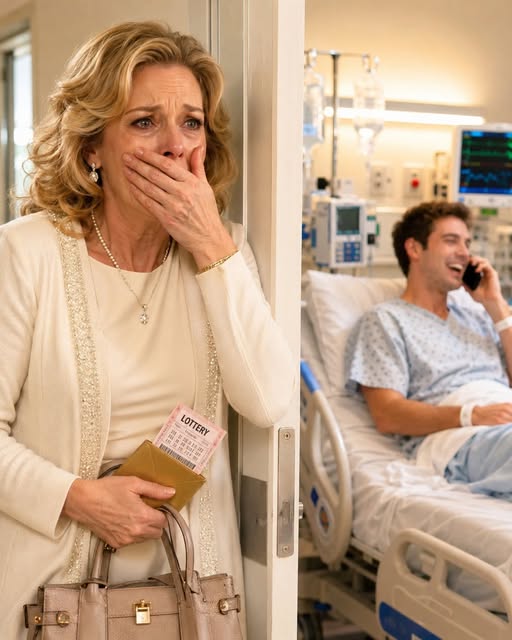
“I was standing outside my son’s hospital room with a lottery ticket worth twenty million dollars in my purse, ready to save his future—when I heard him laughing over speakerphone about how easy it was to manipulate me for money. Moments later, a mysterious stranger warned me not to tell him about the jackpot because an even darker secret was hiding behind his illness. In that instant, everything I thought I knew about my only child shattered.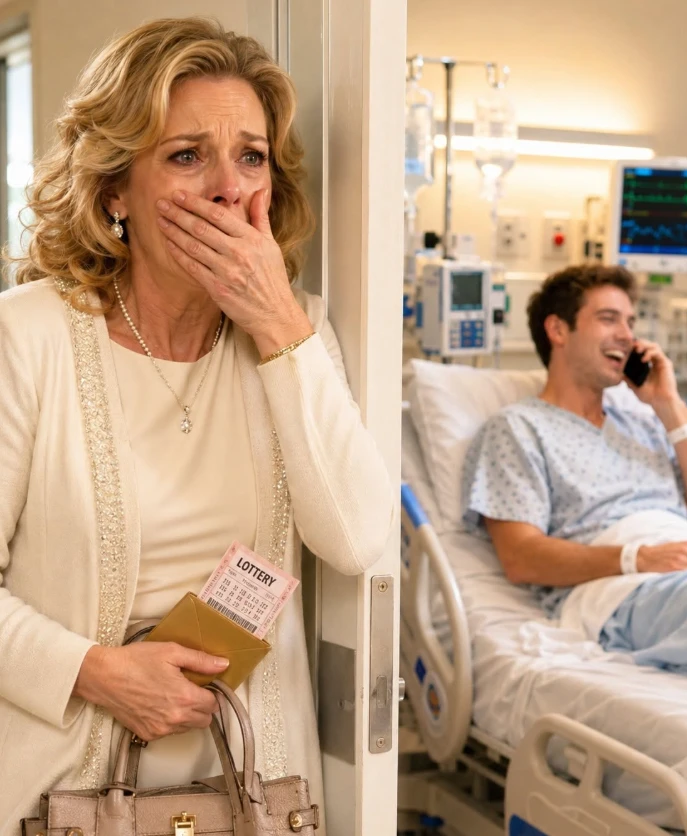
“If my mom thinks I’m dying, she’ll give me every last dollar she has.”
The words hit me like a knife straight through my chest.
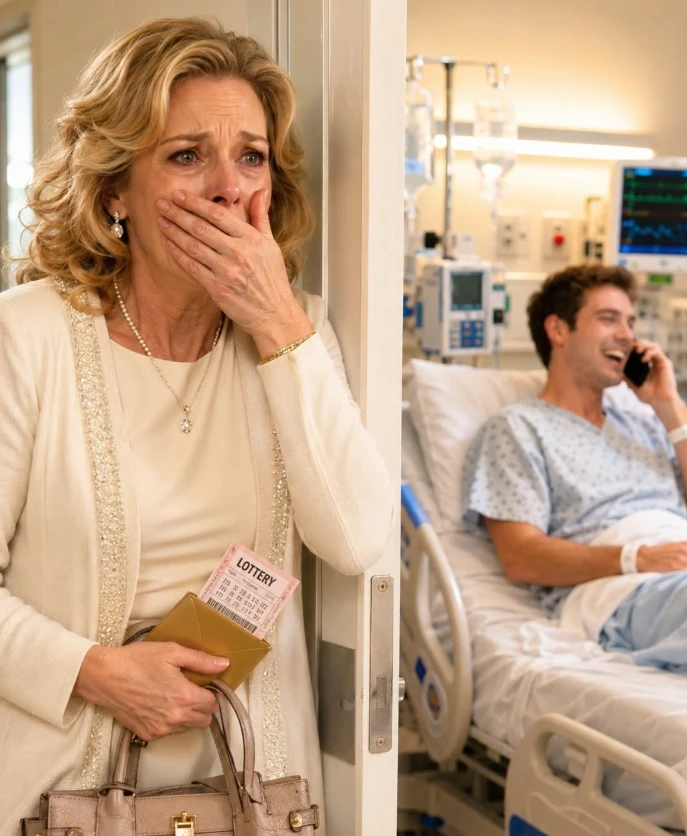
I froze outside Room 12 at St. Jude Community Hospital, my hand hovering inches from the door. The lottery ticket inside my purse suddenly felt heavier than a brick.
The door was cracked open.
Inside, Spencer was talking to a woman on speakerphone.
“Don’t you feel guilty?” she asked.
“Sometimes,” Spencer said with a chuckle that made my stomach twist. “But Mom loves feeling needed. I don’t even have to ask anymore. I just act worried, and she throws money at the problem.”
My fingers tightened around my purse.
For months, I had sacrificed everything. I sold my jewelry. I pawned my late mother’s sewing machine. I buried myself in debt paying for specialists, treatments, medications, and endless tests.
Every time Spencer called crying, I found a way.
Every single time.
That morning, after checking the winning lottery numbers for the fifth time, I had imagined walking into his room and saying, “You’ll never have to worry again, son.”
Now I stood there listening to him plan how to spend money he didn’t even know existed.
“When I get discharged,” Spencer continued, “I’ll tell her my business is collapsing. She’ll pay the rent, replace my equipment, and wipe out my credit card debt. She always fixes everything.”
The woman hesitated.
“What if her good news has nothing to do with you?”
Spencer laughed.
A cold, arrogant laugh.
“Everything ends up being about me.”
The air vanished from my lungs.
I leaned against the wall to keep myself from falling.
At sixty years old, after decades of sacrifice, I realized my son didn’t see my love as love.
He saw it as an unlimited credit line.
A nurse approached me with a folder.
“Mrs. Riley, aren’t you going in? He’s been asking for you.”
I forced a smile.
“I forgot something in my car, sweetheart. I’ll be right back.”
I walked away without looking back once.
In the parking lot, I locked myself inside my aging sedan and stared at the lottery ticket.
Twenty million dollars.
Enough to change generations.
My phone buzzed.
Spencer: “Where are you? You said you had good news.”
I replied, “Traffic is terrible. We’ll talk later.”
Then I turned my phone off.
For the first time in thirty-four years, I didn’t come running when my son called.
Back home, I placed the ticket on my kitchen table—the same table where I’d spent years counting coins to cover his debts.
Then I opened a notebook and wrote:
How much has he lied to me?
How much money has he taken?
How far would he go if he learned I won twenty million dollars?
Before I could finish the last question, my phone lit up with a text from an unknown number.
“Mrs. Riley, don’t tell Spencer about the lottery yet. There’s something much worse that you need to know.”
My heart nearly stopped.
The message was signed with one name.
Naomi.
And suddenly, I realized the conversation outside that hospital room was only the beginning of a nightmare I never saw coming.
I stared at Naomi’s name until the letters blurred.
I did not know any Naomi.
My first instinct was to delete the message. It could have been a scam, a cruel joke, or someone trying to exploit a frightened mother. But the fact that she knew about the lottery changed everything.
Only three people knew I had bought the ticket: the cashier at the convenience store, the state lottery system, and me.
Spencer did not know.
At least, I had believed he did not.
My hands trembled as I typed.
“Who are you, and how do you know?”
The response came less than a minute later.
“I worked with Spencer. Please don’t call him. Don’t answer questions about the ticket. Meet me somewhere public.”
I looked toward the dark kitchen window, suddenly feeling watched inside my own home.
“What is the secret?”
Three dots appeared, disappeared, and appeared again.
Finally, Naomi replied.
“Spencer may not be sick.”
I read the sentence twice.
Then a third time.
My chair scraped backward as I stood.
That was impossible.
I had sat beside Spencer during appointments. I had seen him in hospital gowns. I had picked up prescriptions and paid invoices. I had watched him lose weight, tremble, and clutch his chest in pain.
For eight months, he had told me that a rare neurological condition was damaging his nervous system. According to him, doctors were still trying to determine whether it was autoimmune, degenerative, or something even worse.
He said his insurance refused to cover experimental treatments.
He said he might not have more than two years.
Sometimes six months.
The timeline changed depending on how urgently he needed money.
I had been too terrified to notice.
I typed, “I saw him in the hospital today.”
Naomi answered immediately.
“He checks himself in for symptoms that disappear before testing. Most of the time, doctors discharge him with no serious diagnosis. He tells you something different afterward.”
A chill spread through me.
I remembered asking Spencer why his medical records were always delayed.
He said privacy rules made things complicated.
I remembered offering to speak directly with his doctors.
He said he was embarrassed and wanted dignity.
I remembered one specialist appointment I had tried to attend. Spencer changed the time without telling me, then said the doctor had confirmed his condition had worsened.
May you like



I had never seen the report.
Not once.
“Meet me at Brewster Café on Ninth Street,” Naomi wrote. “Thirty minutes. Sit near the front window.”
Every sensible instinct told me not to go alone.
So I called the only person I still trusted.
My younger brother, Martin.
We had not spoken regularly since our mother died four years earlier. Not because of a fight, but because Spencer had slowly convinced me that Martin judged me, resented my closeness with my son, and only contacted me when he wanted something.
When Martin answered, his voice sounded cautious.
“Elaine?”
“I need help.”
The caution vanished.
“Where are you?”
Twenty-five minutes later, Martin parked across from Brewster Café. He did not lecture me about calling after nearly a year of silence. He simply listened while I told him about the hospital conversation, the lottery ticket, and Naomi’s warning.
When I finished, Martin gripped the steering wheel.
“You bought the ticket when?”
“Tuesday.”
“And Spencer has no idea?”
“I don’t think so.”
Martin looked at me.
“Do not assume that.”
Those five words stayed with me as we entered the café.
Naomi was sitting near the window in a gray coat. She looked to be in her early thirties, with tired eyes and both hands wrapped around a coffee she had not touched.
When I approached, she stood.
“Mrs. Riley?”
“Yes.”
Her gaze shifted to Martin.
“My brother,” I explained. “He stays.”
Naomi nodded.
“Good. You shouldn’t be alone.”
We sat.
For a moment, no one spoke.
Then Naomi pulled a small flash drive from her coat pocket and placed it on the table.
“I was Spencer’s bookkeeper.”
I frowned.
“Spencer told me his business was too small to afford employees.”
“It wasn’t a normal business,” Naomi said. “He and his partner created consulting companies, wellness programs, and patient assistance groups. Most existed only on paper.”
My stomach tightened.
“What does that have to do with his illness?”
“Everything.”
Naomi explained that Spencer had learned how easily people gave money when illness was involved. He began with small online fundraisers, claiming he needed testing for a mysterious condition. When strangers stopped donating, he turned to relatives.
Then he discovered that emotional stories could attract private investors, charitable groups, and vulnerable families searching for medical guidance.
Spencer began selling expensive treatment referrals.
He claimed to know specialists.
He promised access to experimental programs.
He collected deposits from desperate people and sent them to clinics that either did not exist or had never heard of him.
I shook my head.
“No. Spencer can be selfish, but he wouldn’t steal from sick families.”
Naomi’s expression did not change.
“He did.”
She opened her laptop and showed us spreadsheets.
Names.
Payments.
Dates.
Amounts.
Some were hundreds of dollars. Others were tens of thousands.
One column was labeled emotional leverage.
Beside my name were the words:
Widowed mother. Guilt responsive. Maximum personal access.
I covered my mouth.
Martin whispered something under his breath.
Naomi clicked another folder.
There were recordings.
In one, Spencer bragged to his partner about convincing me to refinance my house.
In another, he said my retirement account would be easier to reach once he gained power of attorney.
In a third, he laughed about practicing hand tremors before visiting me.
I listened to my son imitate the frightened voice he used when he called late at night.
“Mom, I’m scared. I don’t know what’s happening to me.”
Then his real voice returned.
“She transfers the money before breakfast.”
I pulled away from the laptop.
“That’s enough.”
Naomi closed it.
“I’m sorry.”
I could not breathe properly.
I wanted to scream that the recordings were fake. I wanted to accuse Naomi of editing them. I wanted to run to the hospital, shake Spencer awake, and force him to tell me there had been some terrible misunderstanding.
But deep inside, beneath the grief, another feeling was emerging.
Recognition.
I remembered every inconsistency I had ignored.
The bills without hospital letterheads.
The prescriptions he never let me see.
The treatments scheduled only after I received money.
The dramatic relapses whenever I refused a request.
I remembered Spencer recovering instantly when friends invited him on vacation.
I remembered him claiming he could not walk, then seeing a social media photo of him standing beside a rented sports car two towns away.
He told me the photo was old.
I believed him because believing him hurt less than doubting my own child.
Martin leaned forward.
“How did you find out about the ticket?”
Naomi looked at me.
“That’s the darker part.”
My hands went cold again.
She explained that Spencer had installed a monitoring application on my phone months earlier while pretending to fix a battery problem. It copied messages, browsing activity, photographs, and location data.
When I photographed the lottery ticket and enlarged the numbers to check them, the image uploaded automatically to a private account Spencer controlled.
He knew before I reached the hospital.
The conversation I overheard had not been casual.
It had been preparation.
“He planned for you to tell him,” Naomi said. “He expected you to walk into that room and reveal the jackpot. Then he was going to say his condition had suddenly become treatable through an overseas clinic.”
“How much?” Martin asked.
“Five million dollars for the first phase.”
The café seemed to tilt around me.
Naomi continued carefully.
“When you left the hospital, he became suspicious. He contacted his partner and told him to move faster.”
“What does that mean?”
“They already prepared documents declaring you mentally incompetent.”
I stared at her.
“They can’t do that.”
“They can try.”
Naomi showed us scanned copies of legal forms. According to the papers, I had begun suffering memory loss, paranoia, and confusion after my husband’s death. Spencer was supposedly concerned that I was vulnerable to scams and incapable of managing money.
Several statements appeared to be from neighbors.
One signature looked like mine.
It was not.
Naomi pointed to another file.
“He planned to seek emergency guardianship if you refused to give him control of the lottery winnings.”
My voice barely worked.
“Why are you telling me?”
For the first time, Naomi looked away.
“My mother had cancer.”
The hardness in her face cracked.
“She found Spencer’s company through a support group. He promised he could get her into a treatment program. She paid him almost everything she had.”
Naomi swallowed.
“The program was fake. By the time we discovered the truth, we had lost money, time, and hope.”
“I’m sorry,” I whispered.
“She died last year.”
Silence settled over the table.
“I took the bookkeeping job under a different last name,” Naomi continued. “I wanted evidence. I copied files for months. I was preparing to go to the authorities, but Spencer became suspicious. This morning, I saw the photograph of your ticket in the surveillance folder. I knew he would destroy you if he got control of that money.”
Martin looked at the flash drive.
“Have you contacted the police?”
“Not yet. I spoke to a financial crimes investigator anonymously. He told me evidence matters more if we can document Spencer attempting to access the winnings.”
I straightened slowly.
“You want me to let him try.”
Naomi shook her head.
“I want you to protect yourself while he reveals what he intends to do.”
For the first time since leaving the hospital, my thoughts became clear.
I was still heartbroken.
But I was no longer confused.
“What do I need to do?”
That evening, Martin took me to a new phone store. We preserved my old phone as evidence and bought a replacement under his account.
Then we went to a bank where Spencer had no connections.
I rented a safe-deposit box and locked the lottery ticket inside.
The next morning, I contacted the state lottery office using the official number. I spoke to a claims specialist, who explained how to secure the ticket and begin the confidential claims process.
Because the prize was so large, she advised me to consult an attorney and financial adviser before signing anything.
Martin knew exactly whom to call.
His former college roommate, Daniel Cho, had become an estate attorney specializing in trusts, fraud prevention, and guardianship disputes.
By noon, Daniel was sitting in Martin’s dining room, reading every document Naomi had provided.
When he finished, he removed his glasses.
“This is serious.”
“Can Spencer take the money?” I asked.
“Not if we act first.”
Daniel arranged for an independent physician to evaluate my mental competence. He documented that I understood my finances, made informed decisions, and showed no evidence of cognitive impairment.
Then he created a trust with strict protections.
The lottery ticket would be claimed through the appropriate legal structure. Spencer would have no authority over it.
No access.
No control.
Not one dollar.
Daniel also revoked every previous authorization I had ever given my son. Medical access. Financial access. Emergency access. Property permissions.
We froze my credit.
Changed my banking passwords.
Flagged suspicious accounts.
Then we reviewed the money I had already given Spencer.
Over eight months, I had transferred him $186,400.
I had taken loans against my house.
Liquidated part of my retirement fund.
Sold family possessions.
And paid more than thirty invoices connected to clinics, pharmacies, and laboratories.
Daniel’s investigator discovered that most of those businesses shared mailing addresses with companies linked to Spencer.
I had not been paying for medical treatment.
I had been funding his fraud network.
By late afternoon, my new phone had fifty-three missed calls.
Spencer left voice messages that changed in tone every few minutes.
“Mom, where are you? I’m worried.”
“Call me. The doctors found something.”
“You can’t disappear when I’m hospitalized.”
“I know about the ticket.”
That message stopped me.
His next one was colder.
“We need to talk before you make a mistake.”
Then came the threat.
“People are going to think you’re unstable if you keep acting like this.”
Daniel replayed it twice.
“He’s already laying the groundwork,” he said.
I looked at Naomi.
“What happens next?”
“We let him believe you’re scared.”
I hated the idea.
But I hated what Spencer had done even more.
So I called him.
He answered before the first ring finished.
“Mom?”
I made my voice shake.
“Spencer, I’m sorry.”
His tone softened instantly.
“Where are you? I’ve been terrified.”
“I heard part of your conversation.”
There was a pause.
Then he sighed like a patient son dealing with a difficult parent.
“You misunderstood.”
“You said I give you money whenever you act sick.”
“It was a joke.”
“You laughed.”
“Mom, people use dark humor when they’re scared.”
I closed my eyes.
For thirty-four years, that voice had owned me.
As a child, Spencer learned that tears made me surrender.
As a teenager, anger made me apologize.
As an adult, illness made me empty my accounts.
But now I could hear the machinery behind every word.
“I won the lottery,” I said.
His breathing changed.
Only slightly.
But I heard it.
“How much?”
“Twenty million dollars.”
Silence.
Then came the performance.
“Oh my God, Mom. That’s incredible. After everything you’ve been through, you deserve this.”
I almost laughed.
Not because anything was funny, but because I could finally see how quickly greed transformed him into the perfect son.
“We should celebrate,” he continued. “But we need to be careful. People take advantage of winners.”
“I know.”
“I can help you.”
There it was.
“I’m frightened,” I whispered.
“That’s why you need me. I’m your son.”
He paused before adding the final hook.
“And I received my test results. It’s worse than we thought.”
I gripped the phone.
“What did they say?”
“There’s a treatment center in Switzerland. They’ve had success with cases like mine, but insurance won’t cover it.”
“How much?”
“Five million to begin.”
Exactly as Naomi predicted.
I let my breathing become uneven.
“I don’t know, Spencer.”
“You don’t know?”
His mask slipped for half a second.
Then his voice became gentle again.
“Mom, this could save my life.”
“I need time.”
“You don’t have time.”
The words came out sharper now.
“The treatment slot expires tomorrow. Bring the ticket to the hospital. We’ll call the lottery office together.”
“I thought you were being discharged.”
Another pause.
“They found complications.”
“Can I speak to your doctor?”
“No.”
“Why not?”
“Because I’m an adult, and I’m tired of being treated like a child.”
I said nothing.
Spencer lowered his voice.
“After Dad died, I promised I would take care of you. Let me do that now. Bring the ticket.”
My husband, Thomas, had died when Spencer was sixteen.
For years, Spencer invoked his father whenever he needed obedience.
Dad would want this.
Dad would trust me.
Dad would be ashamed of you.
But Thomas had not raised a thief.
And he would never have asked me to sacrifice myself for a lie.
“I’ll come tomorrow morning,” I said.
Spencer exhaled.
“Good. Bring your identification too.”
When the call ended, Daniel stopped the recording.
“That is enough to justify immediate action.”
But Naomi shook her head.
“Not enough to expose the whole operation. Spencer will claim he believed he was sick.”
I looked at her.
“What would be enough?”
“His partner is coming to the hospital tomorrow. They plan to present fake treatment documents and pressure you into signing a transfer agreement.”
Martin stood.
“Absolutely not.”
“I won’t sign anything,” I said.
Daniel studied me.
“We can arrange protection. Investigators nearby. Recording devices. Hospital security informed discreetly.”
Martin turned to me.
“You do not have to do this.”
“Yes,” I said. “I do.”
Not for revenge.
Not even for the money.
I needed to see how far my son would go when he believed I was still the mother who could not say no.
The next morning, I walked into Room 12 carrying an empty purse.
The real ticket remained secured.
A high-quality copy sat inside a sealed envelope.
Spencer was sitting upright in bed, wearing a hospital gown and looking remarkably healthy.
His face brightened when he saw me.
“Mom.”
He opened his arms.
I allowed him to hug me.
For one terrible second, I remembered the little boy who used to climb into my bed during thunderstorms.
I remembered bandaging his knees.
Packing his lunches.
Working double shifts so he could attend college without loans.
I wanted that boy back.
But the man holding me had used those memories as weapons.
“You look tired,” Spencer said.
“So do you.”
He smiled sadly.
“The illness.”
A man in a dark blue suit stood near the window.
“This is Dr. Adrian Keller,” Spencer said. “He represents the treatment center.”
The man offered his hand.
Daniel had already identified him as Adrian Knox, Spencer’s business partner. He had no medical license.
“I’m sorry we’re meeting under these circumstances,” Adrian said.
He opened a folder containing glossy brochures, fabricated success rates, and a contract requiring an immediate transfer of five million dollars.
I sat beside Spencer.
“This says the payment goes to a consulting company.”
“Our center uses financial partners,” Adrian explained smoothly.
“Can I call the center directly?”
“The international department is closed.”
“It’s morning in Switzerland.”
Adrian’s smile tightened.
Spencer placed his hand over mine.
“Mom, please. I don’t have the strength for an interrogation.”
I looked at him.
“What exactly is your diagnosis?”
His eyes flickered.
“You know the diagnosis.”
“I know several diagnoses. They changed.”
“The condition evolved.”
“What is it called today?”
Adrian interrupted.
“Mrs. Riley, rare illnesses are complicated.”
“So is fraud.”
The room went silent.
Spencer slowly removed his hand.
“What did you say?”
I reached into my purse and placed the envelope on the table.
His eyes locked onto it.
“I said fraud.”
Spencer’s expression changed so quickly it frightened me.
The weak patient disappeared.
His shoulders straightened.
His eyes hardened.
“Who have you been talking to?”
“That shouldn’t matter if you’re telling the truth.”
“Give me the ticket.”
“No.”
His jaw tightened.
“Mom, this isn’t the time to act irrationally.”
“You mean independently.”
“I mean dangerously.”
Adrian closed the folder.
“We should postpone this conversation.”
“No,” Spencer snapped. “We’re finishing it.”
He stepped out of bed.
There was no trembling.
No weakness.
No struggle.
He stood perfectly steady.
I looked down at his legs.
Spencer followed my gaze and realized his mistake.
For months, he had claimed he needed assistance walking.
“Adrenaline,” he said quickly.
I almost felt embarrassed for him.
He reached for the envelope.
I pulled it away.
“Tell me about the monitoring software on my phone.”
His face emptied.
Adrian moved toward the door.
Two financial crimes investigators entered before he reached it.
Behind them came hospital security and a uniformed officer.
Spencer backed away.
“What is this?”
Naomi stepped into the room.
For the first time, real fear appeared on my son’s face.
“You,” he whispered.
Naomi looked directly at him.
“Yes.”
Adrian rushed toward the bathroom, but an investigator blocked him.
Spencer turned to me.
“Mom, whatever she told you is a lie.”
Naomi placed copies of the spreadsheets on the table.
Spencer did not look at them.
He looked only at me.
“Tell them to leave.”
“No.”
“I’m your son.”
“I know.”
“You’re confused.”
“I was evaluated yesterday.”
His expression tightened.
“What?”
“My doctor confirmed I am fully competent. My attorney revoked every authorization you had. My accounts are protected. My credit is frozen. The lottery ticket is secured, and you will never control it.”
Spencer stared at the envelope.
“That’s not the real ticket.”
“No.”
His face turned red.
“You tricked me.”
I stood.
“You taught me how.”
The investigators separated Spencer and Adrian.
Hospital staff confirmed that Spencer had admitted himself the previous day complaining of dizziness and numbness. His preliminary testing showed nothing dangerous. No doctor had diagnosed a terminal illness.
The hospital gown was simply another costume.
As an officer read him his rights, Spencer struggled against the grip on his arm.
“Mom, stop this.”
I did not move.
“They’re going to destroy my life.”
“You destroyed other people’s lives.”
“You don’t understand.”
“I understand perfectly.”
His voice cracked.
For a second, it sounded almost genuine.
“I needed money.”
“You had a business degree. You had opportunities. You had a mother who would have helped you build an honest life.”
“It was never enough.”
The words escaped before he could stop them.
There it was.
The truth beneath every lie.
Nothing I gave him had ever been enough because gratitude had never been part of the arrangement.
He believed love meant ownership.
He believed my purpose was to supply whatever he wanted.
Spencer’s eyes filled with rage.
“You owe me.”
I felt the last surviving illusion inside me break cleanly in half.
“No,” I said. “I don’t.”
They led him from the room.
He kept calling my name until the elevator doors closed.
Six months later, Spencer and Adrian were indicted on multiple charges involving financial fraud, identity theft, forged documents, unlawful computer access, and conspiracy.
Investigators identified twenty-three victims.
Several were elderly.
Others were families seeking help for serious illnesses.
Naomi’s evidence became central to the case.
My financial losses were partially recovered after authorities seized several accounts and properties connected to Spencer’s companies.
The rest was gone.
Strangely, losing the money no longer hurt as much as losing the version of my son I had carried in my heart.
I attended one court hearing.
Spencer looked thinner, though this time there was no hospital gown and no dramatic performance.
His attorney approached me in the hallway.
“Your son is willing to accept responsibility if you submit a statement asking for leniency.”
I looked through the courtroom window.
Spencer was laughing with his lawyer’s assistant.
The sound reminded me of the laugh I heard outside Room 12.
“How much responsibility?” I asked.
The attorney hesitated.
“He acknowledges that some business decisions were inappropriate.”
“Inappropriate?”
“He maintains that he believed the programs could eventually help people.”
I handed the statement back unsigned.
“No.”
Spencer later pleaded guilty after several victims agreed to testify.
The judge sentenced him to prison and ordered restitution.
Before sentencing, Spencer asked to speak.
He turned toward me.
For one weak moment, hope rose inside me.
I thought he might apologize.
Instead, he said, “My mother abandoned me when I was sick.”
A murmur spread through the courtroom.
I did not cry.
The prosecutor stood and displayed medical findings showing that Spencer had no terminal condition.
Then Naomi’s recordings played.
The room heard him practicing symptoms.
Laughing about victims.
Calling me an unlimited credit line.
When the recordings ended, even Spencer’s attorney would not look at him.
The lottery claim was finalized privately through the trust Daniel created.
After taxes and professional fees, the amount was less than twenty million, but it was still more money than I could have imagined possessing.
I paid off my house.
Repurchased my late mother’s sewing machine from the pawnshop.
The owner remembered me and had kept it in storage because he suspected I might return.
I also repaid the loans that had nearly destroyed my retirement.
But I did not buy a mansion.
I did not buy luxury cars.
I did not try to erase grief with expensive things.
Instead, Naomi and I created the Thomas Riley Patient Protection Foundation, named after my husband.
The foundation helps families verify medical charities, treatment programs, and fundraising requests before they surrender their savings.
We also provide legal support to older adults facing financial exploitation by relatives.
Martin joined the board.
Daniel handled the legal structure.
Naomi became director of investigations.
During the foundation’s first year, we helped stop seven fraudulent schemes and recovered more than one million dollars for victims.
One afternoon, Naomi found me in the foundation office examining an application.
It came from a mother whose adult daughter needed legitimate treatment after a serious diagnosis.
The mother had already sold her car.
“She reminds you of yourself,” Naomi said.
“Yes.”
“What are you going to do?”
I reviewed the verified medical records, hospital confirmation, and treatment plan.
Then I approved the grant.
“Help her,” I said. “But make sure she keeps enough to protect her own future too.”
Naomi smiled.
“That’s the part people forget.”
I looked at the photograph on my desk.
It showed Thomas, Martin, Naomi, and me at the foundation’s opening ceremony.
Spencer was not in it.
For months, I felt guilty whenever I noticed his absence.
Then I understood something important.
Forgiveness did not require access.
Love did not require surrender.
And being a mother did not mean allowing my child to destroy me.
Spencer wrote to me twice from prison.
The first letter blamed Naomi.
The second blamed Adrian.
Neither contained an apology.
I did not respond.
A year later, a third letter arrived.
It was shorter.
“Mom, I don’t know how to become someone you can trust again.”
I sat at my kitchen table with the letter in one hand and my mother’s restored sewing machine beside me.
For the first time, Spencer had not demanded money.
He had not threatened me.
He had not mentioned his father.
I still did not know whether the words were sincere.
So I wrote only one sentence in return.
“Start by telling the truth when there is nothing to gain from it.”
Then I mailed the letter and returned to my life.
My future was not the one I had imagined when I stood outside that hospital room with a winning ticket in my purse.
I thought twenty million dollars would allow me to save my son.
Instead, the truth saved me.
And eventually, it allowed me to save people who actually wanted help—not control.
Sometimes I still hear Spencer’s voice in my memory.
“If my mom thinks I’m dying, she’ll give me every last dollar she has.”
He had been right about the woman I was then.
But he never understood the woman I became after hearing him.
I had spent thirty-four years believing a good mother should always open the door when her child knocked.
Now I knew better.
Sometimes the most loving thing a mother can do is close the door, lock it, and refuse to hand over the key.