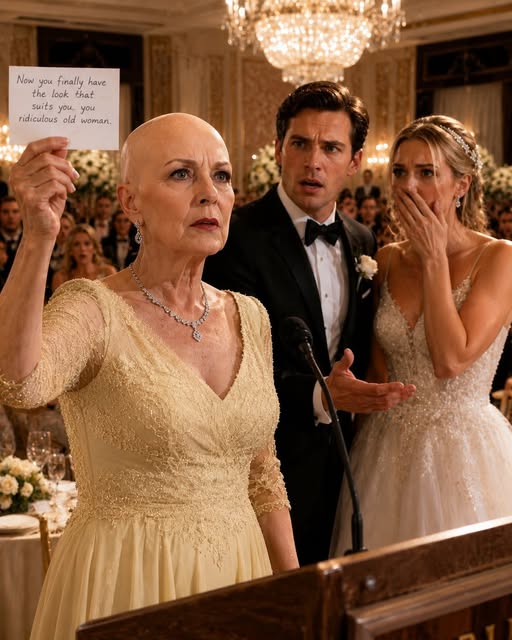
I woke up bald on my son’s wedding morning with a note from my future daughter-in-law telling me I finally looked the way an old woman should—only hours before I was supposed to transfer $120 million of our family inheritance to the bride and groom, and by the time the toast began, I was no longer the one about to be humiliated.
At sixty-eight, I believed I understood the difference between an uneasy feeling and a complete disaster.
Then I woke on Jackson’s wedding morning, reached for my silver hair, and touched nothing but smooth skin.
I ran barefoot toward the mirror.
My head had been shaved entirely while I slept.
A folded note sat on the nightstand.
I recognized Natalie’s handwriting immediately.
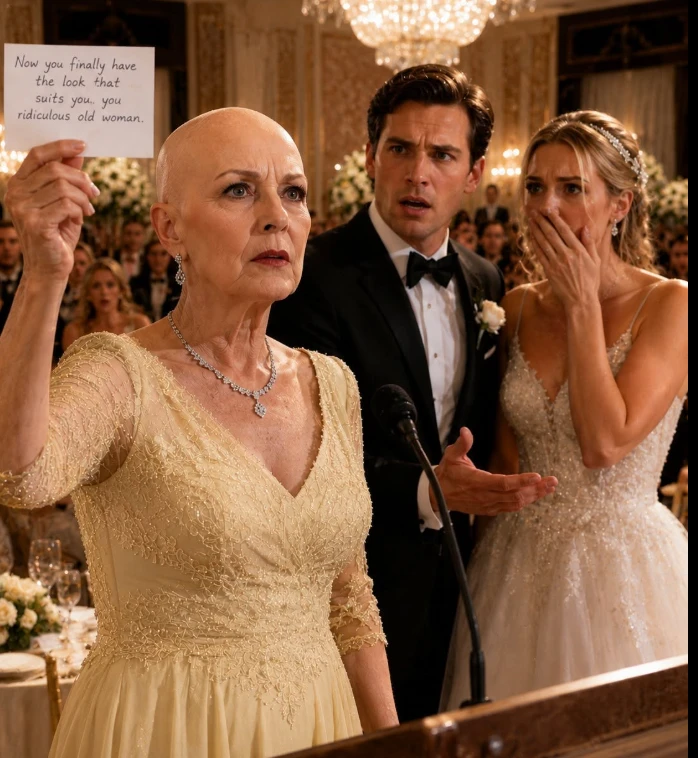
“Now you finally have the look that suits you, you ridiculous old woman.”
My hands started trembling.
Nobody attending the wedding knew what I had arranged for the following morning.
My late husband, Frank, and I had built our fortune from the ground up.
Before he died, we agreed that when Jackson married, I would give our son lasting financial security.
One hundred twenty million dollars.
The transfer was scheduled for the morning after the ceremony.
That made Natalie’s note feel less like a cruel joke and more like a revelation.
I had genuinely tried to love her.
After Frank died, Jackson buried himself in grief and work.
Then he met Natalie at a charity gala, and my son finally seemed alive again.
She was beautiful.
Polished.
Charming.
But small things unsettled me.
Her jokes about my age.
Her remarks about my clothing.
The way her smile disappeared whenever Jackson looked away.
Every conversation eventually returned to money, property, and the luxurious life they imagined once they moved far away from me.
During the wedding planning, she dismissed my grandmother’s pearls, removed Frank’s favorite dish from the menu, and mocked our traditional family venue for being outdated.
Anything connected to Jackson’s father or our family history seemed to offend her.
The truth became impossible to ignore at the rehearsal dinner.
From inside a restroom stall, I heard Natalie laughing with her bridesmaids.
One woman joked that at least I was paying for the wedding.
Natalie replied:
“There are one hundred twenty million reasons to tolerate her.”
Then she said that once the money arrived, everything would change.
According to her, Jackson had already agreed that they needed distance from me.
I should have confronted him immediately.
Instead, I promised myself I would wait until after the honeymoon.
By morning, that hesitation had become punishment.
After finding the note, I called Jackson.
Straight to voicemail.
I sent him a message explaining that something terrible had happened and that I needed him.
Natalie answered instead.
She told me not to bother him because he was preparing for his special day.
Then she suggested I stay home rather than appear at the wedding looking for sympathy.
I opened my closet.
My pale-blue mother-of-the-groom dress had been cut into strips.
My jewelry box was gone.
The security records showed that the alarm had been disarmed overnight.
My housekeeper confirmed that she had seen Natalie leaving my bedroom.
For several minutes, I sat on the edge of the bed, feeling every one of my sixty-eight years.
The mirror reflected someone exposed and humiliated.
Then something inside me shifted.
I had built a business.
I had buried the man I loved.
I had survived everything life had placed before me.
I would not allow a woman who confused kindness with weakness to erase me.
I called my sister, Judith.
Then I called my attorney.
Two hours later, Judith arrived carrying a silver wig, a navy dress, and enough strength for both of us.
At the Westbrook Hotel, I found Jackson dressed in his tuxedo and looking painfully similar to his father.
I told him exactly what Natalie had done.
His reaction shattered me.
He became angry with me.
Natalie appeared wearing white satin and sweetly asked what I had done to my hair.
When I said she already knew, Jackson accused me of trying to destroy his wedding.
That hurt more than losing my hair.
The ceremony passed in a blur.
During cocktail hour, I overheard Natalie telling guests that I was emotionally unstable and incapable of accepting another woman in Jackson’s life.
She said they might need to arrange professional care for me after the honeymoon.
She was no longer satisfied with humiliating me privately.
She was rewriting my identity in public before taking my son and my husband’s legacy.
That was when my restraint ended.
I stepped into a quiet hallway, called my financial adviser, and stopped the transfer.
When I returned, the chandeliers glowed above the ballroom.
May you like



The band played softly.
Natalie smiled as though every part of her plan had succeeded.
A young waiter approached me discreetly.
He had overheard her laughing about my shaved head and boasting that my money would belong to her by morning.
Then my adviser arrived.
The paperwork was complete.
The $120 million transfer had been canceled.
The maid of honor finished her speech, and the room turned toward me for the mother-of-the-groom toast.
Natalie gave me one final victorious smile.
I rose with her handwritten note inside my purse, steadied my hand, and walked toward the microphone.
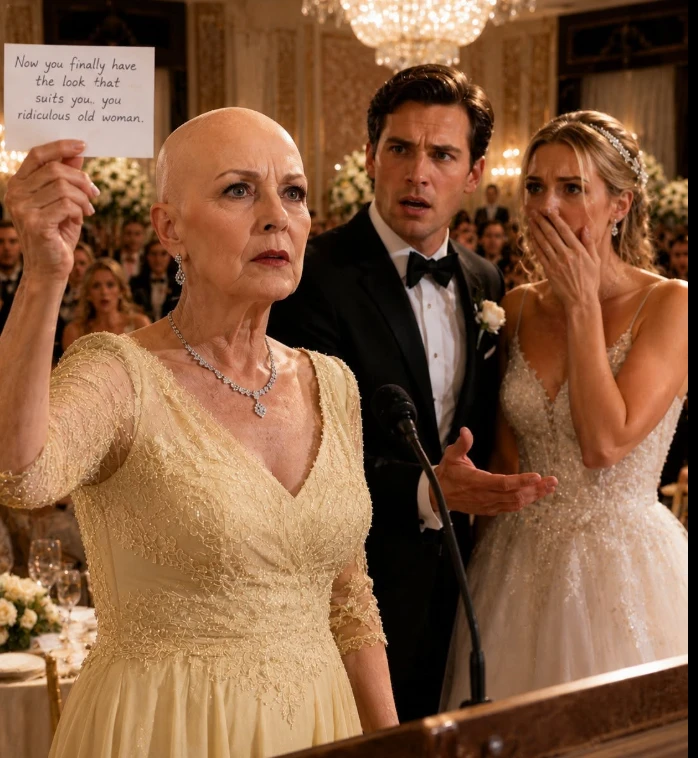
I placed both hands on the edge of the lectern and looked across the ballroom.
Nearly three hundred guests sat beneath the chandeliers, waiting for me to offer the usual words.
How beautiful the bride looked.
How proud Frank would have been.
How marriage required patience, kindness, and sacrifice.
Natalie lifted her champagne glass toward me.
Jackson stood beside her with one hand resting at the small of her back. He looked tense, but not frightened. He still believed I would protect him from embarrassment, just as I had protected him from nearly every consequence since the day he was born.
The band fell silent.
I leaned toward the microphone.
“When Jackson was six years old,” I began, “he cut a large section from the front of his hair because another boy at school told him it would grow back thicker.”
A ripple of laughter moved through the room.
Jackson’s expression softened slightly.
“He came into my bedroom wearing a baseball cap and refused to remove it. He thought I would be angry. Instead, his father and I spent twenty minutes trying not to laugh.”
More guests smiled.
Natalie relaxed.
She believed I had surrendered.
“Frank sat our son on the bathroom counter,” I continued, “finished the haircut properly, and told him something I have remembered for thirty-two years.”
I looked directly at Jackson.
“He said, ‘Hair grows back. Trust does not always do the same.’”
The smiles around the room faded.
Jackson’s hand dropped from Natalie’s back.
I reached up and removed the silver wig Judith had brought me.
A wave of gasps passed through the ballroom.
For one second, I wanted to cover my head.
The instinct was powerful.
Natalie had counted on it.
She had wanted me to feel exposed.
Instead, I set the wig carefully on the lectern and stood beneath the chandeliers with my shaved scalp fully visible.
“This was done to me last night while I was unconscious.”
The room became perfectly still.
Jackson looked at Natalie.
She did not look back at him.
I took the folded note from my purse.
“The person responsible was kind enough to leave a written explanation.”
I unfolded it.
“Now you finally have the look that suits you, you ridiculous old woman.”
Someone near the back whispered, “Oh my God.”
Natalie’s father lowered his champagne glass.
Her mother stared at her.
Jackson stepped toward me.
“Mom, stop.”
I looked at him.
“Stop what?”
“This isn’t the place.”
“No,” I agreed. “My bedroom would have been the appropriate place to discuss it. Unfortunately, when I called you from there this morning, you refused to answer.”
“I was getting married.”
“And I had been assaulted.”
His face tightened.
“You don’t know Natalie did this.”
“I saw her leave your room,” my housekeeper said.
Every head turned.
Mrs. Alvarez stood near the service entrance beside Judith and my attorney, Samuel Price.
She had worked in my home for fourteen years. She was not theatrical, emotional, or easily intimidated.
She looked directly at Natalie.
“You came downstairs at three-sixteen this morning,” she said. “You had Mrs. Hale’s jewelry case in one hand and an electric clipper in the other.”
Natalie’s complexion changed.
“That is a lie.”
Mrs. Alvarez did not raise her voice.
“The hallway camera recorded you.”
Jackson turned toward the ballroom entrance.
A projection screen had been lowered behind the band.
My attorney nodded to the hotel technician.
The first image appeared.
Natalie entering my house at 1:42 in the morning.
She wore a hooded coat over her rehearsal-dinner dress.
The next image showed her disarming the alarm.
The third showed her carrying a small black case upstairs.
The time stamp read 1:49.
At 3:16, she descended with my jewelry box and the clippers.
Nobody spoke.
Natalie stared at the screen.
Then she laughed.
It was a thin, brittle sound.
“You invited me into that house hundreds of times.”
“Not last night,” I said.
“You gave Jackson the alarm code.”
Jackson looked at her sharply.
“What?”
She realized too late that she had said too much.
I turned toward my son.
“Did you give her the code?”
His silence told me the truth.
“Jackson.”
“She said she needed your pearls.”
Natalie snapped her head toward him.
He continued quickly, as though speed might make his explanation sound reasonable.
“She told me you had promised she could wear Grandmother’s pearls today, but you had changed your mind because you wanted to punish her.”
“I never promised her those pearls.”
“I didn’t know that.”
“You never asked me.”
“You were already making everything difficult.”
The words left his mouth before he could stop them.
I studied my son’s face.
He was not sorry that Natalie had entered my home.
He was angry that the consequences had arrived during his reception.
“Where are the pearls now?” I asked.
Natalie folded her arms.
“I don’t know.”
My attorney spoke from beside the screen.
“They were recovered from the bride’s luggage twenty minutes ago.”
Her mother made a sound of disbelief.
Samuel continued.
“The hotel security director found Mrs. Hale’s jewelry box beneath clothing in a suitcase scheduled to be transported to the airport after this reception.”
Natalie turned toward him.
“You had no right to search my luggage.”
“The police obtained a warrant.”
A pair of uniformed officers stepped through the ballroom doors.
The guests nearest the entrance moved away instinctively.
Jackson looked at me as if I had brought armed soldiers into a church.
“You called the police on my wedding day?”
“I called them after discovering I had been drugged, assaulted, and robbed.”
His eyes widened.
“Drugged?”
The physician Judith had brought to my home had drawn blood before I left for the hotel.
Preliminary testing revealed a sedative in my system.
I had not taken one.
Mrs. Alvarez remembered Natalie insisting on making me tea after the rehearsal dinner.
She called it a peace offering.
I had drunk half the cup before becoming unusually tired.
I told the ballroom exactly that.
Natalie shook her head.
“This is insane.”
“The cup is being tested,” Samuel said.
“You cannot prove I put anything in it.”
“We will see.”
One of the officers moved closer.
Natalie stepped behind Jackson.
He looked from her to me.
For the first time that day, the anger on his face began to fracture.
“Did you give her something?”
“No.”
“Natalie.”
“She is doing this because she hates me.”
I almost felt sorry for how easily the words came to her.
She had practiced them for months.
Perhaps years.
Every accusation became jealousy.
Every boundary became cruelty.
Every question became evidence that I was unstable.
“Your future wife has spent the last several weeks telling people I am mentally deteriorating,” I said to Jackson.
“She was worried about you.”
“Was she?”
I nodded to Samuel.
He placed another document beneath the ballroom camera.
It appeared on the screen.
PETITION FOR TEMPORARY PROTECTIVE GUARDIANSHIP.
My full name was printed across the top.
Eleanor Franklin Hale.
Below it were claims that I had become forgetful, paranoid, financially impulsive, emotionally volatile, and potentially incapable of managing my affairs.
The document requested that control over my medical decisions and a portion of my assets be transferred temporarily to my closest living relative.
Jackson Hale.
The room erupted in whispers.
Jackson went pale.
Natalie seized his arm.
“That was only a precaution.”
I looked at my son.
“Your signature is on page seven.”
He stared at the screen.
“I didn’t know she had filed it.”
“That was not my question.”
He swallowed.
“Did you sign it?”
“She said it was an estate-planning document.”
Samuel displayed the signature page.
The title appeared in bold directly above Jackson’s name.
CONSENT TO SERVE AS GUARDIAN AND FIDUCIARY.
Jackson’s defense collapsed before he tried to make it.
“I didn’t read every page.”
“You signed a statement saying I was mentally impaired.”
“I trusted Natalie.”
“But not me.”
He looked at the floor.
That was when I understood the full shape of what had happened.
Natalie could not have done this without him.
Perhaps he had not known she intended to shave my head.
Perhaps he had not known she drugged my tea.
But he had given her my alarm code.
He had signed papers questioning my competence.
He had listened while she mocked me and chose silence because confrontation threatened the future he wanted.
He had not merely failed to protect me.
He had helped build the doorway through which she entered.
Natalie moved toward the microphone.
“This is ridiculous. Eleanor has been trying to break us apart since the engagement.”
Her voice trembled, but she forced it louder.
“She controls Jackson with money. She controls everyone with money.”
Several guests avoided her eyes.
Others watched with open fascination.
Natalie pointed at me.
“She offered us a fortune and then held it over our heads. Every dinner. Every decision. Every wedding detail. It always came back to what she was giving us.”
“That is not true,” Jackson said quietly.
Natalie turned on him.
“Don’t start pretending now.”
His face tightened.
“What does that mean?”
She laughed again.
“You knew the transfer was the reason we could finally live the way we deserved.”
“I knew Mom wanted to help us.”
“She was buying access to our marriage.”
“No,” I said. “I was trying to honor a promise to my husband.”
Natalie faced me.
“You think being old makes you sacred. It doesn’t.”
Judith took one step forward, but I lifted my hand.
I did not need my sister to fight this battle.
Natalie continued.
“You had your life. Your marriage. Your business. Your houses. You should have handed everything over gracefully instead of forcing Jackson to keep asking permission like a child.”
“Did he tell you he felt that way?”
“He didn’t have to.”
Jackson stared at her.
She was no longer pretending for him.
That mask had slipped.
“Once the transfer cleared,” she said, “we would have been free.”
“Free from what?” I asked.
“From you.”
The ballroom doors remained open behind the police officers.
Beyond them, hotel staff stood frozen in the corridor.
I took a slow breath.
“Then I have good news.”
Natalie’s eyes narrowed.
“You are free.”
I looked toward my financial adviser.
Mr. Collins approached carrying a slim folder.
“The transfer scheduled for tomorrow morning has been canceled,” he said.
No one moved.
Natalie’s expression emptied.
“What?”
“The one hundred twenty million dollars will not be transferred to Jackson or to any marital account.”
Jackson stared at me.
“Mom.”
Natalie stepped toward Mr. Collins.
“You can’t cancel it.”
He looked at her calmly.
“It was Mrs. Hale’s money. She could cancel it at any time before execution.”
“You signed an agreement.”
“No,” I said. “I signed a revocable letter of intent.”
She turned toward Jackson.
“You told me it was guaranteed.”
He looked dazed.
“My father designed the arrangement carefully,” I continued. “The money was never intended to reward a wedding ceremony. It was intended to support a stable marriage.”
Natalie’s face twisted.
“You planned this.”
“Frank did.”
My late husband understood wealth too well to release it without protection.
The gift would have gone into a family trust rather than directly into Jackson’s bank account.
For the first five years, neither spouse could withdraw principal without independent trustee approval.
If the marriage ended because of documented abuse, fraud, infidelity, coercion, or criminal conduct, the unspent assets would return to the Hale estate.
Natalie had apparently never seen the trust documents.
Jackson had received them.
He simply had not read those either.
“What happens to the money now?” a voice asked from one of the tables.
I looked toward the guests.
“Nothing tonight.”
Then I turned back to Jackson.
“My son has spent months discussing one hundred twenty million dollars as though it were already his. I think he needs time to discover who he is without it.”
His eyes filled.
“You’re cutting me off.”
“No.”
“I am removing the reward you expected for marrying someone who abused me.”
Natalie grabbed his arm.
“Tell her she cannot do this.”
He pulled away.
She stared at him.
“Jackson.”
“You shaved my mother’s head.”
“She was humiliating me.”
“She was asleep.”
“She was trying to ruin our wedding.”
“You drugged her.”
“You don’t know that.”
“You stole her jewelry.”
“I was borrowing it.”
He looked at her as though he had never seen her clearly before.
Maybe he had not.
Maybe he had spent two years looking only at the version of Natalie who reflected what he wanted to believe about himself.
Successful.
Independent.
Finally beyond his mother’s influence.
The truth was that he had exchanged one form of dependence for another.
The officers approached.
One of them spoke quietly to Natalie.
“You need to come with us.”
Her mother stood.
“On what charge?”
“At this time, burglary and theft. Additional charges may follow pending laboratory results.”
Natalie’s father closed his eyes.
The maid of honor began crying.
Natalie did not move.
She looked at Jackson.
“Do something.”
He remained beside the table.
“You told me she cut her own dress.”
“I thought she would stay home.”
“You said she was becoming unstable.”
“She is.”
The desperation in Natalie’s voice sharpened.
“Look at her. What normal mother does this during her son’s wedding?”
I put the wig back on the lectern but did not wear it.
“A normal mother might have remained silent.”
I met Jackson’s eyes.
“I have done that too often.”
The officers took Natalie by the arms.
She resisted only when they reached the ballroom doors.
Then she turned toward me.
“You think you won?”
“No.”
My voice was calm.
“My son married a woman who hated me, helped her build a case to take control of my life, and chose to believe I was lying when I told him I had been attacked.”
I looked at Jackson.
“Nobody won.”
Natalie was led away beneath the same chandeliers she had chosen for her perfect reception.
The ballroom remained silent after the doors closed.
Jackson stood alone beside the wedding cake.
His bride’s champagne glass still waited beside his.
The flowers were still white.
The candles still burned.
Every elegant detail remained in place, but the fantasy had collapsed around him.
I picked up the silver wig.
“My toast is finished.”
Then I walked away from the microphone.
Jackson followed me into the hallway.
“Mom.”
I kept moving.
“Mom, wait.”
Judith and Samuel were several steps behind us.
I stopped near a tall window overlooking the hotel courtyard.
Jackson’s eyes were red.
“You knew before the ceremony that you were canceling the money.”
“Yes.”
“Why did you let me marry her?”
The question stunned me.
“You are thirty-eight years old.”
“You could have stopped this.”
“I tried to tell you what she had done.”
“You should have shown me the footage.”
“I did not receive it until after the ceremony.”
“But you suspected her.”
“Yes.”
“Then why didn’t you force me to listen?”
Something inside me became very tired.
“Because you are not six years old anymore.”
He looked away.
“I loved her.”
“I know.”
“She manipulated me.”
“She did.”
His eyes returned to mine.
“Then why are you treating me like I’m as guilty as she is?”
“Because she could not have entered my home without your code.”
He flinched.
“She could not have filed the guardianship petition without your signature.”
“I did not understand it.”
“You did not want to understand.”
“That isn’t fair.”
“No?”
I stepped closer.
“You watched her belittle me for two years. You watched her remove every tradition connected to your father because she called them outdated. You heard her describe me as controlling whenever I expressed an opinion. Every time I tried to discuss it, you accused me of jealousy.”
“I was trying to protect my relationship.”
“By sacrificing ours.”
He shook his head.
“I never wanted you hurt.”
“You simply accepted the possibility.”
That sentence struck him.
He leaned against the window ledge.
“I thought you were stronger than she was.”
The confession was almost childish.
“You always survive everything.”
I stared at him.
My husband’s death.
The recession that nearly destroyed our first company.
The surgery that removed part of my lung.
Years of negotiations with men who assumed a woman could be intimidated into selling.
Jackson had watched me survive all of it.
Somewhere along the way, my strength had become his excuse not to protect me.
“You believed I could endure whatever she did,” I said.
He covered his face.
“I’m sorry.”
I did not answer.
Not because I wanted to punish him.
Because an apology offered in the first moments after exposure is often fear wearing the clothes of remorse.
I needed to know which one stood before me.
The police investigation answered questions I had not known to ask.
The sedative in my blood matched tablets found in Natalie’s bridal suite.
A second bottle was discovered inside her luggage with the prescription label removed.
The electric clippers carried strands of my hair.
My grandmother’s pearls, two diamond bracelets, and a sapphire ring Frank had given me on our fortieth anniversary were hidden inside a shoe box beneath her honeymoon clothing.
But those crimes were only the surface.
Detectives found copies of my bank statements, trust documents, medical records, and property deeds on Natalie’s laptop.
She had created a folder titled TRANSITION.
Inside was a timeline.
Wedding.
Inheritance transfer.
Honeymoon.
Guardianship filing.
Medical evaluation.
Property consolidation.
Assisted-living placement.
The final entry was scheduled six weeks after the wedding.
Move Eleanor permanently.
The facility listed beside my name was in Arizona.
I had never visited it.
It specialized in memory care.
Natalie had already paid a deposit.
When detectives interviewed the facility administrator, she produced an application signed by Jackson.
He came to my house the next morning.
I met him in Frank’s study.
For the first time since childhood, Jackson looked frightened to sit in his father’s chair.
He placed the facility application on the desk.
“I signed this.”
“I know.”
“Natalie said it was for her grandmother.”
“My name is printed on every page.”
“She covered the top section.”
I looked at him.
He swallowed.
“I know how that sounds.”
“It sounds like you signed another document without reading it.”
“I trusted my wife.”
“You trusted her with my life.”
He sank into the chair opposite me.
“What are you going to do?”
“About what?”
“The police. The guardianship investigation. They said I may have committed fraud.”
“Did you knowingly lie about my health?”
He looked toward the fireplace.
“Natalie said we needed evidence that you were becoming confused.”
“Did you provide any?”
He hesitated.
That was enough.
“What did you tell them?”
He rubbed both hands over his face.
“I said you repeated questions.”
“I do not.”
“I know.”
“What else?”
“That you forgot appointments.”
“I run a company with nine thousand employees.”
“I know.”
“What else, Jackson?”
His voice became barely audible.
“That you became aggressive when challenged.”
I stared at him.
He had helped manufacture the person Natalie wanted the world to see.
An unstable old woman.
Difficult.
Confused.
Unsafe.
A woman whose testimony could be dismissed after her money and freedom had been taken.
“Why?”
He started crying.
“I thought it was temporary.”
“That does not answer me.”
“She said if I controlled the trust for a few months, we could restructure everything before you changed your mind.”
“The money was not yours to restructure.”
“She made it sound like you were going to punish us forever.”
“Did I ever threaten to cancel the gift before today?”
“No.”
“Did I ever refuse to help you?”
“No.”
“Did I ever ask you to choose between your wife and me?”
“No.”
“Then what exactly were you protecting yourself from?”
He looked at me.
“Feeling like I still needed you.”
The truth was ugly.
But it was finally honest.
Jackson had spent his life surrounded by wealth he had not created.
Frank and I paid for his education.
We funded his first business.
We purchased his first apartment.
When that business failed, we paid the debts quietly so investors would not pursue him.
Jackson had mistaken rescue for humiliation because accepting help required him to acknowledge that he had not built his life alone.
Natalie recognized that wound and fed it.
She told him he deserved control.
She told him the inheritance would prove he was finally independent.
She convinced him that taking my money while removing me from his life was freedom.
“You could have said no to the gift,” I told him.
He gave a broken laugh.
“I didn’t want to.”
“No.”
“You wanted the money without the discomfort of loving the person who gave it.”
He closed his eyes.
The district attorney eventually offered Jackson a choice.
He could be charged as Natalie’s co-conspirator, or he could cooperate fully, surrender every document, testify truthfully, and accept responsibility for making false statements in the guardianship petition.
He chose cooperation.
For once, I did not guide him.
I did not hire the attorney.
I did not pay his legal fees.
I did not speak to prosecutors on his behalf.
Jackson sold his apartment to cover the cost of his defense.
He took leave from the consulting company where he worked.
When reporters waited outside his building, he experienced for the first time what it felt like to face humiliation without his parents standing between him and the world.
Natalie’s history emerged slowly.
Her legal name had once been Natalie Pierce.
At twenty-six, she worked for a private elder-care management company in Florida.
A civil complaint accused her of pressuring an eighty-one-year-old widow to change financial beneficiaries and grant Natalie access to her accounts.
The case was settled confidentially.
The widow died before trial.
Three years later, Natalie became engaged to the son of a wealthy real-estate developer in Boston.
That engagement ended after the man’s father discovered she had ordered credit reports on the entire family.
She left Massachusetts, changed her surname to her mother’s maiden name, and moved to Chicago.
Then she attended the charity gala where she met Jackson.
She did not select him by accident.
She had researched our family before introducing herself.
Photographs recovered from her cloud account showed Jackson standing across the ballroom that night, unaware that Natalie had already downloaded articles about Frank’s death, our estimated fortune, and my only son.
The discovery destroyed Jackson more completely than the arrest.
He had believed their meeting was fate.
To Natalie, it had been strategy.
Her trial began ten months after the wedding.
She rejected every plea offer.
She insisted I had fabricated the allegations because I could not tolerate losing control over my son.
Then the prosecutor displayed the TRANSITION folder.
The jury saw the Arizona facility application.
They saw my stolen medical records.
They heard audio Natalie had secretly recorded while coaching Jackson to describe me as confused.
In one recording, he said, “My mother will never agree to assisted living.”
Natalie replied, “She won’t have to agree once we control the doctors.”
The final evidence came from the young waiter who had approached me during the reception.
His name was Eli Mercer.
While clearing glasses near the bridal suite, he had heard Natalie laughing with her maid of honor.
He recorded part of the conversation because he believed they were discussing a crime.
Natalie’s voice filled the courtroom.
“By tomorrow morning, the money moves. Six weeks after that, the old woman moves. Jackson will cry for a month and then realize I gave him his life back.”
Her maid of honor asked, “What if Eleanor fights?”
Natalie laughed.
“With what? She’ll be bald, drugged, and telling everyone her daughter-in-law attacked her. We already have Jackson saying she’s unstable.”
The jury convicted Natalie of burglary, aggravated assault, administering a controlled substance, theft, attempted exploitation of a vulnerable adult, forgery, and conspiracy.
She received fifteen years in prison.
At sentencing, she finally looked at Jackson.
“You ruined everything,” she told him.
He did not answer.
For once, he understood that responding would only allow her to place the weight of her choices onto someone else.
The marriage was annulled.
There had been no honeymoon.
No inheritance.
No new house.
The white satin dress remained locked inside an evidence room long after the flowers from the reception had died.
My hair began growing back before the trial ended.
At first it appeared as a soft gray shadow.
Then short silver strands.
Judith wanted me to purchase more wigs.
I refused.
For months, I attended meetings, charity events, and court hearings with my head uncovered.
People stared.
Some looked away quickly.
Others told me I was brave.
I did not feel brave.
I simply refused to carry Natalie’s shame for her.
The canceled money remained inside the Hale Family Trust.
I changed the terms.
Jackson would not receive one hundred twenty million dollars for marrying.
No future spouse would be treated as a condition of inheritance.
Instead, the trust would release smaller amounts based on work, service, and demonstrated financial responsibility.
Most of the original gift funded the Frank and Eleanor Hale Center for Independent Aging.
The organization provided legal assistance to older adults facing fraudulent guardianships, coercive care placements, family exploitation, and financial abuse.
Eli received a scholarship from the foundation.
Mrs. Alvarez became a paid adviser on household employee reporting protections.
The navy dress Judith brought me that morning was placed in the foundation’s first office behind a glass case.
Not because it was beautiful.
Because it reminded me that dignity is sometimes nothing more complicated than getting dressed and walking into the room where people expected you to hide.
Jackson and I did not speak for nearly six months after Natalie’s conviction.
He wrote letters.
I read them.
I did not answer.
The first letters explained.
The next apologized.
The later ones stopped asking me to forgive him.
That was when I began believing he might finally understand.
He moved into a small apartment outside Milwaukee and accepted a position managing logistics for a nonprofit housing organization.
The salary was modest.
His last name opened no doors there.
His colleagues did not know about the inheritance until a reporter found him months later.
He remained.
A year after the wedding, Jackson came to the Hale Center’s opening ceremony.
He stood at the back.
My hair had grown into a short silver crop by then.
During my speech, I saw him watching me with an expression I could not immediately name.
Not pride.
Not grief.
Perhaps humility.
Afterward, he waited until the room emptied.
“You look like Dad,” he said.
I touched my hair.
“He had more.”
Jackson smiled faintly.
Then the smile disappeared.
“I used to think you never needed anyone.”
“I needed your father.”
“I know.”
“I needed you too.”
His face tightened.
“I failed.”
“Yes.”
I did not soften the word.
He nodded.
“I signed papers that could have taken your freedom.”
“Yes.”
“I gave her access to your home.”
“Yes.”
“I believed her because her version of you made it easier to take your money.”
The honesty hurt.
But it was clean.
“I’m sorry,” he said.
“I know.”
“Will we ever be all right?”
I looked at my son.
The boy Frank had taught to remove a ruined haircut without shame.
The man who later watched another person use humiliation as a weapon against his mother.
“I don’t know what all right means anymore.”
He accepted that.
“But we can begin with truthful,” I said.
Tears filled his eyes.
“All right.”
He visited once a month after that.
Then twice.
We did not discuss the trust.
He never asked.
That mattered.
Three years later, Jackson married again.
Her name was Danielle.
She taught high-school chemistry and drove a twelve-year-old car.
The first time we met, she asked about Frank’s favorite dish because Jackson wanted it served at the wedding.
She did not call my traditions outdated.
She did not praise my jewelry.
She did not ask what Jackson would inherit.
Six weeks before the ceremony, he came to my house carrying a folder.
For one terrible second, the sight of wedding documents made my chest tighten.
He placed them on the table.
“A prenuptial agreement,” he said.
“That is your business.”
“I want you to read one section.”
I opened the folder.
The clause stated that neither spouse would claim any right to my assets, trusts, businesses, or future gifts.
Danielle had already signed it.
“You did not have to do this.”
“I know.”
“Did she ask you to?”
“No. I did.”
He sat across from me.
“I wanted to prove something.”
“To me?”
“To myself.”
I closed the folder.
“You cannot build a marriage around proving you are different from who you used to be.”
His expression fell slightly.
“But you can build one around making different choices.”
He nodded.
On his second wedding morning, I woke naturally.
No sedative.
No missing jewelry.
No note.
My silver hair had grown to my shoulders.
Judith helped me pin it back with Grandmother’s pearls.
Before leaving for the ceremony, I stood in front of the same bedroom mirror where I had once found my head shaved.
For years, I believed that had been the moment Natalie humiliated me.
It was not.
Humiliation requires the victim to accept the meaning chosen by the person causing it.
Natalie wanted my bald head to mean I was old, powerless, ridiculous, and easy to erase.
Instead, it became the face printed beside every article about the foundation that later protected thousands of older people.
The photograph she intended as proof of my weakness became a symbol of survival.
At the ceremony, Jackson waited for me near the entrance.
“You came,” he said.
“I said I would.”
He looked nervous.
Not because of the money.
There was none scheduled for the following morning.
He was nervous because marriage mattered to him now in a way the performance had not before.
“I want to ask you something,” he said.
“What?”
“Will you walk with me?”
Traditionally, the groom entered alone.
But Jackson looked toward the aisle, then back at me.
“Dad should be here.”
“Yes.”
“He isn’t.”
“No.”
“I thought maybe we could walk in together.”
My throat tightened.
This was not forgiveness.
Forgiveness is too large to fit inside a single gesture.
It was one step.
Then another.
We entered the chapel side by side.
No one stared at my hair.
No one whispered about an inheritance.
Frank’s favorite dish was served at dinner.
During the reception, Jackson rose to give a toast.
He looked toward Danielle first.
Then toward me.
“My father once told me hair grows back, but trust does not always do the same.”
I felt Judith reach for my hand.
Jackson continued.
“He was right. What he did not tell me was that trust can sometimes return very slowly if the person who broke it stops demanding that the wound heal on their schedule.”
The room became quiet.
“My mother taught me that part.”
He lifted his glass.
“To the people who tell us the truth after we have made it difficult to love us.”
I did not cry.
Not then.
Later, alone in the hotel corridor, I allowed myself a few tears.
The first wedding had almost cost me my freedom.
The second did not erase that.
Nothing could.
But it proved that consequence and love were not opposites.
I could hold Jackson accountable and still hope he became better.
I could refuse him money and still offer him a place beside me.
I could remember what he had done without allowing that memory to decide every future moment.
The original one hundred twenty million dollars was never transferred to my son.
By the time I turned seventy-five, the Hale Center had opened offices in eleven states.
Its attorneys overturned fraudulent guardianships, recovered stolen homes, stopped forced institutional placements, and returned millions of dollars to families targeted by people who believed age made someone easy to control.
A copy of Natalie’s handwritten note remained sealed inside the organization’s archive.
I never displayed it.
Her cruelty did not deserve a frame.
But I remembered every word.
Now you finally have the look that suits you, you ridiculous old woman.
She had mistaken age for defeat.
She believed the lines on my face meant I was too tired to fight.
She believed motherhood would make me protect my son from consequences.
She believed wealth was meaningful only when it could be taken, spent, and used to control others.
She was wrong about all of it.
I did not stop the transfer because I wanted revenge.
I stopped it because money given without judgment becomes a weapon in the hands of people who mistake entitlement for love.
I did not expose Natalie because I feared losing Jackson.
I exposed her because saving a son does not always mean preserving the life he has chosen.
Sometimes it means allowing that life to collapse before it buries everyone beneath it.
And I did not remove my wig in front of three hundred wedding guests because I wanted their pity.
I removed it because Natalie had already begun telling the world who I was.
Unstable.
Jealous.
Old.
Pathetic.
Disposable.
I decided they would hear from me before her lie became my identity.
On the morning of my son’s first wedding, I woke believing my dignity had been shaved away while I slept.
By nightfall, I understood that dignity had never been in my hair.
It was in the phone call that stopped the money.
The evidence I carried into the ballroom.
The truth I spoke when silence would have been more comfortable.
And the decision to walk away from the microphone without apologizing for what everyone had been forced to see.
Natalie had wanted me exposed.
She succeeded.
Everyone saw me.
They saw my bald head.
They saw my age.
They saw my grief.
They saw the pain on my face when my son chose disbelief.
But they also saw what Natalie had failed to understand.
An old woman who has survived love, loss, business, motherhood, and betrayal is not a weak young woman with more years behind her.
She is every version of herself that has survived long enough to stand in the same room.
By the time the toast began, Natalie believed I was the only person about to be humiliated.
Then I took off the wig.
Opened her note.
Canceled the inheritance.
And allowed the truth to introduce her instead.