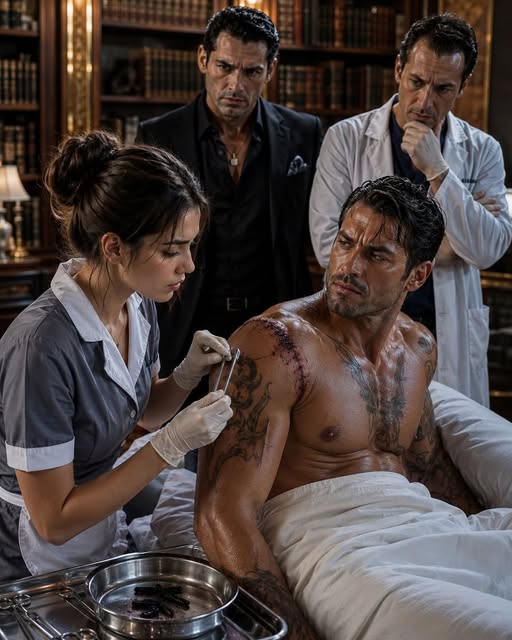
“Twenty surgeons, endless treatments, and millions of dollars couldn’t stop New York’s most feared crime boss from slipping closer to death—until I, a twenty-two-year-old housemaid, noticed something hidden inside his failing shoulder.
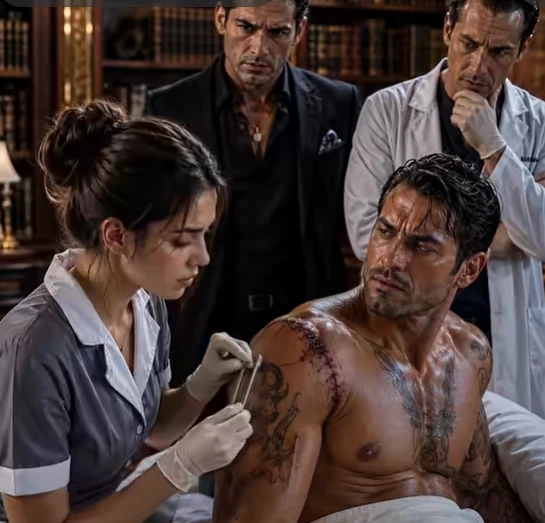
When Vincent Moretti ordered his men to hand me the surgical scissors, every person in that room went silent as I prepared to remove what his own doctor insisted belonged there.
Six months earlier, I had started cleaning the Moretti estate for barely enough money to cover the medical bills my mother had left behind.
I learned quickly that being invisible was useful.
I cleaned floors, carried medical waste, and kept my eyes down whenever Vincent’s associates gathered behind closed doors.
But I still felt his presence even when I didn’t look at him.
Vincent Moretti was not a man you ignored. Even weakened, even half-delirious with fever, he filled every room like a storm waiting to break.
Then, four weeks before that night, Vincent was injured during an attack on his car.
The wound passed through his left shoulder without damaging bone or a major artery. According to his doctors, he should have recovered.
Instead, he got worse.
The tissue around the surgical incision began deteriorating. His fever climbed. Treatment after treatment failed.
And yet, every time I passed his room, I found myself slowing down.
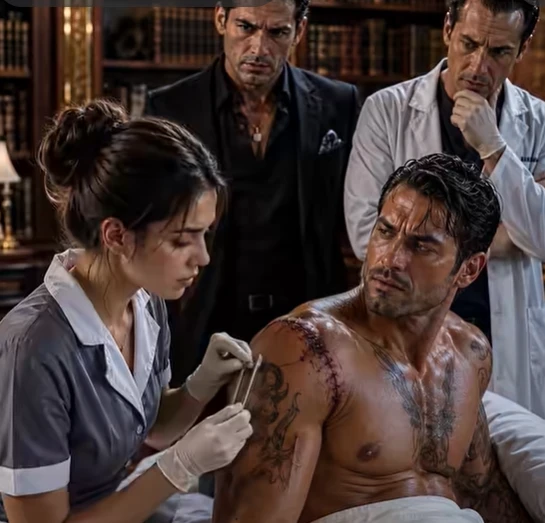
That night, I entered the library, which had been converted into a private medical room, carrying a disposal bag.
Vincent’s temperature had reached 104.
Dr. Malcolm Hayes stood beside his bed, insisting there was only one option left.
“The arm has to come off.”
Vincent’s second-in-command, Luca, stared at him coldly.
“You remove his arm, Doctor, and you’d better be absolutely certain you were right.”
Hayes stiffened.
He had already tried strong antibiotics and repeated procedures to clean the wound. Nothing worked.
As I approached the bed, an unfamiliar smell stopped me.
Burnt almonds.
Chemical dye.
I knew that smell.
My mother had worked in a garment factory for forty years. Some evenings, she came home carrying that exact odor after handling chemically treated industrial fibers.
Dr. Hayes removed Vincent’s bandages.
That was when I saw them.
Black stitches were buried deep inside his shoulder.
They were unusually thick and braided, with dark fluid seeping from the fibers.
“Those stitches are wrong,” I whispered.
Silence swallowed the room.
Hayes slowly turned toward me.
“Excuse me?”
“That isn’t normal surgical thread.”
Luca’s hand moved toward the weapon beneath his jacket.
Hayes gave a mocking laugh. “She cleans this house. I’m a trauma surgeon.”
His arrogance should have intimidated me.
It didn’t.
“I know thread,” I said. “And whatever that is, it’s releasing something into his wound.”
Hayes stepped toward me. “Get her out.”
Then Vincent opened his eyes.
And for a second, they locked directly onto mine.
“Give her the scissors.”
Hayes froze.
“Mr. Moretti, cutting those sutures could cause severe bleeding.”
Vincent’s bloodshot gaze remained fixed on me.
“Give. Her. The scissors.”
Luca handed them over.
The instant the metal touched my palm, my fear sharpened into focus.
I wasn’t pretending to be a doctor.
But my mother had taught me fibers, tension, knots, and how different materials reacted under pressure.
Still, I felt Vincent watching me—not like a patient, but like he was memorizing me.
I gripped the first black knot with surgical tweezers.
Snip.
The braided cord slipped free.
The dark fluid surrounding it stopped spreading, replaced by clean red blood.
I removed another.
Then another.
By the time I finished, six black stitches lay in a stainless-steel basin.
My hands were stained, and the weight of what I had done suddenly hit me.
If I was wrong, I had just made a fatal mistake in front of some of the most dangerous men in New York.
“She’s made it worse!” Hayes shouted, rushing forward.
Luca immediately blocked him.
“Don’t touch him.”
Nobody moved.
One minute passed.
Then another.
The heart monitor changed.
Vincent’s racing pulse began slowing.
His breathing became deeper.
The harsh sound that had filled his lungs gradually eased.
Even the bitter chemical smell around his shoulder started fading.
Dr. Hayes stared at the monitor.
“That’s impossible.”
Vincent Moretti was stabilizing.
Luca turned toward the doctor, his expression suddenly colder.
“Looks pretty possible from here.”
May you like


Relief rushed through me so fast that I had to steady myself against the table.
But I felt something else too.
Vincent was still holding my wrist.
Not tightly enough to hurt me—but enough that he hadn’t let go.
His thumb moved slightly against my skin, as if testing whether I was real.
Then his hand closed more firmly.
And something in my chest tightened in response.
“Lock the estate,” he whispered.
Luca frowned. “Boss?”
Vincent’s grip tightened.
“Nobody leaves.”
Then he looked directly at me, and whatever relief I felt vanished.
“Because those stitches weren’t a medical mistake,” he said. “Someone put them inside me knowing exactly what they would do.”
His eyes lingered on me a second longer than necessary.
As if he was trying to decide whether I was part of the threat… or the only reason he was still alive.
And for the first time, I realized I wasn’t just afraid of Vincent Moretti.
I was aware of him.
“Stay,” he said quietly, still holding my wrist.
It wasn’t an order this time.
It almost sounded like something else he didn’t know how to say.
Something that made the room feel even more dangerous than before.
“Stay.”
For a second, I thought Vincent Moretti was giving me another order.
Then I looked at his hand around my wrist.
The grip was weak.
His skin was burning.
His eyes, normally sharp enough to make grown men lose their train of thought, were glassy with fever.
And the word sounded different.
Not You belong here.
More like:
Don’t disappear before someone explains why I’m still alive.
I looked down at the stainless-steel basin.
Six lengths of thick black braided material lay inside it, slick with blood and dark drainage.
They looked wrong even now.
Too coarse.
Too shiny.
Nothing like the fine medical sutures I had seen discarded in that room during the last four weeks.
Dr. Malcolm Hayes pointed at me.
“She has contaminated an open surgical wound.”
Luca’s shoulders tightened.
Vincent released my wrist.
“Then fix it.”
Hayes froze.
Vincent’s voice was barely above a whisper.
“You’re the surgeon.”
That shut the room down.
Hayes stepped forward.
“I need him sedated immediately.”
“No.”
The word came from me.
Everyone looked at me.
My stomach dropped.
I had apparently forgotten who I was speaking around.
Hayes almost smiled.
“You have done enough.”
“I’m not saying don’t treat him.”
I swallowed.
“I’m saying don’t throw those away.”
I pointed at the black fibers.
“Bag them.”
Hayes stared at me.
“Why?”
“Because if those stitches weren’t supposed to be there, somebody should find out what they are before they disappear.”
Luca’s eyes shifted toward Hayes.
That was the first moment I saw fear in the doctor.
Very small.
But real.
Luca noticed too.
He picked up a sealed specimen container from the supply cart.
Hayes reached toward him.
“Those are contaminated biological materials.”
Luca looked at his hand.
Then at Hayes.
“Exactly.”
He placed the black strands inside.
Vincent’s stabilization lasted less than ten minutes.
The slower pulse did not mean he was cured.
His fever remained dangerously high.
The tissue around his shoulder still looked terrible.
He was dehydrated, septic enough that even I understood the monitors were not celebrating anything.
Removing those fibers had changed something.
It had not solved everything.
Dr. Hayes tried to resume control.
“We need to take him back to surgery.”
Vincent looked at Luca.
“Not with him.”
Hayes went pale.
“Vincent.”
“I said not with you.”
“You’re delirious.”
“Then you should have no difficulty convincing another doctor.”
Luca pulled out his phone.
“Who?”
Vincent shut his eyes.
“Shah.”
Hayes immediately objected.
“Priya Shah doesn’t operate privately.”
Vincent opened one eye.
“She will tonight.”
He was wrong.
Dr. Priya Shah did not come to the estate.
She demanded Vincent be moved to St. Catherine’s Medical Center, where she had an operating room, blood bank, imaging, infectious-disease support, and what she described over the phone as “equipment designed for actual medicine instead of rich-man theater.”
I liked her before I met her.
Twenty-eight minutes later, Vincent Moretti left his estate in an ambulance.
No armored convoy.
No dramatic gunmen hanging from SUVs.
One ambulance.
Two security vehicles.
Luca.
And, inexplicably, me.
I had tried to leave.
Luca stopped me at the front entrance.
“Boss said stay.”
I looked at him.
“I am not one of his employees tonight.”
“You are literally one of his employees.”
“Then I quit.”
That almost made him smile.
“Look.”
He lowered his voice.
“Dr. Shah wants to know exactly what you saw.”
“That I can explain.”
“At the hospital?”
“I don’t have to ride with him.”
“No.”
Luca nodded.
“You don’t.”
The answer surprised me.
He stepped aside.
“If you want to go home, I’ll have a car take you.”
No threat.
No hand around my arm.
No reminder of who Vincent was.
I looked through the glass doors toward the ambulance.
Then at the specimen container in Luca’s hand.
My mother’s voice lived in my memory.
Thread tells you what happened if you look at the ends.
She had taught me that when I was twelve.
She could take a torn seam between her fingers and tell whether it failed from tension, heat, age, or cheap manufacturing.
Forty years in a garment factory had given her that skill.
Lung disease had taken everything else.
I looked back at Luca.
“I’ll go to the hospital.”
“Your choice.”
“Yes.”
It was.
I needed that distinction more than I understood then.
Dr. Priya Shah was forty-six, five foot three, and apparently incapable of being intimidated by Italian surnames.
She examined the specimen before examining me.
“These came out of the wound?”
“Yes.”
“All six?”
“Yes.”
“Were you present when the original wound was closed?”
“No.”
“Any later procedures?”
“No.”
“Then do not tell anyone these were surgical sutures yet.”
I stared.
“But—”
“They may have been.”
She looked at me.
“They may also have been packing material, retained foreign fibers, later-added closure material, or something else.”
She sealed the container again.
“We identify before naming.”
I nodded.
Medicine, I was learning, hated dramatic certainty.
Good.
Then she asked me to demonstrate how I had removed them.
Not on Vincent.
On a folded towel.
Where had I held the knot?
How much resistance?
Did anything break?
Had the material stretched?
Was there bleeding before removal?
After?
I answered everything.
Then she said:
“You got lucky.”
My stomach dropped.
“I hurt him?”
“No.”
“You removed superficially accessible foreign material without causing a major bleed.”
Her expression hardened.
“But do not ever do that again.”
“I wasn’t planning to.”
“Good.”
She looked toward the operating-room doors.
“Whatever you removed was not the only problem.”
Vincent underwent surgery forty minutes later.
Dr. Shah reopened the wound.
Removed additional abnormal material.
Excised dead tissue.
Collected deep cultures.
Irrigated.
Inspected the shoulder.
No major vessel injury.
No bone infection visible at that stage.
No reason to amputate the arm that night.
Dr. Hayes’s recommendation suddenly looked less inevitable.
Not automatically sinister.
Just wrong enough to examine.
I waited with Luca.
The entire night.
At four in the morning, he handed me terrible vending-machine coffee.
“You knew the smell.”
“Yes.”
“From sewing?”
“Factory finishing.”
“What chemical?”
“I don’t know.”
He stared.
“But you said—”
“I said I recognized the smell.”
“Not the chemical.”
He thought.
Then nodded.
“Good.”
Apparently everyone around Vincent had learned the danger of pretending to know more than they did.
Or they were learning fast.
My name was Elena Reyes.
Twenty-two.
Housemaid.
College dropout.
Daughter of Marisol Reyes, who had spent four decades sewing uniforms, industrial aprons, work jackets, upholstery covers, and whatever else the factory contract demanded.
When my mother became sick, I left community college to help.
When she died, I had:
$412 in checking.
A car with a transmission that screamed.
And nearly seventy thousand dollars in debt because I had personally taken loans and used credit cards during the final two years of her care.
No one forced me.
No law made me inherit all her medical bills.
I had borrowed because each new treatment sounded like the treatment we would regret not trying.
Then she died anyway.
Six months later, I was cleaning Moretti marble for nineteen dollars an hour.
Life rarely cares whether the numbers feel narratively fair.
At 5:18 a.m., Dr. Shah came out.
Luca stood.
I did too.
“He’s stable.”
My knees nearly weakened.
She continued.
“He is still seriously ill.”
Of course.
“Blood pressure responded to fluids.”
“Fever is down slightly.”
“We removed several additional fragments of braided material.”
“Deep tissue looked inflamed around them.”
“Cultures are pending.”
Luca asked:
“Poison?”
“We do not know.”
Hayes had apparently filled everyone’s vocabulary with that word.
Dr. Shah shook her head.
“Foreign material can cause inflammation.”
“Contaminated material can carry bacteria.”
“Some industrial finishes can irritate tissue.”
“We need pathology, microbiology, and materials analysis.”
“Not guesses.”
Then she looked at me.
“You may have noticed something important.”
May.
I almost laughed.
People in Vincent’s world said things like certainty was a weapon.
Doctors kept saying may.
I found it strangely comforting.
Vincent woke twenty hours later.
I was not there.
I had gone home.
Slept five hours.
Showered three times because I could still smell infection on my hands.
Then I returned only because Dr. Shah’s team asked me to identify whether the fiber sample resembled material I had seen before.
It did.
But I could not identify it precisely.
They sent it to a laboratory.
I was leaving when Luca found me.
“He’s awake.”
“Good.”
“He asked for you.”
My heart reacted before my brain did.
Annoying.
“No.”
Luca blinked.
“No?”
“I’m glad he’s awake.”
“But I’m going home.”
He looked toward Vincent’s room.
Then back.
“Okay.”
I took three steps.
“Elena.”
I stopped.
Luca looked almost embarrassed.
“He wants to know your name.”
I stared.
“He doesn’t know?”
“You started six months ago.”
“And he calls me what?”
“Usually ‘the housemaid with the braid.’”
My mouth fell open.
Luca’s expression remained serious for almost two seconds.
Then he laughed.
I hated him.
“Tell him Elena Reyes.”
“I will.”
I made it to the elevator.
The doors opened.
Then, against every sensible instinct I possessed, I turned around.
“Five minutes.”
Luca said nothing.
His face was unbearable.
“Do not.”
“I didn’t say anything.”
“You were thinking it.”
“Yes.”
Vincent looked smaller in a hospital bed.
Power apparently requires architecture.
No massive desk.
No men standing behind him.
No tailored jacket.
Just a hospital gown, IV lines, oxygen tubing, bandages around his shoulder, and exhaustion.
His eyes opened when I entered.
“Housemaid with the braid.”
I glared at Luca.
He immediately left.
Traitor.
“My name is Elena.”
Vincent looked at me.
“Elena.”
Something about the way he repeated it made me wish I had stayed in the elevator.
“How are you?”
he asked.
I almost laughed.
“You nearly lost your arm.”
“That wasn’t my question.”
“I’m fine.”
“No.”
He used the same word I had used earlier.
Then:
“You were shaking.”
“Most people shake after cutting material out of their employer’s infected shoulder.”
“Fair.”
Silence.
He looked toward the bandage.
“What were they?”
“We don’t know yet.”
“You recognized them.”
“I recognized a smell.”
“From your mother.”
I stared.
“How do you know?”
“Luca.”
Of course.
Vincent looked back at me.
“What did she do?”
“Garment factory.”
“For how long?”
“Forty years.”
“She taught you thread.”
I nodded.
“People think thread is simple.”
“It isn’t.”
“Twist.”
“Fiber.”
“Finish.”
“Tension.”
“Heat.”
“The way it breaks.”
“Mom could tell polyester from nylon in the dark.”
Vincent almost smiled.
“And you?”
“Not that good.”
He closed his eyes.
Then opened them.
“Good enough.”
I hated how warm that made me feel.
So I said:
“You should be suspicious of me.”
His expression changed.
“Why?”
“I had access to the room.”
“I handled medical waste.”
“I could have touched supplies.”
“Your people don’t know me.”
“Six months is nothing.”
Vincent watched me.
“You think I haven’t considered that?”
There he was.
The feared man.
“Have you?”
“Yes.”
My chest tightened.
“Then why am I here?”
“Because Dr. Shah requested your statement.”
“And?”
He looked directly at me.
“Because whoever did this expected nobody beneath a certain rank to be worth listening to.”
Silence.
Then:
“I have made that mistake before.”
That was not the answer I expected.
The laboratory report arrived two days later.
The black material was not approved surgical suture.
It was a braided synthetic cord containing industrial treatment residues not designed for implantation.
The more alarming finding was microbiological.
The fibers carried dense bacterial contamination consistent with a persistent biofilm.
Dr. Shah explained it without drama.
“These cords acted like foreign bodies.”
“They gave bacteria a surface to persist on.”
“That helps explain why repeated antibiotic courses appeared to work briefly and then failed.”
Vincent asked:
“Were they poisoned?”
“Not in the movie sense.”
Dr. Shah hated us all.
“The material was chemically inappropriate for human tissue and contaminated.”
“Whether someone selected it specifically to cause harm is an investigative question.”
“Not a pathology diagnosis.”
I liked her more every day.
Then came another finding.
Some of the removed material appeared newer than the original injury.
Different degrees of tissue integration.
Meaning not all six pieces had necessarily been placed during the first operation.
Some may have been introduced during later wound revisions.
Luca went very still.
“How many times was the wound reopened?”
“Four.”
Dr. Shah answered.
“Three under Hayes.”
“One under Dr. Pritchard.”
Pritchard was a vascular surgeon from Boston.
His procedure note documented standard monofilament closure.
Hospital supply records supported it.
Hayes’s private bedside revisions?
Poor documentation.
No lot numbers.
No standard operating-room inventory records.
And one sentence repeated after each:
Nonstandard closure performed due to tissue fragility.
Nonstandard.
A phrase nobody had questioned because Hayes was the expert in the room.
Vincent wanted Luca to lock down every employee.
I was present when he said it.
I looked at him.
“No.”
Everyone stared at me.
Vincent’s expression darkened.
“What?”
“You can secure records.”
“Restrict access to your medical rooms.”
“Preserve cameras.”
“But you cannot turn seventy employees into prisoners because one doctor may have hurt you.”
Luca looked like he wanted to disappear.
Vincent said:
“One of them may have helped.”
“Then investigate.”
He stared.
“Not detain.”
“You think the police will protect me?”
“I think your employees have rights.”
He looked almost offended by the concept.
“You work in my house.”
“Not anymore.”
Silence.
Luca closed his eyes.
Vincent’s gaze sharpened.
“You quit?”
“I tried yesterday.”
“Luca didn’t tell me.”
Luca looked toward the ceiling.
“Luca apparently enjoys living dangerously.”
Then Vincent did something I did not expect.
He nodded.
“Fine.”
“Fine?”
“You quit.”
“That’s it?”
“What do you want?”
“I don’t know.”
“Congratulations?”
Despite myself:
“Yes.”
His mouth twitched.
“Congratulations.”
Then:
“You’re still a witness.”
“That I’ll cooperate with.”
“And until we know whether the person who did this knows you identified the material, you may be in danger.”
“I understand.”
“Security.”
“No.”
“Elena.”
“No men following me without my knowledge.”
His face hardened.
“I can protect you.”
“I’m sure.”
“That isn’t permission.”
The room went silent.
Something moved behind Vincent’s eyes.
Not anger exactly.
Recognition.
“Then choose.”
I frowned.
“Choose what?”
“Temporary hotel.”
“Driver.”
“Security officer who stays visible.”
“Or none.”
There.
Options.
I chose a hotel for three nights.
No guard inside.
One security officer in the lobby.
I met her first.
Her name was Jasmine Cole.
Former NYPD detective.
She showed me identification.
Explained exactly what she would and would not do.
No monitoring my calls.
No entering my room.
No telling Vincent where I went unless immediate safety required it.
That was protection I could accept.
Vincent did not investigate alone.
That was the second surprising thing.
He wanted to.
Luca wanted to.
Probably every man who had grown up around the Moretti name wanted to handle betrayal inside the family walls.
I said one sentence:
“If you investigate yourself, the guilty person can spend the rest of his life saying you invented it.”
Vincent stared.
Then called outside counsel.
Rachel Kim.
Yes.
Apparently dangerous rich people and traumatized families all eventually meet a Rachel Kim.
She hired an independent forensic firm.
St. Catherine’s preserved medical records.
The laboratory retained samples.
A retired federal healthcare-fraud investigator named Marcus Shaw reviewed procurement.
No one was allowed to “question” staff alone in basement rooms.
Vincent hated that.
Good.
Dr. Hayes hired counsel the next morning.
Smart.
He stopped speaking voluntarily.
Also smart.
Investigators looked at records instead.
His private clinic had purchased medical supplies through a company called Northline Clinical Procurement.
Northline was owned by his brother-in-law.
Not illegal.
Undisclosed to Vincent’s medical-management office.
Potential problem.
Moretti accounts had paid Northline approximately $3.8 million over four years for private medical equipment, nursing coverage, drugs, and surgical support.
Much was legitimate.
Some prices were inflated.
That was bad.
Not attempted murder.
Then analysts found purchases of industrial braided cord.
Not by Northline.
By a small wound-care research company Hayes partly owned.
Why would a surgeon buy industrial cord?
His lawyer said research.
Possible.
There were legitimate materials studies involving nonstandard fibers.
Then came something worse.
A shipment of that cord had been delivered to Hayes’s private surgical suite eleven days after Vincent’s shooting.
Exactly two days before the first unexplained deterioration.
Still not proof he put it inside Vincent.
Then security footage from the estate.
Most medical-room cameras faced the corridor, not the patient.
Privacy.
Good design ordinarily.
The logs showed who entered.
Hayes.
Nurses.
Luca occasionally.
Housekeeping only after procedures.
Me three times.
My stomach dropped when my name appeared.
Vincent looked at me.
I looked back.
“See?”
“What?”
“I told you.”
He said nothing.
One of my entries occurred forty-seven minutes after Hayes completed a dressing change.
I had removed sealed medical waste.
Another housekeeper confirmed it.
Supply-room cameras showed me taking trash bags, gloves, disinfectant.
No medical materials.
Facts.
Good.
Then one night’s footage was missing.
Not mysteriously erased by a master hacker.
The camera system had been rebooted during a software update.
Scheduled.
Documented.
Unfortunately timed.
Hayes had been inside Vincent’s room during part of the outage.
So had a private nurse named Colin Mercer.
Mercer disappeared two days after Vincent entered St. Catherine’s.
That mattered.
They found Mercer in Philadelphia.
Alive.
Not fleeing to another country.
Staying with his sister.
He had resigned because he was terrified.
At first he denied everything.
Then his attorney negotiated a formal interview.
Mercer said Hayes instructed him to bring “special retention cord” during two bedside procedures.
He believed it was experimental medical material.
Why?
Because Hayes was a surgeon.
There it was again.
Hierarchy.
The person with credentials defines what others see.
Mercer noticed the cord smelled strange.
Asked once.
Hayes answered:
“Antimicrobial coating.”
Mercer believed him.
Later, when Vincent worsened, Mercer became suspicious.
Then Hayes told him:
“If anyone asks, standard braided closure.”
That was when Mercer knew.
He still said nothing.
Why?
Fear.
Vincent Moretti was feared.
Dr. Hayes was respected.
Mercer thought admitting he had participated—even unknowingly—would get him killed.
The irony nearly made Vincent laugh.
His own reputation had prevented someone from warning him.
Power can silence information even when the powerful person wants the truth.
That realization changed him more than the infection did.
But Hayes was not the whole story.
He had no reason to risk everything simply to inflate medical bills.
Rachel found the motive in a different set of documents.
Moretti Harbor Holdings.
A legitimate logistics and waterfront-development company controlled by Vincent.
Vincent owned seventy-one percent of the voting shares.
His cousin Adrian Moretti was chief operating officer and held eleven percent.
For six months, Adrian had pushed a $240 million sale of two Brooklyn terminal properties to a private infrastructure consortium.
Vincent refused.
Not because of criminal strategy.
Because the price was too low and the buyer wanted a related long-term management contract that would enrich Adrian personally.
The independent directors agreed with Vincent.
Deal blocked.
Then Vincent was shot.
The company’s emergency governance documents allowed Adrian and two independent directors to exercise temporary operating authority if Vincent was medically incapacitated.
But major asset sales still required either Vincent’s approval or a formal determination that he was expected to remain unable to act for an extended period.
Guess who had prepared a draft medical incapacity letter?
Dr. Malcolm Hayes.
Dated nine days before he recommended amputating Vincent’s arm.
Rachel placed it on the table.
Vincent read.
Once.
Twice.
Then looked at Luca.
“Get Adrian.”
Rachel immediately said:
“No.”
Vincent’s eyes shifted.
“He’s my cousin.”
“That is exactly why no one ‘gets’ him.”
She tapped the document.
“We preserve this.”
“We notify the board.”
“We interview witnesses through counsel.”
“If there is evidence of criminal conduct, it goes to authorities.”
Vincent’s jaw tightened.
“You think I need permission?”
Rachel looked at him as though he were a disappointing intern.
“I think you need admissible evidence.”
I almost smiled.
Vincent noticed.
“Enjoying this?”
“A little.”
He looked offended.
Good.
Adrian denied everything.
At first.
He said the draft incapacity letter was contingency planning.
Possible.
He said he never knew Hayes used nonmedical material.
Possible.
He said the port sale protected company liquidity.
Arguable.
Then investigators found messages.
Not murder instructions.
Nothing cinematic.
Worse because they were bureaucratic.
Adrian to Hayes:
How long until Vincent is considered unable to act?
Hayes:
Depends on course. If amputation happens, recovery and medication support extended incapacity.
Adrian:
Need certainty before 30th. Financing expires.
Hayes:
Working on it.
Still ambiguous.
Then:
Adrian:
He keeps improving after each washout.
Hayes:
Not for long.
There.
Rachel stopped reading.
Vincent did not move.
Nobody in the room breathed.
The final message was sent three days before I cut the black cords.
Adrian:
Do whatever you’ve been doing. I only need two more weeks.
Hayes:
Understood.
No one needed a dramatic confession after that.
Vincent stood.
His left arm was still in a sling.
He had lost weight.
His face looked carved from anger.
Luca rose too.
I saw what was about to happen.
Not necessarily murder.
But something.
A visit.
A threat.
A confrontation where men who had spent their lives solving problems privately would believe restraint was weakness.
I said:
“Sit down.”
Vincent turned.
The entire room froze.
Rachel looked at me with something suspiciously close to amusement.
Vincent stared.
“What?”
“You almost died because people around you decided rules were optional when the outcome felt important enough.”
His expression changed.
I continued.
“Do not prove they learned that from you.”
That landed.
Hard.
For ten seconds I thought he would tell me to leave.
Instead he looked at Luca.
“No one touches Adrian.”
Luca nodded.
“Hayes?”
“No one.”
Then Vincent sat.
Slowly.
Rachel closed the folder.
“Excellent.”
Vincent glared at her.
“I hate lawyers.”
“Most preventable problems do.”
Authorities eventually charged Hayes with serious offenses related to the medical sabotage, fraudulent documentation, and financial conduct that investigators could support.
Adrian faced conspiracy and fraud-related charges tied to the scheme and governance documents.
The prosecution did not call what happened “poisoning by mysterious thread.”
Good.
The case focused on deliberate introduction of inappropriate contaminated foreign material during medical care, false records, and an agreement intended to keep Vincent incapacitated long enough to change control of company decisions.
Mercer cooperated.
His culpability was evaluated separately.
He had assisted procedures and remained silent after becoming suspicious.
He had not designed the scheme.
Different conduct.
Different consequence.
Northline’s billing practices became a civil and regulatory issue.
Again:
Separate.
Not every ugly thing needed to become the same crime.
Vincent kept his arm.
That mattered more to him than he admitted.
Recovery took months.
Not days.
Two additional debridements.
Six weeks of targeted antimicrobial treatment based on cultures and infectious-disease recommendations.
Physical therapy.
Pain.
Weakness.
Limited range of motion.
Night sweats.
Anger.
He hated needing help.
During his first therapy session at the estate, I watched from the doorway because I had come to collect my final paycheck.
He saw me.
“You’re back.”
“I am here for money.”
“That is usually why people come.”
“Mine.”
He almost smiled.
His therapist lifted Vincent’s arm.
Vincent hissed.
“Again.”
she said.
“I did it.”
“Again.”
“I employ you.”
“No.”
She smiled.
“The rehabilitation group employs me.”
I laughed.
Vincent looked betrayed.
Apparently his medical team had learned independent contracting.
Good.
My final paycheck included more than I expected.
Accrued wages.
Unused leave.
A discretionary six-month severance payment.
I took the envelope to Luca.
“What is this?”
“Money.”
“I can see that.”
“You quit during an active security event after performing work far outside your duties.”
“I removed thread.”
“You also lost your job because the estate became evidence.”
“I quit.”
“Fine.”
He sighed.
“Vincent authorized severance.”
I walked into Vincent’s study without permission.
Old habits were changing slowly.
He was at his desk.
Left arm still stiff.
“What?”
I dropped the check down.
“No.”
He looked at it.
Then at me.
“What is wrong with money?”
“Nothing.”
“Then take it.”
“I don’t want to be paid for saving your life.”
His expression hardened.
“You weren’t.”
“That’s exactly what it looks like.”
“It is severance.”
“Six months?”
“Yes.”
“I worked here six months.”
“Yes.”
“That is absurd.”
He leaned back.
“Elena.”
“No.”
He stared.
I stared back.
Then he called Rachel.
On speakerphone.
“Explain the severance.”
Rachel answered:
“It was approved as part of a temporary policy for household workers displaced by the medical investigation and security restructuring.”
I blinked.
“What?”
Vincent looked smug.
Rachel continued.
“Eleven employees received payments.”
Not just me.
That changed everything.
“Same amount?”
“No.”
“Based on tenure and role.”
“Yours includes compensation for cooperation time requested by investigators.”
I looked at Vincent.
“You made it a policy.”
He shrugged with one shoulder.
“The lawyer did.”
Rachel said:
“Do not give him too much credit.”
I took the check.
Not because Vincent wanted gratitude.
Because I had learned money can be legitimate without becoming ownership.
Then he asked about my mother.
I did not know how he knew.
Luca again.
I was going to kill Luca.
“She died.”
“I know.”
“What bills?”
“None of your business.”
Vincent’s jaw tightened.
“That answer means too many.”
I stood.
“Goodbye.”
“Elena.”
I stopped.
“If you need help—”
“No.”
He closed his mouth.
Progress.
I left.
Three weeks later, every former household employee received information about a new employee-assistance program established through an independent benefits administrator.
Medical debt counseling.
Legal referrals.
Emergency grants.
No approval from Vincent.
No requirement to disclose personal details to the Moretti family.
I stared at the brochure.
Called Luca.
“Did he do this because of me?”
“Partly.”
“No.”
“Mostly because Rachel told him household workers had no formal benefit structure and that was ridiculous for a man who spends more on armored glass than payroll administration.”
I laughed.
“Did he ask about my debt?”
“Yes.”
“What did you tell him?”
“None of his business.”
I went silent.
“Luca.”
“Yes?”
“I forgive you for telling him about my mother.”
“Thank you.”
“For today.”
“Fair.”
I used the counseling service.
Not the grant.
A nonprofit adviser helped me refinance part of the debt and negotiate two medical balances I had been paying without realizing the accounts were eligible for reduced settlement.
I still owed money.
Less.
No billionaire erased it.
Better.
Vincent and I did not see each other for almost four months.
That helped.
I went back to community college.
Textile materials, eventually.
I had forgotten how much I loved it.
Fiber science sounded less romantic than removing murderous cord from a crime boss’s shoulder.
Good.
Reality should occasionally be less dramatic than its origin.
I worked mornings at a costume-repair shop.
Evenings at a hotel laundry office.
No marble.
No armed men.
My life became boring enough that I finally began sleeping through the night.
Then Luca called.
I almost ignored him.
“What?”
“Boss wants to ask you something.”
“No.”
“He said I have to ask before telling you what.”
I laughed.
“He is learning.”
“Slowly.”
“What?”
“Would you attend the first day of Hayes’s trial?”
My chest tightened.
“Why?”
“He doesn’t want to be there alone.”
Silence.
Luca immediately added:
“You can say no.”
That was probably scripted.
I smiled.
“No.”
“Okay.”
Then I stopped.
“Wait.”
Luca waited.
“I’ll go.”
“You sure?”
“No.”
“But yes.”
Vincent looked surprised when I entered the courthouse.
“You came.”
“You invited me.”
“I expected you to refuse.”
“I did.”
His mouth twitched.
Then his expression changed.
“Why did you change your mind?”
I looked toward the courtroom doors.
“Because I want to hear how they explain the thread.”
That was partly true.
The rest:
I wanted to see Vincent survive something that did not require pretending fear was strength.
The trial lasted weeks.
I testified once.
Only about what I personally observed.
The smell.
The appearance of the cords.
My mother’s experience with industrial fibers.
The removal.
I did not claim expertise I did not have.
The prosecutor asked:
“Did you diagnose Mr. Moretti?”
“No.”
“Did you know the material was contaminated?”
“No.”
“Did you know who placed it?”
“No.”
“What did you know?”
I looked toward Hayes.
Then toward the jury.
“I knew the thread looked wrong.”
Simple.
Enough.
Hayes was convicted on several of the most serious counts.
Not every count.
Adrian’s case resolved separately through a plea after he agreed to cooperate on financial aspects.
People expected Vincent to celebrate.
He didn’t.
After sentencing, we stood outside the courthouse.
Reporters shouted.
“Mr. Moretti!”
“Do you feel justice was served?”
“Will you retaliate against your cousin?”
“Is Elena Reyes your girlfriend?”
I almost choked.
Vincent kept walking.
Inside the car, I said:
“Girlfriend?”
He looked out the window.
“Reporters are imaginative.”
“You didn’t answer.”
He looked at me.
“Would you have preferred I said no?”
I hated the immediate reaction inside my chest.
“No.”
His eyes changed.
Then:
“Would you prefer I said yes?”
“No.”
“Useful conversation.”
I laughed.
Then he said:
“Dinner.”
“What?”
“Would you have dinner with me?”
Silence.
Not employer.
Not patient.
Four months had passed.
I no longer depended on him financially.
Still:
Vincent Moretti.
Power remained.
History remained.
I looked at him.
“No.”
He nodded.
“Okay.”
That was all.
I spent the next two days furious.
At him?
No.
At how much I wanted him to ask again.
He didn’t.
Good.
Annoying.
Healthy.
Six months later, I asked him.
I went to the estate because Luca had invited me to a retirement dinner for one of the cooks.
Vincent was standing alone on the terrace.
His shoulder had improved.
Not normal.
Better.
He could lift his arm above chest height now.
He noticed me.
“Elena.”
“Vincent.”
Progress too.
I walked over.
“Are you seeing anyone?”
His eyebrows rose.
“No.”
“Good.”
“Why?”
“Dinner.”
He stared.
“What?”
“Would you like to have dinner with me?”
For once, Vincent Moretti had nothing to say.
I smiled.
“You look frightened.”
“I am assessing risk.”
“Coward.”
“Yes.”
Then:
“I would.”
That mattered.
Because I asked.
Dating Vincent was terrible.
He booked an entire restaurant for our first dinner.
I arrived.
Saw eighty empty tables.
Left.
He followed me onto the sidewalk.
“What?”
“You rented the whole place.”
“Privacy.”
“That is not a date.”
“What is it?”
“A hostage dinner with risotto.”
He stared.
Then laughed.
Actually laughed.
We ate pizza at a place where three teenagers took photographs of him from across the room.
He survived.
Second date:
He sent a car.
I took the subway.
Third:
He ordered for me.
I handed the menu back to the waiter.
Vincent said:
“I thought you liked pasta.”
“I do.”
“Then—”
“I can still choose which one.”
His expression changed.
“Right.”
He improved.
Not because I was magical.
Because he decided to practice.
I learned uncomfortable things about him too.
Vincent was not secretly a gentle businessman misunderstood by newspapers.
He had done bad things.
He had ordered violence when he was younger.
He had participated in criminal enterprises inherited through his family and expanded some of them before gradually moving money toward legitimate businesses.
No romantic rewrite.
When I asked:
“Have you hurt people?”
He answered:
“Yes.”
“How many?”
“I don’t know.”
“That’s worse.”
“I know.”
“Do you regret it?”
“Some.”
“Only some?”
He looked at me.
“I regret more now than I did ten years ago.”
Not redemption.
Movement.
I could decide whether that was enough for me.
For a long time, I did not know.
Dating someone powerful does not require pretending the power was built cleanly.
Eventually Vincent cooperated with attorneys to unwind several remaining criminal associations and formalize businesses that had survived on intimidation and informal control.
Not overnight.
Not because my love purified him.
Because almost dying taught him a brutal lesson:
If a system depends on fear, people hide information until fear becomes lethal.
Mercer had seen something wrong and stayed silent because he feared Vincent.
Employees ignored Hayes because credentials outranked questions.
Adrian believed company survival justified removing Vincent’s choice.
Different people.
Same architecture.
Vincent had helped build that architecture.
He could either admire it or change it.
Moretti Harbor Holdings gained independent directors.
Real ones.
Not cousins.
Financial controls.
Whistleblower reporting outside the family.
Medical decisions separated from company leadership.
No physician paid directly through Vincent’s personal office.
Household staff received written contracts.
Benefits.
Complaint channels.
One housekeeper asked:
“Are we becoming a bank?”
Luca answered:
“No.”
“Banks are less regulated.”
Probably not true.
Funny anyway.
Vincent offered me a job after I finished my associate degree.
I said no before he described it.
He glared.
“You don’t know the job.”
“If it reports to you, no.”
“It doesn’t.”
I stopped.
“What?”
He slid a description across the table.
Materials compliance analyst at one of Moretti Harbor’s protective-textile suppliers.
A real role.
Competitive hiring.
Reporting to an independent director of quality assurance.
“I told them about you.”
he said.
“That’s interference.”
“I told them you exist.”
“That is still influence.”
“Yes.”
At least honest.
“I won’t take it.”
His jaw tightened.
“Why?”
“Because I want one thing in my career nobody can explain as you.”
He looked hurt.
Good.
Not because I wanted pain.
Because he had to understand.
Then he nodded.
“Okay.”
I took a job at another manufacturer.
Smaller salary.
Longer commute.
Mine.
Two years later, after building my own record, I joined a national materials-testing laboratory.
No Moretti connection.
That made me absurdly proud.
My mother would have understood.
Or mocked me.
Probably both.
I kept her old sewing tin.
Inside:
Needles.
Buttons.
A faded yellow tape measure.
Three scraps of industrial cord.
One black.
I found it after the trial.
Held it beneath my nose.
Same bitter chemical memory.
Not identical to the cord removed from Vincent.
Similar category.
That distinction mattered.
For years I had told the story as though Mom taught me the exact fiber that saved his life.
No.
She taught me to notice when material behaved wrong.
That was more valuable.
Specific knowledge is useful.
Attention is transferable.
Vincent proposed after four years.
Badly.
Of course.
He had arranged dinner on the terrace.
No empty restaurant this time.
Progress.
He placed a ring box on the table.
I stared.
“No.”
His face went blank.
“I haven’t asked.”
“Sorry.”
He closed the box.
“You want me to leave?”
“No.”
“I want you to ask.”
He looked confused.
“I was going to.”
“Then ask.”
“Elena Reyes.”
“Yes?”
“Will you marry me?”
I looked at him.
The most feared man in New York, according to newspapers.
The man who once ordered entire rooms with one sentence.
Now waiting.
Actually waiting.
“No.”
His face changed.
I took his hand.
“Not yet.”
He exhaled.
“Cruel.”
“Accurate.”
“What do you need?”
“Time.”
“How much?”
“I don’t know.”
He nodded.
Then put the ring away.
No bargaining.
No:
After everything.
No:
I changed for you.
No:
You saved my life.
Six months later, I asked:
“Still have the ring?”
He looked up from breakfast.
“Yes.”
“Ask again.”
He froze.
Then smiled.
I said yes.
Only because no had survived the first time.
We signed a prenup.
Rachel represented neither of us.
Important.
I hired my own lawyer.
Vincent had separate counsel.
Full disclosures.
His assets remained his.
Mine remained mine.
Spousal support terms negotiated.
Estate provisions defined.
No medical proxy assumed.
No company voting rights transferred through marriage.
When Vincent complained about the legal bill, I stared.
“You spent three million dollars on a fountain.”
“It is historic.”
“It sprays water.”
Rachel, who had been invited only to dinner afterward, said:
“Marriage is healing him.”
I disagreed.
“Accountability is.”
Vincent looked miserable.
Perfect.
Luca served as best man.
He cried more than anyone.
Denied it.
Dr. Shah attended.
When the officiant asked whether anyone objected, she raised one eyebrow toward Vincent.
He whispered:
“Don’t.”
She smiled.
I nearly ruined my makeup laughing.
No weapons.
No crime-family spectacle.
No newspaper access.
Small ceremony.
My mother’s sewing tin sat in my dressing room.
Not as a magical talisman.
Because I wanted something of hers nearby.
Before walking out, I held the black thread scrap.
Then put it back.
My mother had not lived long enough to see any of this.
I refused to turn grief into a claim that she somehow arranged it.
She taught me.
Then she died.
I carried what remained.
That was enough.
Vincent’s shoulder never fully recovered.
He could lift his arm.
Drive.
Write.
Carry groceries when he remembered ordinary humans did that.
But cold weather made it ache.
Scar tissue pulled.
Once, years later, I found him rubbing the shoulder in the kitchen.
“Hurts?”
“Yes.”
“Therapy exercises?”
He glared.
“Do not become Shah.”
“Exercises?”
He sighed.
“Yes.”
Good.
The scar remained.
No heroic disappearance.
Bodies remember too.
We never had children.
Not because of tragedy.
Choice.
People assumed Vincent wanted an heir.
He did, once.
Then his idea of inheritance changed.
He created a professional trust for company interests rather than handing control automatically to cousins.
Some shares went eventually to employees.
Some to a foundation.
Some remained with relatives under clear terms.
The old Moretti version of succession had been:
Blood first.
Trust assumed.
After Adrian, Vincent changed it.
“Family should have opportunity.”
he said.
“Not automatic authority.”
I smiled.
“You stole that from me.”
“Yes.”
“Good.”
Dr. Hayes died in prison years later.
Not dramatically.
Heart attack.
When I told Vincent, he became quiet.
“Feel anything?”
I asked.
“Yes.”
“What?”
“I don’t know.”
Fair.
Adrian eventually left custody and rebuilt a smaller life outside New York.
Vincent never reconciled fully.
They exchanged two letters.
One apology.
One acknowledgment.
No reunion.
Improvement does not require restoration.
Mercer, the nurse, lost his license temporarily, completed sanctions, retrained, and eventually worked again under supervision.
Some people thought that was too forgiving.
I didn’t.
He made serious mistakes.
He also cooperated before trial and had not designed the scheme.
Specific consequence.
Specific path back.
If every failure becomes permanent exile, people become better at hiding failure.
Vincent understood that eventually too.
Years later, St. Catherine’s invited me to speak at a patient-safety conference.
I almost refused.
I was not a doctor.
That was exactly why they wanted me.
The session title was terrible:
WHEN NONCLINICAL OBSERVATION CHANGES CLINICAL OUTCOMES
I told them to shorten it.
They didn’t.
I stood in front of surgeons, nurses, infection-control specialists, hospital administrators, and people with more degrees than I had years alive when the story began.
I opened with:
“I did not diagnose Vincent Moretti.”
Good.
Several people looked surprised.
“I did not cure sepsis.”
“I did not understand the chemistry of the cord.”
“I did something smaller.”
“I noticed material that did not look or smell like the medical thread I had seen before.”
Then:
“The dangerous part was not that experts knew less than a housemaid.”
“They knew vastly more.”
“The dangerous part was that one expert’s authority had become strong enough that everyone stopped checking the premise.”
Silence.
That was the real lesson.
Not:
Listen to untrained people instead of doctors.
No.
Listen when observations conflict with assumptions.
Verify.
Document.
Allow questions.
Dr. Shah sat in the front row.
Afterward she said:
“You finally stopped saying you saved his life.”
“I did save his life.”
She glared.
I laughed.
“Partly.”
“Better.”
Vincent hated that story’s public version.
People embellished.
Twenty surgeons.
Millions of dollars.
A housemaid with magic sewing knowledge.
Crime boss staring at her like destiny.
Black poisoned stitches.
Scissors.
Love.
They skipped pathology.
Cultures.
Debridement.
Independent investigation.
Governance.
Months of rehabilitation.
Years of relationship.
Of course they did.
Reality has terrible pacing.
One magazine wrote:
MAID REMOVED DEADLY POISON THREAD AND WON MAFIA KING’S HEART.
I threw it across the room.
Vincent picked it up.
“You won my heart.”
“Shut up.”
“They got that right.”
“You were septic.”
“Still emotionally available.”
“You didn’t know my name.”
“Details.”
I hit him with a pillow.
His bad shoulder.
He yelled.
I apologized for twenty minutes.
He enjoyed every second.
The truth was quieter.
The first night, when Vincent said stay, I stayed because I was afraid leaving would look suspicious.
Later I stayed because the doctors needed information.
Then I left.
That part matters most.
I quit.
I went back to school.
I refused his money when it looked personal.
Accepted benefits when they were structured fairly.
Said no to dinner.
Said no to a job.
Said no to marriage the first time.
Then chose differently later.
Vincent did not become safe because he was powerful enough to protect me.
Power had nearly killed him.
He became safer when he learned that another person’s refusal did not reduce his dignity.
That took years.
Sometimes he still failed.
So did I.
Marriage did not turn him into a gentle saint.
It turned both of us into people with more opportunities to practice.
On the twentieth anniversary of the shooting, Vincent and I visited my mother’s grave.
He had never met her.
We brought no enormous flowers.
She hated expensive flowers.
Carnations.
Cheap ones.
Red.
Vincent stood beside the stone.
“Thank you.”
I stared.
“For what?”
He looked embarrassed.
“Thread.”
I laughed.
“My mother is dead.”
“I am aware.”
“She cannot hear you.”
“Then why did you bring flowers?”
I thought.
“Habit.”
“Same.”
Fair.
I sat on the grass.
Vincent lowered himself beside me, less gracefully.
Age.
Shoulder.
Knees.
All the things feared men eventually acquire.
I said:
“She would have hated you.”
He looked offended.
“Why?”
“You own suits that cost more than her first car.”
“She sounds judgmental.”
“She was.”
Then I told him something I had never said.
“The night I cut those cords, I heard her voice.”
His expression changed.
“What did she say?”
“Nothing supernatural.”
I picked at the grass.
“I remembered her telling me that bad thread doesn’t always break cleanly.”
“That sometimes the problem isn’t the seam.”
“It’s what somebody chose to put through it.”
Vincent looked at his shoulder.
Then:
“She was right about more than fabric.”
“Yes.”
Annoying dead mothers.
Always.
By then Moretti Harbor no longer resembled the organization Vincent inherited.
Some businesses had been sold.
Some closed.
Some placed under independent management.
The criminal operations people associated with his younger years had largely disappeared through prosecutions, divestitures, or deliberate exits.
Not clean.
Never entirely.
History does not disappear because a man gets old and starts funding compliance departments.
Vincent did something I respected more.
He stopped demanding anyone pretend it disappeared.
A research project eventually reviewed harms connected to earlier Moretti businesses.
Where documentation supported restitution, claims were paid.
Some were disputed.
Some impossible to prove.
Some records had vanished decades earlier.
Vincent hated uncertainty.
He funded the process anyway.
Once he complained:
“What if someone lies?”
I answered:
“What if someone doesn’t?”
He glared.
Independent reviewers handled it.
Good.
No spouse adjudicating morality.
Luca retired at sixty-eight.
At dinner he gave a speech.
Terrible decision.
He said:
“I have served Vincent forty-two years.”
I whispered:
“That explains the personality damage.”
Vincent kicked me under the table.
Luca continued.
“The smartest thing I ever did was hand a twenty-two-year-old maid surgical scissors.”
Dr. Shah shouted from across the room:
“No!”
Everyone laughed.
She stood.
“The smartest thing you did was eventually call a hospital.”
More laughter.
Luca raised his glass.
“Fine.”
“Second smartest.”
I said:
“Still no.”
He looked at me.
“Third?”
“Maybe.”
Vincent smiled.
Then Luca became serious.
“We all tell the story wrong.”
The room quieted.
“The scissors mattered.”
“But what saved Vincent afterward was that someone finally asked why the wrong material was there.”
He looked toward me.
“And then everyone had to tolerate the answer being bigger than one bad doctor.”
That was true.
Hayes.
Adrian.
Weak controls.
Fear.
Hierarchy.
Vincent’s own culture.
A problem rarely fits inside the first villain you identify.
Vincent died when he was seventy-nine.
Not violently.
Not in a final shootout.
Heart failure after years of ordinary aging.
I was seventy.
He had become thin.
Slower.
Still impossible.
Near the end, he spent three weeks at home with hospice.
No private surgical suite.
No twenty surgeons.
Just a nurse named Dana who ordered him around with magnificent indifference.
One evening, he woke and touched his left shoulder.
“The thread.”
I looked up from my book.
“What?”
“You kept one?”
“No.”
“Why?”
“Evidence took it.”
“You should have stolen one.”
“That would have been a crime.”
He smiled weakly.
“Finally.”
“What?”
“I corrupted you.”
“After fifty years, this is your victory?”
“Yes.”
Then he closed his eyes.
A few minutes later:
“Elena.”
“I’m here.”
“Stay.”
The same word.
My throat closed.
This time I took his hand.
“Yes.”
Not because he ordered it.
Because I wanted to.
He knew.
That was the difference between the first night and the last.
Before he died, Vincent asked me something.
“Did you ever think you were wrong?”
“About what?”
“The cords.”
“All the time.”
He opened his eyes.
“Really?”
“Yes.”
“When Hayes said I had made it worse, I thought you might bleed to death and Luca would bury me under the roses.”
Vincent smiled.
“Luca hates gardening.”
“Comforting.”
Then:
“What if Shah had said they belonged there?”
“I would have apologized.”
“And?”
“Probably moved to another state.”
He laughed weakly.
Then coughed.
I waited.
He whispered:
“I was wrong too.”
“About?”
“Everything.”
“Too broad.”
He smiled.
He knew I hated broad apologies.
“About why people obeyed me.”
I looked at him.
“I thought fear meant control.”
“Then?”
“It meant they told me what they thought I wanted.”
His eyes closed.
“Hayes understood that.”
“So did Adrian.”
I squeezed his hand.
“And you changed it.”
“Some.”
“Enough?”
“No.”
I thought of his company.
The people.
The old harms.
The things repaired.
The things that could not be.
“No one gets enough.”
His mouth moved slightly.
“You stole that from somebody.”
“Probably.”
Then:
“Elena.”
“Yes?”
“Thank you.”
“For what?”
He looked toward his shoulder.
“Seeing the thread.”
I cried.
Then laughed.
“You still make it sound magical.”
“It felt magical.”
“It was industrial cord.”
“Ruining my deathbed.”
“Yes.”
He smiled.
Good.
Vincent died the following morning.
No dramatic final sentence.
His breathing slowed.
Stopped.
The room remained a room.
Dana checked.
Time recorded.
Paperwork began.
Death is insulting like that.
Even feared men become forms.
I sat beside him for an hour.
Then left.
Because staying forever would not make love larger.
Years afterward, students at the materials laboratory sometimes asked how I entered the field.
I usually said:
“My mother worked in textiles.”
True.
Sometimes they knew the other story.
One young technician stared at me during lunch.
“Wait.”
“What?”
“Are you that Elena Reyes?”
I sighed.
“Depends.”
“The Moretti thread woman?”
I closed my eyes.
“Unfortunately.”
She nearly screamed.
“You cut poison stitches out of a mafia boss!”
“No.”
“But—”
I held up one finger.
“First, they were not normal stitches.”
“Second, ‘poison’ is imprecise.”
“Third, I removed only visible accessible pieces.”
“Fourth, a surgeon did the actual operation.”
She looked disappointed.
“Your version is less cool.”
“It is also why he lived.”
Accuracy does not always perform well.
Still worth it.
The six black cords remained in evidence for decades.
Eventually, after appeals and retention requirements ended, the laboratory asked whether I wanted any personal materials returned.
I said no.
They belonged to the case.
Not to our marriage.
Not to mythology.
Not to me.
My mother’s sewing tin remained enough.
Inside it, the old black cord scrap still sits beside her thimble.
Sometimes I hold it.
Not because it resembles the material that nearly killed Vincent exactly.
Because it reminds me how everything began.
A room full of powerful people.
A surgeon with credentials.
A feared man close to death.
A housemaid carrying a trash bag.
Everyone looking at the same wound.
Only one person recognizing something familiar for reasons none of them respected until she spoke.
That could have become a story about how ordinary people know better than experts.
It wasn’t.
Experts saved Vincent.
Dr. Shah.
Infectious-disease physicians.
Microbiologists.
Pathologists.
Therapists.
Investigators.
Lawyers.
Auditors.
What I contributed was a question.
Why does that thread look wrong?
Sometimes that is enough to change the direction of a room.
People also liked to say Vincent fell in love with me because I saved his life.
I never believed that.
Gratitude is not love.
Fear is not intimacy.
Dependency is not romance.
He may have noticed me that night because I did something nobody expected.
I noticed him because the most feared man in New York looked vulnerable enough to need someone he could not command into certainty.
But love came later.
After I left.
After he let me.
After I said no.
After he learned not to ask again until something changed.
After I built work that did not depend on his name.
After he stopped pretending every kindness had to become loyalty.
After I stopped pretending attraction made the difference in power irrelevant.
Years.
That is less exciting than a hand closing around a wrist beside a hospital bed.
Much safer.
The line everyone remembers is his:
“Stay.”
They imagine that was the beginning.
Maybe.
But not because I stayed.
Because eventually I learned I could leave.
And Vincent learned that if he wanted me beside him, the only version worth having was the one who remained after the door was open.
That lesson saved more than his shoulder.
It changed his house.
His company.
His relationships.
Mine too.
Twenty surgeons had looked at his wound.
They were not fools.
They were treating what they believed was a postoperative infection.
Hayes had built the deception to fit their expectations.
Antibiotics failed.
Debridements helped temporarily.
The wound worsened.
Everyone searched for increasingly complicated explanations because the simplest one—someone was reintroducing the problem—required them to question the person controlling the treatment.
I happened to recognize the wrong material.
That was the opening.
Everything after required people with real expertise to prove why it was wrong.
And when I think about Vincent now, I do not remember the feared crime boss newspapers described.
I remember an old man at seventy-nine complaining that evidence technicians had stolen his souvenirs.
I remember pizza after an empty restaurant.
A rejected proposal.
Physical-therapy exercises he pretended to hate more than he did.
The first time he asked permission before sending a driver.
The first time I watched an employee tell him no and saw him accept it without making the room colder.
Small things.
Repeated.
That was how change became believable.
Not through one grand sacrifice.
Not through love magically curing a violent history.
Through practice.
My mother once told me:
“Good thread holds because every little fiber shares the strain.”
At twelve, I thought she was talking about sewing.
Maybe she was.
Years later, I understood why Vincent nearly died.
Too much depended on too few people.
One surgeon.
One cousin.
One boss everyone feared questioning.
Systems built around a single powerful person look strong until that person becomes vulnerable.
Then every hidden weakness becomes dangerous.
What saved him was not replacing one powerful man with another.
It was letting more people speak.
A nurse.
A housemaid.
An outside surgeon.
Independent counsel.
Auditors.
Employees.
People who could say:
This does not look right.
Without wondering whether the sentence itself would destroy them.
That was the inheritance Vincent eventually left behind.
Not fear.
Not the Moretti name.
Not the stories about what he once controlled.
A company where disagreement became survivable.
A household where workers had contracts instead of favors.
A trust no cousin inherited merely because blood felt persuasive.
And a marriage where neither of us confused love with permanent permission.
So no, I did not remove six poisoned stitches and magically save New York’s most feared crime boss.
I noticed six pieces of thread that should not have been there.
I cut what I could safely reach because a dying man insisted and everyone in the room had already stopped thinking clearly.
Then actual doctors did the medicine.
Investigators did the investigation.
Courts did what courts could.
And time did the rest.
Vincent lived almost fifty years beyond the night everyone thought he would lose his arm.
People called that a miracle.
He called it stubbornness.
Dr. Shah called it “adequate source control and appropriate antimicrobial management,” because she was determined to ruin every good story.
I called it luck, attention, and a question asked at the right moment.
But if there was one thing that truly changed both our lives, it was not the scissors.
It was what happened immediately afterward.
Vincent Moretti—the man who had spent his whole life believing safety meant controlling everyone in the room—looked at a twenty-two-year-old housemaid and asked her to stay.
For years, people told that part like it was romantic because I obeyed.
They missed the ending.
Decades later, on the final night of his life, he asked me the same thing.
“Stay.”
And I did.
Not because he was Vincent Moretti.
Not because I owed him.
Not because I had once saved him.
I stayed because after a lifetime of learning the difference, both of us finally understood the only kind of yes that mattered:
the one that could have been no.