For several seconds, I could not answer.
The investigator’s question seemed simple, but it demanded that I destroy the only rule my family had ever taught me.
Never tell outsiders.
Never embarrass Dad.
Never upset Mom.
Never make Savannah face consequences.
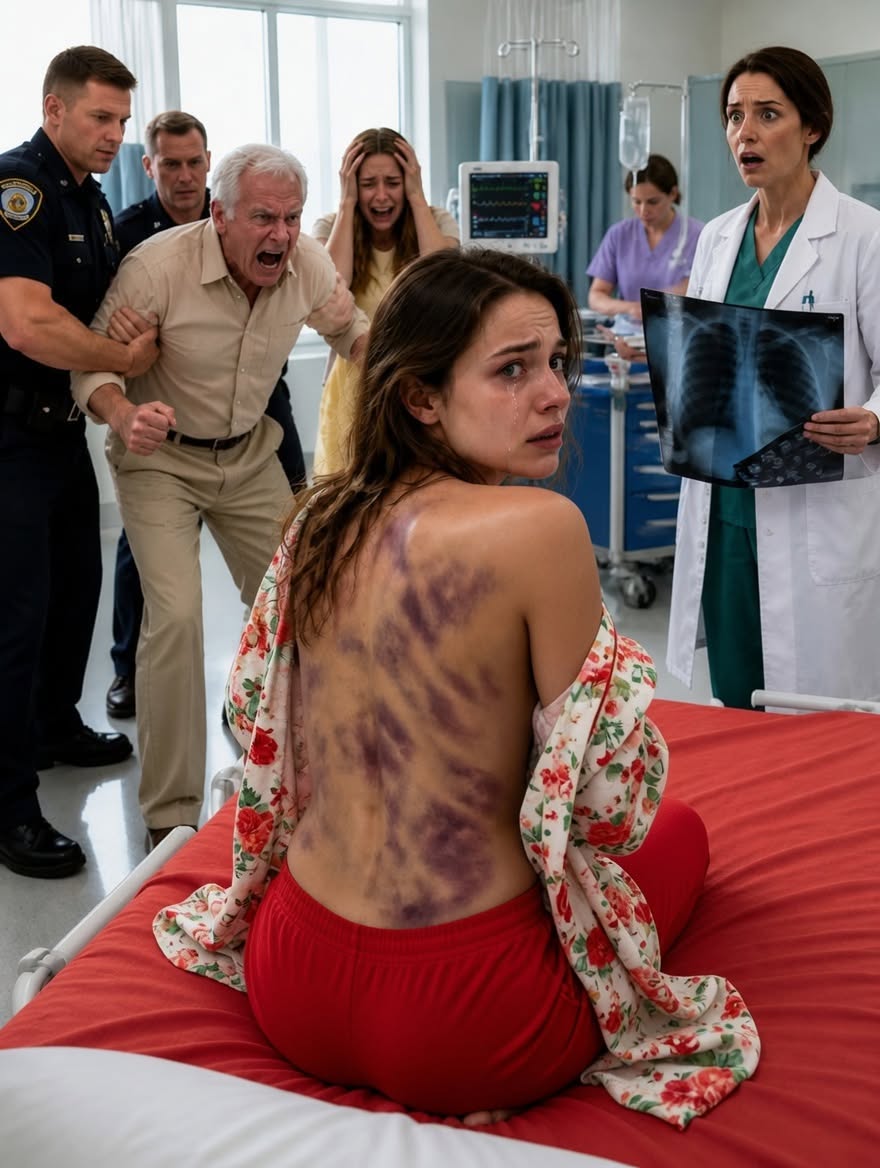
I looked toward the closed curtain. My father’s voice had dropped into a furious whisper on the other side, arguing with the detective. My mother was crying now, but I knew those tears. They were not for me.
They were for the family’s reputation.
The investigator introduced herself as Marissa Cole. She did not touch me or push a notebook into my face. She simply waited.
May you like




“Are you afraid to go home?” she asked.
My throat tightened.
“Yes.”
It was the first honest answer I had given an adult in years.
Marissa nodded slowly, as if the word mattered.
“Are you afraid of your sister?”
“Yes.”
“Are you afraid of your parents?”
That question hurt more than my ribs.
I stared at the hospital blanket.
“My dad doesn’t usually hit me,” I whispered.
Marissa remained still.
“That wasn’t what I asked.”
I could hear Savannah protesting outside the curtain.
“She fell! She always falls!”
The lie came so easily to her.
It always had.
I closed my eyes and remembered being seven years old, hiding in the pantry after Savannah shoved me down the basement stairs. I remembered Dad carrying me upstairs, not to a hospital, but to the couch.
“You startled her,” he had said while wrapping my swollen wrist in a towel. “You know how sensitive your sister is.”
I remembered being ten, waking up on the bathroom floor with blood on my lip after Savannah slammed my head into the sink. Mom had knelt beside me and whispered, “Please don’t tell your teacher. Your sister is going through a hard time.”
I remembered being thirteen, unable to raise my left arm after Savannah struck me with a wooden jewelry box. Dad told the urgent care nurse I had fallen from a bicycle.
The bicycle had been broken for months.
At sixteen, I had become an expert at hiding pain.
I wore long sleeves in warm weather. I changed clothes in bathroom stalls before gym class. I learned how to apply concealer beneath my eyes and how to smile without moving the injured side of my mouth.
Whenever someone asked whether everything was okay, I said yes so quickly they believed me.
Until Dr. Reyes looked at my scans.
“I think it started when I was little,” I told Marissa.
She leaned forward slightly.
“Take your time.”
So I did.
I told her about the basement stairs.
The bathroom sink.
The jewelry box.
The time Savannah locked me in the garage overnight because I had borrowed a sweater without asking.
The broken fingers Dad taped together himself.
The concussion Mom called a migraine.
The nights I slept with a chair beneath my bedroom doorknob.
The mornings my parents made me apologize to Savannah for upsetting her.
At first, the words came out in fragments.
Then they would not stop.
I told her Savannah’s rage could begin over anything: a missing charger, a bad grade, a boy who ignored her, a dress she thought looked better on me.
Sometimes she apologized afterward. Sometimes she cried and promised it would never happen again.
My parents always gathered us in the living room and called it healing.
Savannah would say she was stressed.
Dad would say sisters fought.
Mom would say forgiveness was what held families together.
No one ever asked what held my bones together.
Marissa wrote carefully, pausing whenever I struggled to breathe.
“Has Savannah ever received professional help?” she asked.
“Once,” I said. “A school counselor recommended therapy after she attacked another student in middle school. Dad pulled her out of school for three weeks and said the counselor was biased.”
“Was there a police report?”
“I don’t know.”
“Has she hurt anyone else in the home?”
I hesitated.
“My mother.”
Marissa’s pen stopped.
They sat with me at the kitchen table while Nina made soup.
“The prosecutor has reviewed the initial evidence,” Detective Park said. “Your sister is facing serious charges.”
“And my parents?”
“They are also being investigated for child endangerment, obstruction and failure to provide medical care.”
My hands began shaking.
Marissa noticed.
“You are not responsible for the legal consequences,” she said.
“It feels like I am.”
“That feeling is common,” she replied. “It doesn’t make it true.”
I looked toward the window.
“What if Savannah goes to prison?”
Detective Park answered carefully.
“That decision belongs to the court. Your job is to tell the truth.”
My job.
The phrase sounded unfamiliar.
For years, my job had been keeping everyone calm.
Now my only job was honesty.
The investigation grew faster than anyone expected.
A former teacher came forward after seeing a local news report about charges filed against my parents. She had saved photographs of bruises she noticed when I was eleven.
A neighbor gave police security footage showing Savannah chasing me outside the house two months earlier.
A school nurse produced notes documenting six visits in one semester.
Each time she recommended further evaluation, my father refused.
Then another person came forward.
A woman named Paige Turner.
She had attended middle school with Savannah.
Paige told investigators that Savannah had attacked her in a locker room at age fourteen. The school had prepared to suspend her and involve police, but Dad pressured Paige’s family into accepting a private financial settlement.
The incident vanished from Savannah’s official record.
It had not vanished from Paige’s memory.
She agreed to testify.
My parents’ lawyer attempted to portray Savannah as troubled but misunderstood. He claimed they had been seeking help privately.
The prosecutor introduced Dad’s spreadsheet.
After that, the argument changed.
The question was no longer whether they had known.
It was how long they had chosen to conceal it.
While the case moved forward, I began therapy.
My therapist, Dr. Morgan, had a quiet office with a blue couch and a clock that ticked loudly enough to annoy me.
During our first session, she asked what I wanted my life to look like.
I did not know how to answer.
I had spent so much time surviving Savannah that I had never imagined a future that did not include her anger.
“I want to sleep,” I finally said.
Dr. Morgan nodded.
“That is a good place to begin.”
For the first month, I slept with a chair against Nina’s guest-room door.
No one mentioned it.
One morning, I woke and realized I had forgotten to position the chair.
Nothing had happened.
The discovery made me cry for nearly an hour.
Healing was strange like that.
Sometimes it felt like progress.
Sometimes it felt like grief.
At school, rumors spread quickly.
Some students treated me like I was made of glass. Others avoided me, as though violence could be contagious.
My closest friend, Leah, sat beside me at lunch and did not ask for details.
“I brought you chocolate,” she said.
“I can’t eat chocolate before physical therapy.”
She pushed the bar into her bag.
“Then I heroically volunteer to protect you from it.”
I laughed.
For the first time, laughing did not feel like betrayal.
My mother began sending letters through her lawyer.
The first was three pages long.
She wrote that she loved me.
That she had been afraid of Savannah too.
That she wished she had been stronger.
That families made mistakes.
I read it twice before showing it to Dr. Morgan.
“What do you notice?” she asked.
I studied the page.
“She never says what she did.”
“Anything else?”
“She calls it a mistake.”
“What would you call it?”
I looked at her.
“A choice.”
Mom had made the same choice hundreds of times.
Every bruise she covered.
Every lie she repeated.
Every appointment she canceled.
Every time she told me to forgive without ever making Savannah stop.
I did not answer her letter.
Dad sent only one message through his attorney.
It said:
You will regret allowing strangers to manipulate you against your own family.
I placed it in an evidence envelope.
Six months after the emergency room visit, the first court hearing began.
I was seventeen by then.
My ribs had healed, though one still ached in cold weather. My wrist required months of therapy. The oldest fracture in my shoulder had healed badly enough that doctors said I might always have limited movement.
I wore a dark blue dress and sat beside the victim advocate.
Savannah entered in a gray suit.
She looked smaller than I remembered.
For one dangerous second, guilt rose inside me.
Then I saw her glance at me.
The expression was not regret.
It was hatred.
The prosecutor presented photographs, medical scans, school records and journal entries.
Dr. Reyes testified about the injuries she discovered.
She explained that some fractures were years old and had healed without proper treatment.
Dad’s lawyer suggested I was physically fragile.
Dr. Reyes looked directly at him.
“Fragility does not create patterned trauma.”
Paige testified next.
Then the school nurse.
Then Detective Park.
My parents’ lawyers attempted to argue that they had been overwhelmed by Savannah’s behavior.
The prosecutor asked why they sought settlements and secrecy instead of protection and treatment.
No one gave a convincing answer.
When it was my turn, my legs nearly gave way.
I took the oath and sat facing the courtroom.
The prosecutor approached gently.
“Chloe, do you recognize the six notebooks entered into evidence?”
“Yes.”
“Why did you write them?”
“Because my parents kept changing the story.”
“What do you mean?”
“They would tell me something happened differently. Sometimes they said Savannah barely touched me. Sometimes they said I started it. Sometimes they said I had fallen. I wrote things down so I wouldn’t forget the truth.”
The prosecutor opened one notebook.
“Would you read the entry dated March 14, four years ago?”
My hands shook as I accepted it.
“Savannah pushed me into the glass door. Mom says I should not have laughed when Savannah dropped her plate. Dad says the cut is not deep enough for stitches. They made me promise not to tell Grandma.”
The courtroom was silent.
The prosecutor asked, “Did you receive stitches?”
“No.”
“How was the wound treated?”
“Mom used butterfly bandages.”
“Did it leave a scar?”
I raised my sleeve.
The scar ran along my forearm.
Mom began crying at the defense table.
I did not look at her again.
Savannah’s attorney suggested my journals were exaggerated.
“Teenagers often dramatize conflicts, don’t they?” he asked.
“I was nine when I wrote the first one.”
He paused.
“You were angry with your sister.”
“I was afraid of her.”
“Yet you continued living in the same home.”
“I was a child.”
The answer came out stronger than I expected.
A few people in the courtroom shifted.
The attorney changed direction.
“Your sister sometimes apologized, correct?”
“Yes.”
“So there were periods of reconciliation.”
“No. There were periods between attacks.”
He stopped questioning me soon afterward.
The trial lasted twelve days.
Savannah was convicted of multiple offenses related to the long-term abuse and the incident that sent me to the emergency room. Because she was nineteen during the final attack, she was sentenced as an adult.
The court also ordered a comprehensive psychiatric evaluation and treatment.
My parents accepted plea agreements before their separate trial began.
Dad received prison time for obstruction, child endangerment and falsifying records.
Mom received a shorter sentence, followed by probation and mandatory counseling.
At sentencing, the judge addressed them directly.
“You repeatedly describe your actions as attempts to preserve your family,” she said. “In reality, you preserved a pattern of violence by sacrificing the only person in that home who had no power to escape it.”
Dad stared straight ahead.
Mom wept.
This time, I understood that her tears did not require my comfort.
Outside the courthouse, reporters waited.
Nina guided me toward the car, but Dr. Reyes stood near the steps.
She had come for the sentencing.
I walked over to her.
“You didn’t have to be here,” I said.
“Yes, I did.”
“Why?”
“Because the day I met you, you thought no adult would choose your safety over your family’s excuses.”
My eyes burned.
“I remember.”
“I wanted you to see that some of us still choose it.”
I hugged her carefully.
A year later, Nina and her husband became my legal guardians.
They never asked me to call them Mom or Dad.
They simply gave me a key to the house and told me I would always have a room there.
I graduated high school with Leah beside me.
When my name was announced, Nina cheered loudly enough to embarrass me.
Detective Park attended in plain clothes.
Marissa brought flowers.
Dr. Reyes sent a card that read:
Your life belongs to you now.
I carried it in my pocket all day.
I enrolled in community college and began studying social work.
People sometimes assumed I chose the field because I wanted to save children who reminded me of myself.
That was partly true.
But mostly, I wanted to become the adult I had needed.
During my second year, I was invited to speak at a hospital training seminar about recognizing long-term abuse.
I stood in a room filled with doctors, nurses and social workers.
Behind me, a screen displayed anonymized examples of inconsistent injury reports.
I told them about different clinics.
Long sleeves.
Canceled appointments.
Parents who answered every question for their child.
I told them silence was not proof that nothing was happening.
Sometimes silence was the clearest evidence of all.
After the presentation, a young resident approached me.
“What should we say when we suspect something?” she asked.
I thought about Dr. Reyes standing beside my emergency room bed.
“Do not begin by asking why they stayed quiet,” I said. “Begin by making it safe enough for them to speak.”
Years passed.
My mother continued writing.
Eventually, her letters changed.
She stopped asking for forgiveness.
She stopped calling the abuse a mistake.
In one letter, she wrote:
I knew you were being hurt. I was afraid of your father, afraid of Savannah, and afraid of what people would think. I chose my fear over your safety. There is no excuse for that.
I did not forgive her immediately.
Perhaps forgiveness was never something she had the right to request.
But I kept the letter.
Not because it repaired the past.
Because, for once, she had named it honestly.
Savannah wrote once from prison.
Her letter contained no apology.
She blamed Dad for protecting her too much, Mom for being weak, doctors for misunderstanding her and me for destroying her future.
At the bottom, she wrote:
You were always jealous of me.
I read the sentence without feeling afraid.
Then I placed the letter in a paper shredder.
My twenty-fifth birthday arrived on a rainy Thursday.
After work, I drove to the hospital where Dr. Reyes had treated me.
The emergency department had been renovated, but the smell of disinfectant and coffee was the same.
Dr. Reyes was now the hospital’s chief medical officer.
She met me in the lobby and studied my face.
“You look well,” she said.
“I am.”
We sat near a window overlooking the parking lot.
I told her I had completed graduate school.
I told her I had accepted a position with a child-advocacy center.
Then I handed her a small framed photograph from my graduation.
On the back, I had written:
One phone call gave me a future.
She read it and became quiet.
“I only followed the law,” she said.
“No.”
I shook my head.
“My family spent years teaching me that adults could see what was happening and choose not to act. You proved them wrong.”
Outside, rain struck the glass in steady lines.
For most of my childhood, I had believed families were protected by silence.
That pain became less real when it stayed behind closed doors.
That love meant enduring anything without exposing the people responsible.
I know better now.
Silence does not protect a family.
It protects the person causing harm.
Truth may break doors open.
It may bring detectives, courtrooms, consequences and endings no one expected.
But sometimes, breaking the door is the only way to let someone out.
That night in the emergency room, my father believed he would take me home.
He believed the doctor would accept his explanation because every other adult had.
He believed my fear belonged to him.
Then Dr. Elena Reyes studied my scans.
She saw every fracture my parents had hidden, every injury they had renamed and every year of pain they had tried to bury.
She went silent.
She picked up the phone.
And with one call, she did what no one in my family had ever done.
She chose me.