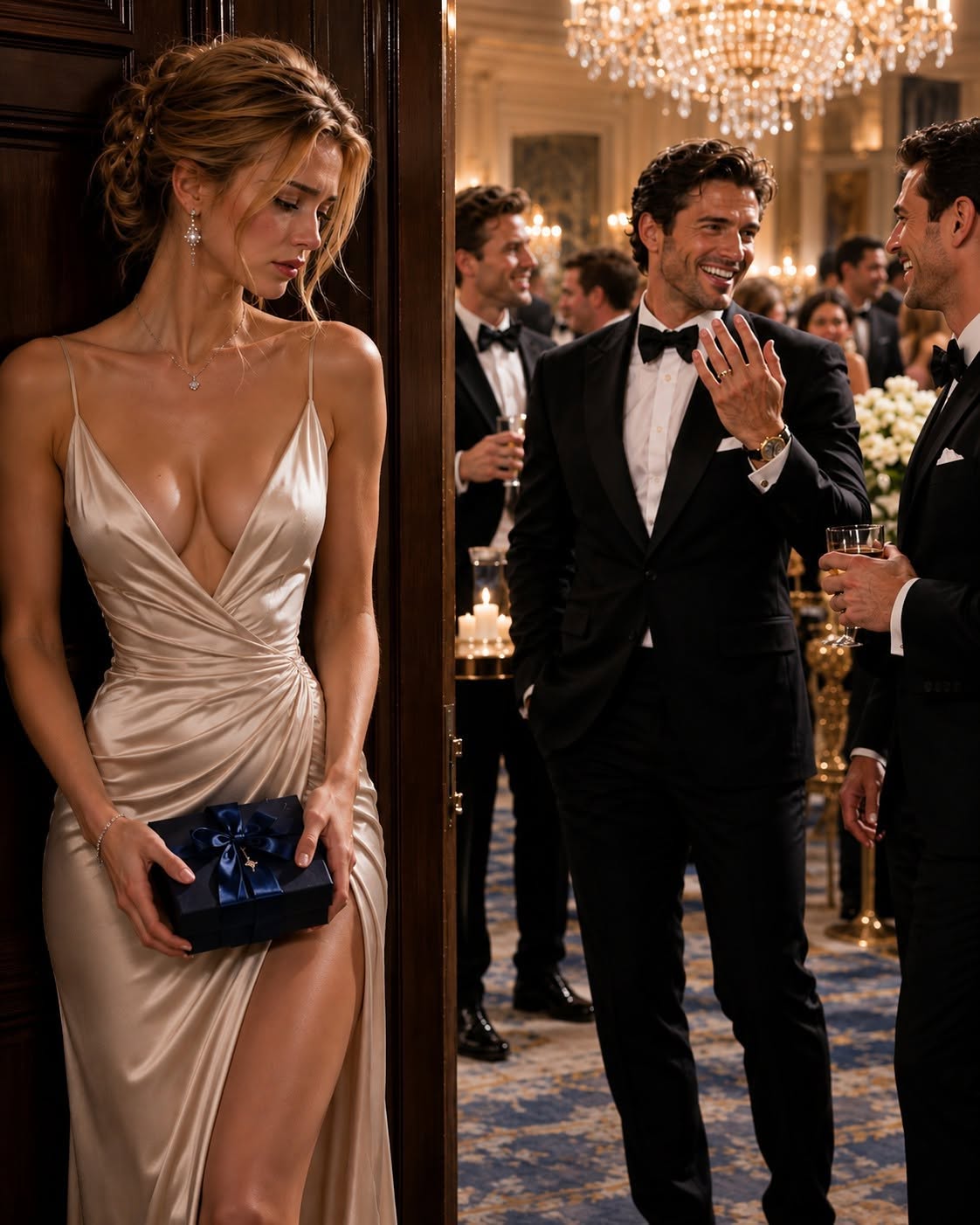
 He laughed, lifted the wedding ring I thought symbolized ten years of love, and said, “She still thinks I wear this for her,” never realizing I was behind him holding the one anniversary gift that could have brought him to tears.
At first, hearing Graham laugh made me smile.
Then I heard what he was laughing about.
“People trust a married man,” he said, twisting his ring. “Especially when they’re afraid of him.”
The men around him laughed.
“So Elena’s good for business?”
Graham raised his glass.
“Best investment I ever made.”
I couldn’t breathe.
Behind my back, I held a navy box containing his late father’s vintage watch.
Graham thought it had disappeared decades ago.
I’d spent months finding it, restoring it, and engraving six words inside:
Every moment still begins with us.
I quietly walked upstairs.
Opened our safe.
Placed the watch inside.
Then locked it away.
I didn’t confront him.
I didn’t cry.
I simply stopped loving him out loud.
For ten years, I’d remembered everything.
Coffee beside his newspaper before sunrise.
Seafood on Fridays when stress killed his appetite.
White roses because stronger flowers triggered his headaches.
Notes hidden inside his briefcase before difficult meetings.
An extra scarf in his car every winter.
So I began removing those things one by one.
Slowly.
Quietly.
At first, Graham noticed nothing.
Three nights later, his car arrived at 7:45.
Normally, I would meet him downstairs.
Instead, I stayed in the library reading.
“Elena?”
He found me beneath the lamp.
“I thought you didn’t hear me.”
“I heard you.”
His expression changed.
Only slightly.
But I saw it.
The next morning, his briefcase left without my usual handwritten note.
Hours later, during a board meeting, Graham opened the familiar pocket.
Empty.
He searched again.
His assistant finally asked, “Mr. Calloway, did you lose something?”
Graham stared at that empty compartment longer than he should have.
That night, he came home early.
The next night, earlier still.
Then, one morning, I found him standing in the kitchen holding his own coffee.
“Elena.”
“Yes?”
“What’s happening?”
I looked at the man who controlled ships, companies, politicians, and men who frightened entire cities.
For once, Graham looked uncertain.
“Nothing,” I said.
But something was happening.
I had quietly contacted an attorney.
I had opened an account in my own name.
And inside the antique safe beside Graham’s forgotten anniversary gift was another envelope.
Divorce papers.
Graham thought my love was useful because it made his empire look respectable.
He was about to discover something far more dangerous.
For ten years, while everyone believed I was merely the boss’s devoted wife, I had been listening.
And I knew exactly where his empire buried its secrets.
For ten years, Graham Calloway had believed the most dangerous thing in his house was him.
He was wrong.
It was memory.
Memory was quiet.
It didn’t raise its voice.
It didn’t carry a weapon.
It didn’t need an army.
It simply waited.
And for ten years, I had remembered everything.
Every name.
Every meeting.
Every shipment.
Every favor.
Every politician who suddenly changed his vote after receiving a phone call from Graham.
Every businessman who walked into our dining room nervous and walked out relieved.
Every envelope that arrived after midnight.
Every time Graham said, “Don’t ask.”
And every time I pretended not to understand.
That was the secret of being married to a powerful man.
People thought you became invisible because you were loved.
Sometimes you became invisible because everyone assumed you were harmless.
Graham had made that mistake.
I intended to let him keep making it.
For now.
The divorce papers remained in the antique safe for six days.
I didn’t touch them.
I didn’t need to.
They were simply there.
Waiting.
The attorney’s name was Daniel Mercer.
He had represented wealthy families in Charleston for thirty years and had the unusual reputation of refusing to be intimidated.
When I first called him, he asked only one question.
“Are you certain?”
“Yes.”
“Are you afraid?”
“Yes.”
“Good.”
I was surprised.
“Good?”
“Fear keeps people careful.”
He had paused.
“Anger makes them careless.”
That sentence stayed with me.
Because I knew Graham.
If he ever realized I was leaving, he would not be heartbroken first.
He would be suspicious.
Then angry.
Then dangerous.
So I would give him nothing.
No dramatic confrontation.
No accusations.
No tears.
No sudden disappearance.
Just absence.
Small pieces of absence.
The coffee.
The notes.
The flowers.
The waiting.
The automatic affection.
The little rituals that had made our marriage feel like a marriage.
I wasn’t taking revenge.
I was withdrawing access.
There was a difference.
On the seventh morning, Graham sat across from me at breakfast.
He had barely touched his food.
“You’re different.”
I looked up.
“Different how?”
“I don’t know.”
He studied me.
“You’re quieter.”
“I’ve always been quiet.”
“Not like this.”
I smiled faintly.
“You’re imagining things.”
He didn’t smile.
“Are you unhappy?”
The question surprised me.
Not because I didn’t know the answer.
Because I wondered whether he actually wanted to know.
“I’ve been thinking.”
“About?”
“Time.”
His eyebrows tightened.
“Time?”
“Yes.”
“How quickly ten years pass.”
He leaned back.
“I know.”
“You do?”
“Of course.”
He looked at his wedding ring.
For half a second, something passed across his face.
Regret?
Guilt?
I couldn’t tell.
Then the mask returned.
“I remember our wedding.”
“So do I.”
“You were nervous.”
“I was terrified.”
He smiled.
“You almost dropped the flowers.”
“You stepped on my dress.”
“You forgave me.”
“Yes.”
He looked at me.
“I loved you.”
I almost stopped breathing.
Past tense.
Loved.
Not love.
Loved.
I wondered if he had noticed what he had said.
He hadn’t.
He stood.
“I have a meeting.”
“Of course.”
He walked toward the door.
Then turned.
“Elena?”
“Yes?”
“Are you still happy here?”
I looked around our kitchen.
The marble.
The windows.
The flowers.
The photographs.
The life we had built.
Then I looked at him.
“I don’t know anymore.”
He stood very still.
Then he left.
The door closed.
And for the first time in ten years, I didn’t wonder whether I had hurt him.
I wondered whether he was finally beginning to understand that I could leave.
Three days later, Graham’s mother called me.
Margaret Calloway was eighty-one.
She lived alone in an old mansion overlooking the harbor.
She had never approved of me.
Not because she disliked me.
Because she understood her son.
“Come see me,” she said.
“When?”
“Today.”
Her tone left no room for negotiation.
I drove there that afternoon.
She was sitting beside a window overlooking the water.
She didn’t ask how I was.
She poured tea.
Then said:
“Graham is afraid.”
I looked at her.
“Of what?”
“You.”
I almost laughed.
“He’s not afraid of me.”
Margaret looked over her glasses.
“You don’t know my son as well as you think.”
“I’ve been married to him for ten years.”
“Exactly.”
She set down her cup.
“You know the husband.”
“What do you know?”
“The boy.”
I said nothing.
Margaret looked toward the harbor.
“When Graham was nineteen, his father gave him one instruction.”
“What?”
“Never trust anyone who loves you too easily.”
My stomach tightened.
“Why?”
“Because my husband believed love was leverage.”
She looked at me.
“And Graham learned.”
I thought about the anniversary party.
The men laughing.
Graham twisting his ring.
“She still thinks I wear this for her.”
Margaret sighed.
“I heard what happened.”
My face remained calm.
“Who told you?”
“Graham.”
That surprised me.
“He told you?”
“He came here last night.”
“Why?”
“He asked whether I thought you were leaving.”
I looked down at my tea.
“And what did you say?”
“I told him I hoped you were.”
I looked up.
Margaret’s expression was sad.
“I loved my husband,” she said.
“But I spent forty years watching him turn my son into someone who couldn’t distinguish loyalty from control.”
She reached toward a drawer.
Pulled out a small envelope.
Then placed it on the table.
“This belongs to you.”
I stared at it.
“What is it?”
“My husband’s.”
“Why are you giving it to me?”
“Because Graham should have given it to you years ago.”
My pulse changed.
I opened the envelope.
Inside was a photograph.
Graham.
Much younger.
Maybe twenty-two.
Standing beside his father.
But that wasn’t what caught my attention.
There was another man in the photograph.
Someone I knew.
Someone who had been in our house dozens of times.
Someone Graham had always introduced as an old family associate.
Victor Hale.
I stared at the photograph.
“Who is he?”
Margaret’s expression changed.
“You don’t know?”
“No.”
She leaned closer.
“Then you don’t know nearly enough.”
Victor Hale was seventy-three.
He had gray hair, a silver cane, and the kind of smile that never reached his eyes.
He had attended every major Calloway function for years.
Graham trusted him.
At least, I thought he did.
Margaret told me Victor had worked for Graham’s father.
Not as an employee.
As something closer.
An accountant.
A fixer.
A keeper of records.
“He knew where every dollar went,” Margaret said.
“And now?”
“Now he knows where every secret went.”
I looked at the photograph again.
“Why did Graham keep him around?”
“Because Victor knows what happened to his father.”
“What happened?”
Margaret’s eyes moved toward the window.
“Your husband’s father didn’t die the way people think.”
I froze.
“He died of a heart attack.”
“That is what the papers said.”
“What actually happened?”
She didn’t answer.
Instead, she asked:
“Do you remember the year?”
“2009.”
“Do you remember what Graham was doing then?”
“Starting his shipping company.”
“No.”
She shook her head.
“He was taking control.”
“Of what?”
“Everything.”
I stared at her.
“Margaret, what are you telling me?”
She looked at the door.
Then whispered:
“Your husband’s empire was not built by Graham.”
“Who built it?”
“His father.”
“And?”
“And the man who destroyed his father was Graham.”
I couldn’t speak.
Margaret slid another envelope toward me.
“Don’t open that here.”
“What is it?”
“Proof.”
I drove home without turning on the radio.
The envelope sat on the passenger seat.
I didn’t open it.
Not until I reached my office.
I locked the door.
Closed the curtains.
Then opened it.
Inside were bank statements.
Property records.
Handwritten ledgers.
Copies of contracts.
And a photograph of Graham’s father meeting with three men.
One was Victor.
One was a politician I recognized.
The third man was dead.
I knew his name.
Thomas Bell.
A federal prosecutor who had disappeared from public life fifteen years earlier.
I kept reading.
The documents described a network of shell companies.
Shipping contracts.
Port access.
Political donations.
Cash transfers.
But then I found something else.
A handwritten note.
In Graham’s father’s handwriting.
“G knows enough.”
Below it:
“If anything happens to me, Victor has the file.”
I stared at the words.
G knows enough.
Graham.
I sat down.
My husband had known.
Maybe from the beginning.
Maybe his empire wasn’t built from nothing.
Maybe he had inherited something far darker.
And if that was true, the secrets I had heard for ten years weren’t just secrets about Graham.
They were secrets about his father.
And perhaps the reason Graham had laughed when he called our marriage a business strategy was because he genuinely believed everything could be reduced to strategy.
Including me.
That night, Graham came home at 10:14.
I was reading in the library.
He entered without speaking.
Then stood behind my chair.
“You’re not wearing your ring.”
I looked down.
I had forgotten.
The ring sat on the desk.
“I took it off.”
“Why?”
“It was uncomfortable.”
He stared at me.
“You’ve worn it every day for ten years.”
“I know.”
“Put it back on.”
I looked up.
“Why?”
His expression hardened.
“Because you’re my wife.”
There it was.
Not because you love me.
Not because it means something.
Because you’re mine.
I stood.
“I’ll put it back on when I want to.”
For several seconds, neither of us moved.
Then Graham laughed.
Not the public laugh.
Not the charming one.
Something colder.
“You’re angry.”
“No.”
“You’re punishing me.”
“No.”
“Then what are you doing?”
I looked at him.
“Thinking.”
“About leaving?”
I didn’t answer.
He stepped closer.
“Who have you been talking to?”
“Friends.”
“What friends?”
“You wouldn’t know them.”
His jaw tightened.
“Don’t play games with me, Elena.”
“I learned from the best.”
His eyes narrowed.
“What does that mean?”
I smiled.
“Goodnight, Graham.”
I walked past him.
Behind me, I heard his fist strike the wall.
I didn’t turn around.
The next morning, Daniel Mercer called.
“You need to move faster.”
“Why?”
“Your husband has begun moving assets.”
I froze.
“How do you know?”
“I don’t.”
“Then how?”
“I have people who know.”
My heart raced.
“Which assets?”
“Several properties.”
“Can he do that?”
“Some of them.”
“What about the companies?”
“That’s more complicated.”
I sat down.
“What should I do?”
“Nothing emotional.”
“I know.”
“Open a separate legal account.”
“Already done.”
“Secure your records.”
“Done.”
“Change your passwords.”
“Done.”
There was silence.
Then Daniel said:
“Elena.”
“Yes?”
“Have you been preparing for this for a long time?”
I looked at the locked safe.
“Yes.”
“How long?”
“Years.”
He exhaled.
“Then I need you to tell me something.”
“What?”
“Do you have evidence of criminal conduct?”
I thought about the boxes.
The conversations.
The names.
The photographs.
The ledger.
“Yes.”
“Enough to expose him?”
“I don’t know.”
“Then don’t expose anything yet.”
“Why?”
“Because if Graham realizes you have evidence, he won’t negotiate.”
“What will he do?”
Daniel was silent.
Then:
“He’ll go to war.”
For the next two weeks, Graham became a different man.
He started coming home earlier.
He asked where I had been.
Who I had spoken to.
Why I was going to the city.
Why I had opened a new bank account.
Why I had changed the password to my email.
He never accused me directly.
He didn’t need to.
The questions were enough.
Then he started bringing me gifts.
A diamond bracelet.
A rare bottle of wine.
A new car.
A necklace.
I returned them.
He became angry.
“Why?”
“I don’t need them.”
“You used to love gifts.”
“I used to love what they meant.”
“What did they mean?”
“That you were thinking about me.”
He stared.
“I am thinking about you.”
“Now.”
His expression tightened.
“Yes.”
“Why?”
He didn’t answer.
I knew.
He was trying to restore the balance.
He had spent ten years believing he gave.
I had received.
Now he was discovering that gifts couldn’t buy back a feeling once someone stopped believing in it.
Then came the first threat.
Not from Graham.
From someone else.
I was leaving a restaurant when a black sedan pulled beside me.
The window lowered.
A man looked at me.
“Mrs. Calloway.”
I stopped.
“Who are you?”
“You should stop digging.”
My heart beat faster.
“I’m not digging.”
He smiled.
“Your husband doesn’t like surprises.”
Then the car drove away.
I stood on the sidewalk.
My hands shook.
I called Daniel.
Then the police.
Then Graham.
I waited.
He answered on the second ring.
“What happened?”
I told him.
He went silent.
“Describe the man.”
I did.
Graham’s voice changed.
“Where are you?”
“Outside the restaurant.”
“Go inside.”
“Why?”
“Now.”
I went inside.
Ten minutes later, Graham arrived.
He didn’t ask whether I was hurt.
He asked what the man said.
I told him.
Graham’s face became expressionless.
“Did you recognize him?”
“No.”
“I do.”
“Who is he?”
Graham looked away.
Then said:
“Someone who should never have spoken to you.”
For a moment, I saw something in his face.
Fear.
Real fear.
Not for himself.
For me.
And that complicated everything.
Because there were still pieces of the man I had loved.
Buried deep.
But still there.
That night, Graham sat on the edge of our bed.
I was by the window.
“I didn’t know.”
“Know what?”
“That they would come after you.”
I stared at him.
“Who?”
He didn’t answer.
“Graham.”
He looked at me.
“There are things about my family you don’t know.”
“I know.”
His expression changed.
“What do you know?”
“Enough.”
He stood.
“Who told you?”
“Does it matter?”
“Yes.”
“Why?”
“Because if someone has been talking to you, they’re in danger.”
“Are you threatening them?”
“No.”
He shook his head.
“I’m warning you.”
“About what?”
“My father.”
I froze.
“Your father?”
“He wasn’t the man you think he was.”
“I never knew him.”
“Exactly.”
He walked toward the window.
“He built everything.”
“The shipping companies?”
“The money.”
“The political connections?”
“Yes.”
“The people?”
“Yes.”
“And you?”
“I inherited it.”
“Then why did you tell everyone you built it?”
“Because nobody respects an heir.”
I stared at him.
He continued.
“So I rebuilt it.”
“How?”
“By making it legitimate.”
I almost laughed.
“Legitimate?”
“Yes.”
“Your businesses?”
“Yes.”
“And the men who come to this house at midnight?”
His jaw tightened.
“Some things take time to disappear.”
I looked at him.
“What did your father do?”
He turned.
“Things I don’t want to become.”
“Then why did you?”
He looked at me.
“I didn’t.”
I wanted to believe him.
That was the problem.
A part of me still did.
Then he said:
“My father ordered people killed.”
My stomach dropped.
“I was twenty-two.”
He looked away.
“I found out.”
“What did you do?”
“I stopped him.”
“How?”
“Quietly.”
I understood.
“You took control.”
“Yes.”
“And you continued the business.”
“I changed it.”
“Did you?”
His eyes hardened.
“Yes.”
I thought about the men in our house.
The meetings.
The threats.
The fear.
“Graham.”
“Yes?”
“You’re still him.”
“No.”
“You just became better at hiding it.”
He looked wounded.
That surprised me.
“Maybe.”
Then he whispered:
“But I loved you.”
I looked at him.
“Did you?”
“Yes.”
“Then why did you call me an investment?”
His eyes closed.
“I was drunk.”
“You weren’t.”
“I was showing off.”
“You meant it.”
“I didn’t.”
“You said it.”
He opened his eyes.
“I said something cruel.”
“No.”
I shook my head.
“You said something honest.”
He looked at me.
And for the first time, neither of us had anything left to say.
Three days later, Victor Hale disappeared.
Not physically.
He simply stopped answering Graham’s calls.
Then Margaret called me.
“He’s gone.”
“Where?”
“I don’t know.”
“Did he contact you?”
“No.”
“Then how do you know?”
“Because Graham came here.”
My stomach tightened.
“What did he want?”
“The file.”
“What file?”
“The one I gave you.”
I didn’t breathe.
“He knows?”
“I don’t think so.”
“Then why did he ask?”
“Because Victor told him his father left something behind.”
I looked toward the safe.
“Does Graham know about the documents?”
“No.”
“Are you sure?”
“Yes.”
“Margaret, if Graham finds out—”
“I know.”
She lowered her voice.
“That’s why I need you to listen.”
“What?”
“Victor contacted me this morning.”
I froze.
“He’s alive.”
“Where is he?”
“He said he would only meet one person.”
“Who?”
“You.”
I met Victor at an old church outside Charleston.
He was sitting alone in the last pew.
When I entered, he stood.
“You came.”
“Yes.”
“You look like her.”
“Who?”
“Your husband’s mother.”
He smiled sadly.
“You have her courage.”
“I don’t feel courageous.”
“Courage rarely feels like courage.”
He gestured toward the pew.
“Sit.”
I did.
He pulled a small recorder from his coat.
“Before I give you this, you need to understand something.”
“What?”
“Graham isn’t the only person who knows about the Calloway network.”
“I know.”
“No.”
He looked at me.
“You don’t.”
He pressed a button.
A voice filled the empty church.
Graham’s father.
Older.
Angry.
“You think you can walk away?”
Then another voice.
Graham.
Young.
“I am not you.”
His father’s voice:
“You are my son.”
Graham:
“I won’t kill for you.”
His father:
“You already have.”
Silence.
Then Graham:
“I was protecting myself.”
His father laughed.
“You’re learning.”
The recording ended.
I stared at Victor.
“What is this?”
“Your husband’s first confession.”
“Confession to what?”
“His father’s murder.”
My heart stopped.
“Graham killed his father?”
Victor shook his head.
“No.”
“Then what?”
“He allowed him to die.”
I frowned.
“What does that mean?”
“His father was poisoned.”
“By whom?”
“I don’t know.”
“Then how is Graham involved?”
“He knew.”
“Before?”
“Yes.”
“And he did nothing?”
Victor nodded.
“That’s why he has spent ten years trying to make everything legitimate.”
I stared at him.
“Because he felt guilty.”
“Yes.”
I thought about Graham’s nightmares.
The headaches.
The sleepless nights.
The way he sometimes stood at windows for hours.
I had always thought it was stress.
Maybe it was guilt.
Victor reached into his coat.
“This is why I called you.”
He handed me a flash drive.
“What is it?”
“Everything.”
“Everything?”
“Bank accounts. Names. Transactions. Political payments. Security footage. Recordings.”
I stared at the drive.
“Why me?”
“Because Graham loves you.”
I almost laughed.
“He doesn’t.”
“He does.”
“He called me an investment.”
Victor’s expression softened.
“He said that because he was afraid.”
“Afraid of what?”
“Losing you.”
I looked away.
“He already did.”
Victor nodded.
“Perhaps.”
Then he said:
“But he also needs you.”
“For what?”
“To end what his father started.”
I took the flash drive to Daniel.
He didn’t open it immediately.
He stared at it.
“This could destroy him.”
“I know.”
“Or you.”
“I know.”
“Or half the people in Charleston.”
“I know.”
He looked at me.
“Are you sure?”
“Yes.”
We opened it.
The first folder contained financial records.
The second contained photographs.
The third contained audio.
The fourth contained names.
The fifth was labeled:
CALLoway / FINAL.
Daniel stopped.
“Don’t open that.”
“Why?”
“Because if this contains what I think it does, once we know, there is no going back.”
I stared at the folder.
Then clicked.
Inside was one document.
A list of names.
Twenty-seven.
Beside each name was a date.
Some were alive.
Some were dead.
Some were politicians.
Some were judges.
Some were businessmen.
Some were law enforcement officers.
And at the bottom was a note:
“Those who remain protected remain useful.”
Daniel leaned back.
“This isn’t just organized crime.”
“What is it?”
“A network.”
“Of what?”
“Influence.”
He pointed to the names.
“People who helped Graham’s father.”
Then he pointed to another column.
“People Graham has been paying.”
I looked closer.
There were judges.
Prosecutors.
Port officials.
City council members.
A federal official.
And one name that made my blood turn cold.
Daniel saw my expression.
“Who?”
“My brother.”
He looked at me.
“Your brother?”
“Yes.”
“Are you sure?”
I nodded.
“He died eight years ago.”
Daniel looked at the document.
“According to this, he wasn’t dead.”
I stared at the name.
Beneath it was a date from three years ago.
A payment.
A large one.
My brother had supposedly died in a boating accident.
But the records said otherwise.
Someone had been paying him.
After his death.
I couldn’t breathe.
Daniel looked at me.
“Elena.”
I whispered:
“What if he isn’t dead?”
We found him two days later.
Not in Charleston.
Not in South Carolina.
In Savannah.
He had changed his name.
He had built a quiet life.
A wife.
Two children.
A small business.
When I saw him, I couldn’t speak.
He couldn’t either.
Then he hugged me.
I cried.
Not because I had found my brother.
Because I realized someone had spent eight years making me believe I had lost him.
“Why?”
He looked at me.
“Because Graham saved my life.”
I froze.
“What?”
“Your brother’s boat didn’t sink by accident.”
“Who did it?”
“Your husband’s father.”
I stared.
“Why?”
“I knew too much.”
“And Graham?”
“He found me afterward.”
“Why didn’t you tell me?”
“He said they’d kill you.”
“Who?”
“The people who worked for his father.”
I shook my head.
“You let me mourn you.”
“I know.”
“You watched me suffer.”
“I know.”
“How could you?”
He started crying.
“I thought keeping you alive mattered more.”
I looked at him.
“That isn’t a life.”
“No.”
He wiped his face.
“I know that now.”
Then he handed me a folder.
“Graham knew where I was.”
I froze.
“What?”
“He sent money.”
“Why?”
“To keep me hidden.”
I stared at the folder.
“He never told me.”
“He didn’t want you to know.”
“Why?”
“Because he knew you would hate him.”
I looked down.
Maybe I did.
Maybe I hated him.
Maybe I still loved him.
The two feelings could exist at the same time.
That was the cruelest part.
When I returned to Charleston, Graham was waiting.
He stood in the library.
No security.
No assistants.
No men.
Just him.
“You found Victor.”
“Yes.”
“You found your brother.”
I froze.
“How do you know?”
“Because I know everything that happens around me.”
I stared.
“You knew?”
“Yes.”
“For eight years?”
“Yes.”
“You let me believe he was dead.”
“I protected him.”
“You lied to me.”
“Yes.”
“You lied about everything.”
“No.”
He stepped closer.
“I lied about some things.”
“That’s supposed to make me feel better?”
“No.”
His voice broke.
“I don’t know how to make you feel anything except betrayed.”
I looked at him.
“Then why are you still standing here?”
“Because I need to tell you the truth.”
“I’ve heard enough.”
“No.”
He shook his head.
“You’ve heard pieces.”
He reached into his jacket.
Pulled out a small box.
My heart stopped.
He placed it on the desk.
I recognized it.
Navy blue.
The anniversary gift.
The watch.
“You found it?”
“No.”
“I did.”
He opened the box.
Inside was his father’s vintage watch.
The same one I had restored.
The same one I had engraved.
Graham stared at it.
“You thought I didn’t know.”
“You did?”
“I found it years ago.”
My stomach dropped.
“What?”
“I found it in an antique shop.”
He touched the watch.
“I recognized it.”
“Then why didn’t you say anything?”
“Because I knew you were looking for it.”
“Why?”
“Because you once told me you wanted to give me something that belonged to my father.”
I couldn’t speak.
“You searched for months.”
“Yes.”
“I watched you.”
My eyes filled.
“You knew?”
“Yes.”
“Then why did you laugh at our anniversary?”
He closed his eyes.
“I was drunk.”
“You’ve said that.”
“I was trying to impress men I hated.”
“That doesn’t excuse it.”
“I know.”
“You called me an investment.”
“I know.”
“You made our marriage sound like a transaction.”
“I know.”
“Why?”
He looked at me.
“Because I was afraid.”
“Of me?”
“Of needing you.”
I stared at him.
He continued.
“My father taught me that love was weakness.”
“And you believed him.”
“Yes.”
“For ten years?”
“Yes.”
He picked up the watch.
“But you changed me.”
I shook my head.
“I don’t know if that’s true.”
“It is.”
He turned the watch over.
Opened the back.
Read the engraving.
Every moment still begins with us.
His eyes filled with tears.
“You wrote this?”
“Yes.”
“Why?”
“Because I loved you.”
He nodded.
“I know.”
“Do you?”
“Yes.”
He looked at me.
“And that’s why I knew you would eventually leave.”
I whispered:
“Then why didn’t you stop me?”
He smiled sadly.
“Because stopping you would prove you were never free.”
For the first time that night, I saw the man beneath the empire.
Not the crime boss.
Not the businessman.
Not the husband who had humiliated me.
Just Graham.
Broken.
Afraid.
Human.
And that made what came next harder.
“I have the files,” I said.
He nodded.
“I know.”
“Then you know what happens next.”
“Yes.”
“Your empire ends.”
“Yes.”
“You could go to prison.”
“Yes.”
“You could lose everything.”
“Yes.”
“Why aren’t you stopping me?”
He looked at me.
“Because you were right.”
“About what?”
“I don’t deserve the life I built.”
I stared.
He continued.
“I spent ten years convincing myself I was different from my father.”
“You are.”
“No.”
He shook his head.
“I just had better manners.”
I almost cried.
“Graham…”
“I don’t want you to protect me.”
“Then what do you want?”
“You.”
I looked away.
“You can’t ask me for that.”
“I know.”
“Not after what you did.”
“I know.”
“I don’t trust you.”
“I know.”
“You broke something.”
“I know.”
He stepped closer.
“But if you walk away, I won’t stop you.”
I looked at him.
“Promise?”
“Yes.”
“And if I turn over everything?”
“Yes.”
“You’ll cooperate?”
“Yes.”
“With the authorities?”
“Yes.”
“With the financial investigation?”
“Yes.”
“With the names?”
He closed his eyes.
“Yes.”
I whispered:
“Why?”
“Because maybe the only good thing I can do now is make sure you don’t have to become like me to survive me.”
The next morning, Daniel met with federal investigators.
The files were transferred.
The investigation became massive.
Banks froze accounts.
Federal agents executed warrants.
Politicians resigned.
Businessmen hired lawyers.
Port officials disappeared.
Two judges recused themselves.
Three more were investigated.
The Calloway network collapsed in six weeks.
Not with gunfire.
With subpoenas.
Not with blood.
With evidence.
Not because I had become stronger than Graham.
Because Graham had finally stopped protecting the system.
And that was more powerful than anything I could have done alone.
The arrest happened on a rainy Thursday.
I was in the kitchen.
Graham was standing by the window.
The doorbell rang.
He looked at me.
“That’s them.”
I nodded.
He walked to the door.
Before opening it, he turned.
“I’m sorry.”
I didn’t answer.
He opened the door.
Federal agents stood outside.
One read the warrant.
Graham listened.
Then put his hands behind his back.
The cuffs clicked.
He didn’t resist.
As they led him away, he looked at me.
Not like a king.
Not like a boss.
Like a husband.
I stood in the doorway.
Neither of us spoke.
Then he disappeared into the rain.
The trial lasted eight months.
The prosecution presented thousands of pages.
The defense argued that Graham had transformed an inherited criminal network into legitimate businesses.
The prosecutor agreed.
Then said:
“Transformation does not erase history.”
Graham pleaded guilty to multiple charges.
He also agreed to cooperate.
His sentence was substantial.
Not life.
But long enough.
Long enough to miss years of his life.
Long enough to understand that choices have consequences.
I testified once.
Only once.
The prosecutor asked:
“Mrs. Calloway, did your husband ever threaten you?”
“No.”
“Did he physically assault you?”
“No.”
“Then why did you leave?”
I looked at Graham.
He sat at the defense table.
Older.
Tired.
Human.
“I left because I realized being safe isn’t the same as being loved.”
The courtroom was silent.
The prosecutor asked:
“Did Mr. Calloway’s criminal activity affect your marriage?”
“Yes.”
“How?”
“Everything became a transaction.”
“Explain.”
I took a breath.
“He believed people were valuable based on what they could provide.”
“And you?”
“I was the respectable wife.”
“What did that mean?”
“It meant I made him look normal.”
The prosecutor nodded.
“Do you still love him?”
The courtroom seemed to hold its breath.
I looked at Graham.
Then said:
“I don’t know.”
His eyes lowered.
The prosecutor didn’t ask again.
After the trial, Graham sent me one letter.
It was six pages.
I read it once.
Then again.
He didn’t ask me to wait.
He didn’t ask me to visit.
He didn’t ask me to forgive him.
He simply wrote:
“I spent my whole life believing control was the opposite of fear.
I was wrong.
Control was how I hid my fear.
I controlled people because I was afraid they would leave.
I controlled businesses because I was afraid they would collapse.
I controlled you because I was afraid that if you ever saw me clearly, you would leave too.
Then you saw me clearly.
And you left.
You were right.
You should have.
I don’t know whether there is a version of me worthy of the woman you were.
But I know this:
You were never an investment.
You were the only thing in my life I couldn’t put a price on.
And I was too broken to understand that until I lost you.”
I folded the letter.
I didn’t forgive him.
Not then.
But I didn’t hate him either.
Sometimes healing begins when you stop forcing yourself to feel one thing.
I sold the house six months later.
Not because I couldn’t live there.
Because I no longer wanted to.
I kept the library.
The garden.
The photograph from our wedding.
Not because I wanted the marriage back.
Because ten years of my life had happened there.
They were mine too.
I wasn’t going to let Graham’s mistakes erase them.
I moved into a smaller house near the water.
No guards.
No black SUVs.
No men standing outside.
No late-night meetings.
No coded phone calls.
Just quiet.
At first, the quiet frightened me.
Then I loved it.
I learned to sleep without waiting for a car to arrive.
I learned to drink coffee without making another cup.
I learned to buy flowers because I liked them.
Not because Graham had headaches.
I learned to wear perfume he never liked.
I learned to leave my phone in another room.
I learned that freedom can feel strangely empty before it feels beautiful.
One year after Graham’s arrest, I received another letter.
This one was shorter.
“I heard you started the foundation.”
I had.
The Elena Calloway Foundation for Women Leaving High-Control Relationships.
It helped women with legal fees, housing, financial planning, and security.
The letter continued:
“I’m proud of you.
I know I don’t deserve to say that.
But I am.
G.”
I folded it.
Put it in a drawer.
And went back to work.
Three years passed.
I built a new life.
I traveled.
I worked.
I helped women who had been convinced they couldn’t survive without powerful men.
I learned something from every one of them.
Some had husbands.
Some had fathers.
Some had business partners.
Some had wealthy families.
The details changed.
The pattern didn’t.
Control disguised as protection.
Fear disguised as love.
Money disguised as security.
And silence disguised as peace.
I taught them what Daniel had taught me.
Document everything.
Separate your finances.
Protect your identity.
Build a support system.
Don’t announce your exit before you’re ready.
And never confuse someone’s ability to control your life with their ability to define your worth.
Then one autumn afternoon, Margaret called.
“Graham has been released.”
I closed my eyes.
“Okay.”
“He asked about you.”
“What did you tell him?”
“That you were happy.”
Silence.
“Are you?”
I looked out the window.
“Yes.”
It was true.
“Good,” Margaret said.
Then she hung up.
I didn’t think about Graham for the rest of the day.
Until evening.
When someone knocked on my door.
I knew before I opened it.
Graham stood on the porch.
Older.
Thinner.
Gray at the temples.
No security.
No expensive coat.
No watch.
Just a simple dark jacket.
He looked at me.
I looked at him.
“Hello, Elena.”
“Hello.”
He glanced inside.
“May I come in?”
I hesitated.
Then stepped aside.
He entered.
He looked around.
“This is beautiful.”
“Thank you.”
“It’s peaceful.”
“Yes.”
He nodded.
“I understand why you left.”
“You didn’t before?”
“No.”
He looked down.
“I thought peace was boring.”
“And now?”
“Now I think it’s expensive.”
I smiled despite myself.
He saw it.
But didn’t comment.
We sat in the living room.
He didn’t touch me.
Didn’t move closer.
Didn’t ask for anything.
After several minutes, he said:
“I brought something.”
He reached into his pocket.
A small navy box.
My heart stopped.
He placed it on the table.
I didn’t open it.
“What is it?”
“The watch.”
I stared.
“You had it?”
“They returned my personal property.”
“Why give it to me?”
“Because it was always yours.”
I opened the box.
The old watch rested inside.
I turned it over.
The engraving was still there.
Every moment still begins with us.
My eyes filled.
Graham looked away.
“I used to think that sentence meant we would always be together.”
He paused.
“Now I think it means something else.”
“What?”
“That every moment can begin again.”
I closed the box.
“Graham.”
“Yes?”
“I can’t go back.”
“I know.”
“I don’t know if I could ever trust you.”
“I know.”
“I don’t want the old life.”
“Neither do I.”
I looked at him.
“Then why are you here?”
He smiled sadly.
“To return something that belonged to you.”
“The watch?”
“No.”
“What?”
“My apology.”
I stared.
He continued.
“You gave me ten years.”
“I chose them too.”
“You gave me love.”
“Yes.”
“I treated it like a business asset.”
“Yes.”
“I can’t undo that.”
“No.”
“But I can finally admit what it was.”
“What?”
“The greatest thing anyone ever gave me.”
I looked down.
“Thank you.”
He stood.
“That’s all.”
“You’re leaving?”
“Yes.”
“Where will you go?”
“North.”
“Why?”
“Somewhere nobody knows me.”
I almost smiled.
“That’s probably good for you.”
“Yes.”
He walked toward the door.
Then stopped.
“Can I ask one thing?”
“What?”
“Did you ever love me?”
I looked at him.
“Yes.”
His eyes closed.
“For how long?”
“Until I heard you laugh.”
He nodded.
“I understand.”
Then he left.
I watched him walk down the road.
I didn’t follow.
I didn’t call him back.
And for the first time, watching Graham Calloway disappear didn’t feel like losing something.
It felt like putting something down.
That night, I placed the watch on my desk.
I considered locking it away.
Instead, I opened the back.
The engraving was still there.
Every moment still begins with us.
I took a small piece of paper.
Wrote one sentence.
Then placed it inside the box.
Not underneath the watch.
Beside it.
It said:
“Some moments end so better ones can begin.”
I closed the box.
Years later, people would ask me whether I regretted marrying Graham Calloway.
I always gave the same answer.
“No.”
They were surprised.
“How can you say that?”
Because regret would mean I wished those ten years had never existed.
I don’t.
They made me who I am.
I loved him.
I was betrayed by him.
I lost him.
I found myself.
All of those things can be true.
The woman who entered that wedding ten years earlier believed love meant standing beside someone forever.
The woman who left understood something different.
Love is not proven by how long you stay.
Sometimes love means staying.
Sometimes love means leaving.
Sometimes love means forgiving.
Sometimes love means never going back.
And sometimes the greatest act of love is choosing yourself after years of being told that someone else’s power makes your life valuable.
Graham thought our marriage was a business strategy.
He thought my presence made his empire look respectable.
He thought my love made me predictable.
He was wrong.
My love made me patient.
My patience made me observant.
My observations became evidence.
And my evidence became the thing that finally brought his empire down.
But I never wanted his empire.
I never wanted his money.
I never wanted his fear.
I wanted the man who drank coffee with me at sunrise.
The man who used to laugh when I burned pancakes.
The man who once danced with me in the kitchen because the radio played our wedding song.
Maybe that man had existed.
Maybe he had simply been buried under years of fear, ambition, and his father’s legacy.
I’ll never know.
And I don’t need to.
Because I finally learned that loving someone doesn’t require understanding every broken piece of them.
It only requires understanding what their brokenness does to you.
Graham’s brokenness hurt me.
So I left.
And when I left, I discovered something extraordinary.
The world did not end.
Charleston did not collapse.
I did not become powerless.
His empire did not take my identity with it.
I remained.
I rebuilt.
I became someone who no longer needed permission to make decisions.
Someone who could enter a room without wondering whether the most powerful man inside approved of me.
Someone who could sleep without waiting for footsteps.
Someone who could wear a ring or not wear one.
Someone who could love flowers without remembering whose headaches they were supposed to prevent.
Someone who could drink coffee alone and enjoy the silence.
Someone who finally understood that freedom isn’t always loud.
Sometimes freedom is a quiet kitchen.
A locked door.
A bank account with your own name on it.
A phone that no longer makes you afraid.
A morning when you wake up and realize nobody owns your future.
And sometimes freedom is a navy box sitting on a desk.
Inside it, a watch that once symbolized a marriage.
And beside it, a note reminding you that time belongs to you now.
I still have the watch.
Not because I want Graham back.
Because it reminds me of something far more important.
Time passes whether we are ready or not.
Ten years passed while I was loving a man who didn’t understand what he had.
Another ten passed while I rebuilt myself.
And now, when I look at that old watch, I don’t see the woman who was betrayed.
I see the woman who listened.
The woman who remembered.
The woman who waited until the right moment.
The woman who walked away without needing to destroy herself in the process.
Graham once told a room full of powerful men that our marriage was his best investment.
He was wrong.
I was never his investment.
I was his wife.
His partner.
His blind spot.
His conscience.
And eventually, the person who refused to let his mistakes become my prison.
He thought I had been standing behind him that night as a silent wife.
He was right about one thing.
I was standing behind him.
But he misunderstood what that meant.
I wasn’t behind him because I was weak.
I was behind him because I was listening.
And by the time he realized what I had heard, the truth was already bigger than his empire.
That was the moment everything changed.
Not when the investigators arrived.
Not when the accounts were frozen.
Not when the courtroom doors opened.
Not when Graham walked away in handcuffs.
It changed much earlier.
On our tenth anniversary.
Behind a half-open door.
When the man I loved lifted his wedding ring and laughed.
And I quietly stopped loving him out loud.
That was the beginning.
Not of revenge.
Of freedom.
And sometimes the most powerful thing a woman can do is not destroy the man who underestimated her.
It is simply build a life so complete without him that his power no longer matters.
That is what I did.
That is what I would do again.
And if there is one thing I know now, it is this:
Never mistake a quiet woman for an unaware woman.
Never mistake patience for weakness.
Never mistake love for blindness.
And never assume that because someone stayed beside you for ten years, they will stay forever.
Sometimes they were simply learning where all the doors were.
Sometimes they were quietly putting the pieces together.
Sometimes they were waiting for the courage to turn the key.
And sometimes, when the door finally opens, they don’t walk out angry.
They walk out free.
I did.
And I never looked back.
